Recommended resources
The freely available resources this lesson will direct you to.
Hello! In our last lesson, we explored the world of metallurgical defects, understanding how failures in melting and processing can compromise the integrity of titanium components. This focus on quality control and failure prevention highlighted a key theme: in the titanium industry, technical precision and economic viability are deeply intertwined.
Today, we pivot from the microscopic world of defects to the macroscopic world of business economics. We will tackle this lesson's main goal: to develop a first-principles cost model for a Kroll process plant. This is a fundamental tool for any operator, investor, or executive in this space. Instead of relying on market prices alone, a first-principles model builds costs from the ground up—based on raw materials, energy, and capital—allowing you to understand the core profitability of a process, identify key cost drivers, and evaluate strategic opportunities. Given your background in financial modeling and analysis, you'll find the structure familiar, but the application to a heavy industrial process will provide a new perspective.
We will structure our model, identify the key cost categories, and then use the provided resources to find real-world data to populate it.
1. The Anatomy of a Cost Model
At its heart, the cost of producing titanium sponge can be broken down into two main categories: Operating Expenses (OpEx) and Capital Expenses (CapEx).
- Operating Expenses (OpEx): These are the ongoing costs to run the plant. They can be further divided into:
- Variable Costs: Costs that scale directly with production volume, like raw materials and energy.
- Fixed Costs: Costs that are incurred regardless of production level, like salaries for permanent staff and plant maintenance.
- Capital Expenses (CapEx): This is the upfront cost to build the plant and its major equipment. For a cost-per-unit model, we typically annualize this cost by spreading it over the expected lifetime of the plant.
Our goal is to calculate the total cost per kilogram of titanium sponge:
Let's start by quantifying the operating expenses, which are driven by the physical inputs to the Kroll process.
2. Operating Costs (OpEx): Materials and Energy
First, let's remind ourselves of the overall Kroll process flow.
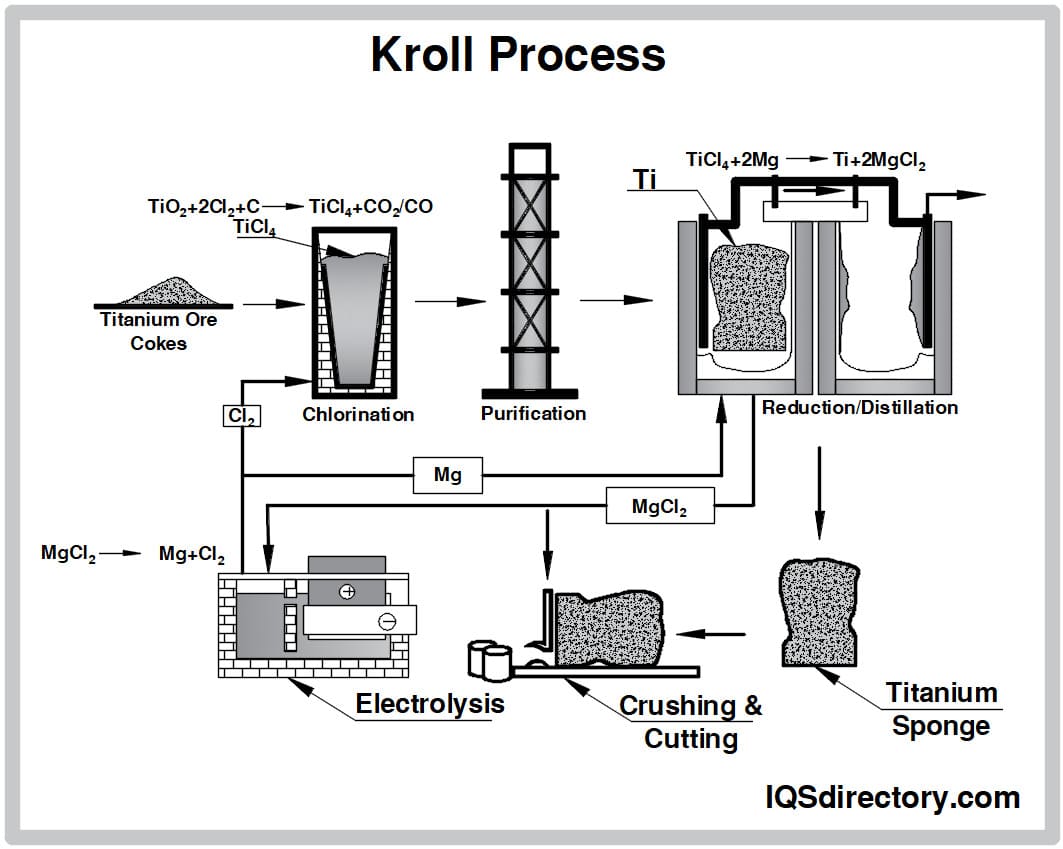
To build our model from first principles, we need to know the exact quantities of raw materials and energy consumed to produce a unit of titanium sponge.
2.1. Mass Balance: The Raw Material Recipe
Fortunately, a detailed mass balance is available for a typical Kroll process plant. The image below provides the specific inputs required to produce one metric ton (1,000 kg) of titanium sponge.
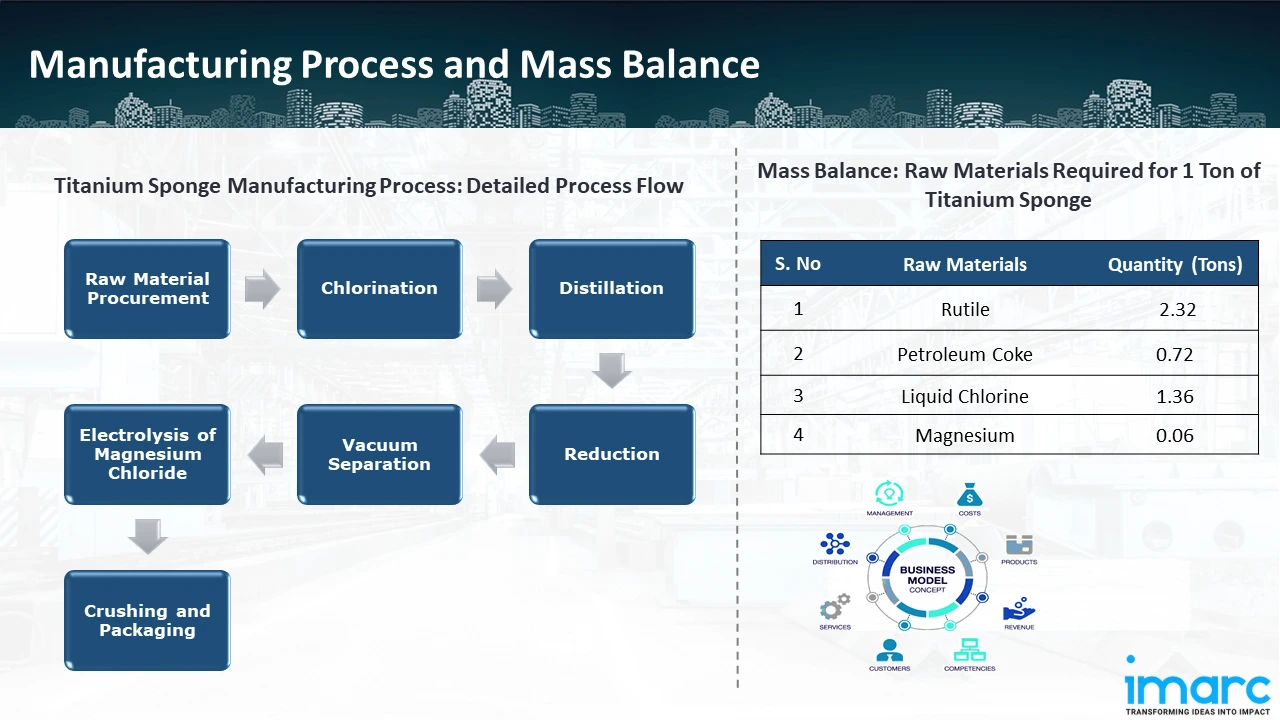
From this resource, we can extract the primary material inputs:
- Rutile (TiO₂): 1.92 tons
- Petroleum Coke: 0.5 tons
- Liquid Chlorine: 0.25 tons
- Magnesium: 1.2 tons
These figures represent the inputs needed to produce 1 ton of Ti sponge. An important subtlety lies in the figures for magnesium and chlorine. The Kroll process is a closed loop where the MgCl₂ byproduct is electrolyzed to regenerate Mg and Cl₂. Therefore, these quantities represent the makeup material required to replace process losses, not the total amount used in the reaction. For our cost model, this is perfect, as we only need to account for the cost of materials that are actually consumed.
2.2. Energy Balance: Powering the Process
The Kroll process is famously energy-intensive. The high temperatures for chlorination (1000 °C) and reduction (~900 °C), plus the energy needed for distillation and electrolysis, make energy a dominant operating cost.
Let's turn to a study that breaks down this consumption.
[PDF] Sustainable Recovery of Titanium Alloy: From Waste to Feedstock ...
The paper 'Sustainable Recovery of Titanium Alloy' provides a detailed analysis of the energy requirements for titanium production. This will give us the data for the energy component of our OpEx.
Please read section 2.5, 'Energy Consumption for Titanium Preparation'. Focus on the final summary paragraph and the accompanying pie chart (Figure 10). The author derives an average total energy consumption and breaks it down by process step. Note the total value and the major contributing factors.
The paper concludes that, on average, producing 1 kg of titanium sponge requires approximately 258 MJ of energy. The breakdown provided is insightful:
- Feedstock TiCl₄ production: 129 MJ/kg
- Regeneration and loss of Mg: 73.2 MJ/kg
- Sponge loss: 42.96 MJ/kg
- Vacuum distillation: 11.7 MJ/kg
- Mg reduction: 0.9 MJ/kg
This gives us a specific energy consumption figure to use in our model. The largest components—creating the TiCl₄ feedstock and regenerating the magnesium—confirm where the energy-intensive steps of the process lie.
2.3. Fixed Costs: Labor
Estimating labor costs from the outside is challenging, but we can make a reasonable, data-driven approximation. A petition filed by the industry provides a crucial data point.
[PDF] Titanium-Sponge-232-Petition-09-27-2018-3.pdf - USW.org
This petition from TIMET, a major US producer, contains valuable operational data disclosed as part of a trade case. We can use this to estimate the labor component of our cost model.
Please read the short subsection '3. TIMET: America’s Last Titanium Sponge Producer' (page 25). Find the number of employees at the Henderson plant and its annual production capacity.
The document states that TIMET's Henderson plant employs "about 500 skilled workers" and has a capacity of "approximately 13,000 MT of titanium sponge per year."
With this, we can create a first-principles estimate for the labor cost per kg:
This demonstrates how operational data, even at a high level, can be used to build out the fixed cost components of our model.
3. Capital Costs (CapEx): The Price of Entry
Quantifying CapEx is often the most difficult part of an external analysis, as equipment costs are proprietary. However, the same industry petition provides invaluable, real-world figures from past projects. These serve as excellent top-down estimates for the Total Installed Cost (TIC) of a Kroll plant.
[PDF] Titanium-Sponge-232-Petition-09-27-2018-3.pdf - USW.org
Let's return to the TIMET petition. The section on the 'State of the Domestic Titanium Sponge Industry' discusses several investment (and divestment) decisions, giving us real-world capital cost figures.
Please read the subsections '1. RTI/Arconic’s Aborted Titanium Sponge Plant' and '2. ATI Closures of Titanium Sponge Plants' (page 25). Also, find the figure for a new chlorination unit in the subsection 'd. TIMET’s Make or Buy Dilemma' (page 28). Note down the capital costs mentioned.
This document provides several powerful data points:
- RTI's planned Mississippi plant (2007): $300 million.
- ATI's Rowley, Utah plant (built ~2009): cost nearly $500 million.
- TIMET's potential new chlorination unit alone: in excess of $100 million.
The $500 million figure for the ATI plant is a comprehensive benchmark for a modern, large-scale facility. While its exact capacity isn't stated in this document, industry sources put it at around 11,000 metric tons/year.
To incorporate this into our per-kg cost, we need to annualize it. Assuming a typical plant lifetime of 20-25 years, we can calculate the annual capital charge. For a 20-year lifetime:
And the CapEx per kg would be:
4. Activity: Build Your First-Principles Cost Model
Now, let's assemble these pieces into a coherent model. Your task is to structure a simple cost model and calculate the estimated cost to produce one kilogram of titanium sponge.
Use the data we've gathered and the placeholder prices below. The goal is to understand the structure and the relative contribution of each component.
Placeholder Prices (for illustrative purposes):
- Rutile (TiO₂): $0.45/kg
- Petroleum Coke: $0.20/kg
- Liquid Chlorine (makeup): $0.30/kg
- Magnesium (makeup): $2.50/kg
- Electricity: $0.05/kWh (Note: 1 kWh = 3.6 MJ)
- Average Fully-Burdened Salary: $100,000/year
Instructions:
-
Create a simple table or spreadsheet with the following cost categories:
- Variable OpEx:
- Rutile
- Coke
- Chlorine
- Magnesium
- Energy
- Fixed OpEx:
- Labor
- Annualized CapEx:
- Variable OpEx:
-
For each category, calculate the cost per kg of titanium sponge using the data from this lesson.
- For material costs, remember to use the input ratios from the mass balance (e.g., 1.92 kg of Rutile per kg of Ti sponge).
- For energy, convert the 258 MJ/kg requirement into kWh and apply the price.
- For labor and CapEx, use the per-kg figures we calculated.
-
Sum all categories to find the total estimated cost per kg.
Take about 15 minutes to perform these calculations. This exercise will cement your understanding of the plant's cost structure.
Conclusion
In this lesson, we have constructed a first-principles cost model for a Kroll process titanium sponge plant. We moved beyond qualitative descriptions to quantify the specific inputs of materials, energy, labor, and capital that drive the final production cost.
Key Takeaways:
- A first-principles cost model is built from the ground up using mass balances, energy requirements, and capital estimates.
- Operating costs for the Kroll process are dominated by feedstock (rutile) and energy, due to the high-temperature reactions and electrochemical recycling loop.
- Capital costs are immense, with a modern plant costing hundreds of millions of dollars. When annualized, this represents a significant fixed cost that demands high plant utilization to be economical.
- Public documents, like regulatory filings and trade petitions, can be a surprisingly rich source of the data needed to build such a model.
The model we've just built is more than an academic exercise. It is the analytical foundation for real-world strategic decisions. In our next lesson, we will use this framework to analyze the economic implications of the Kroll process being a batch process and evaluate the challenges to developing a continuous alternative. We will explore how changing from batch to continuous could impact each component of our cost model and why, despite decades of research, this transition has proven so difficult.