Recommended resources
The freely available resources this lesson will direct you to.
Welcome to your first lesson. We'll begin by establishing the architectural foundation for the agentic infrastructure you aim to build. Your goal is to create a sophisticated, production-grade system featuring a hierarchy of agents managed by a central orchestrator. This initial lesson is designed to give you a clear, principled understanding of why this architectural choice is not just viable, but optimal for your needs.
Today, we will analyze the trade-offs between three major architectural paradigms: single-agent, general multi-agent, and hierarchical multi-agent systems. By the end of this lesson, you will be able to articulate a strong justification for adopting a hierarchical model, grounding your decision in well-established design patterns and their implications for scalability, control, and maintainability.
From Single Agent to Collective Intelligence
As an experienced developer, you're familiar with the principle of starting simple. In agentic AI, the simplest starting point is the single-agent system. You've already built simple agents, so you know that this typically involves a single Large Language Model (LLM) equipped with a set of tools to perform tasks. This model is effective for straightforward problems but begins to show its limitations as complexity scales.
To understand these limitations, let's turn to a conceptual guide from LangChain, a prominent framework in this space.
Conceptual Guide: Multi Agent Architectures
This video, "Conceptual Guide: Multi Agent Architectures," begins by explaining the challenges of scaling single-agent systems, which provides the motivation for exploring more complex architectures.
Please watch the segments covering the downsides of single-agent systems from the beginning and the subsequent overview of the benefits of multi-agent systems that ends at the two-minute mark. As you watch, focus on these three core problems: Tool Overload: What happens when one agent has too many tools? Context Complexity: How does a growing history of actions impact performance? Lack of Specialization: Why is it difficult for a single agent to be an expert in multiple domains simultaneously?
As the video highlights, scaling a single agent leads to diminishing returns. The LLM's effectiveness degrades when it must choose from an overly large toolset, and its context window can become overwhelmed with a long history of actions and observations. Furthermore, trying to force expertise in diverse areas—like data analysis, customer communication, and code generation—into a single, monolithic prompt is inefficient.
This is analogous to the shift from monolithic applications to microservices in traditional software architecture. Instead of one large, unmanageable service, we define smaller, specialized services with clear responsibilities. In the world of AI, this leads us to multi-agent architectures.
A Taxonomy of Multi-Agent Architectures
Multi-agent systems address the limitations of a single agent by distributing tasks among a team of specialized agents. This approach promotes modularity, enables specialization, and provides more granular control over the system's workflow. However, "multi-agent" is a broad term, and the way agents are organized and communicate—their architecture—is a critical design decision.
Let's explore the most common patterns. The image below, from The Product Compass Newsletter, provides an excellent visual overview of several agentic architectures, from simple to complex.
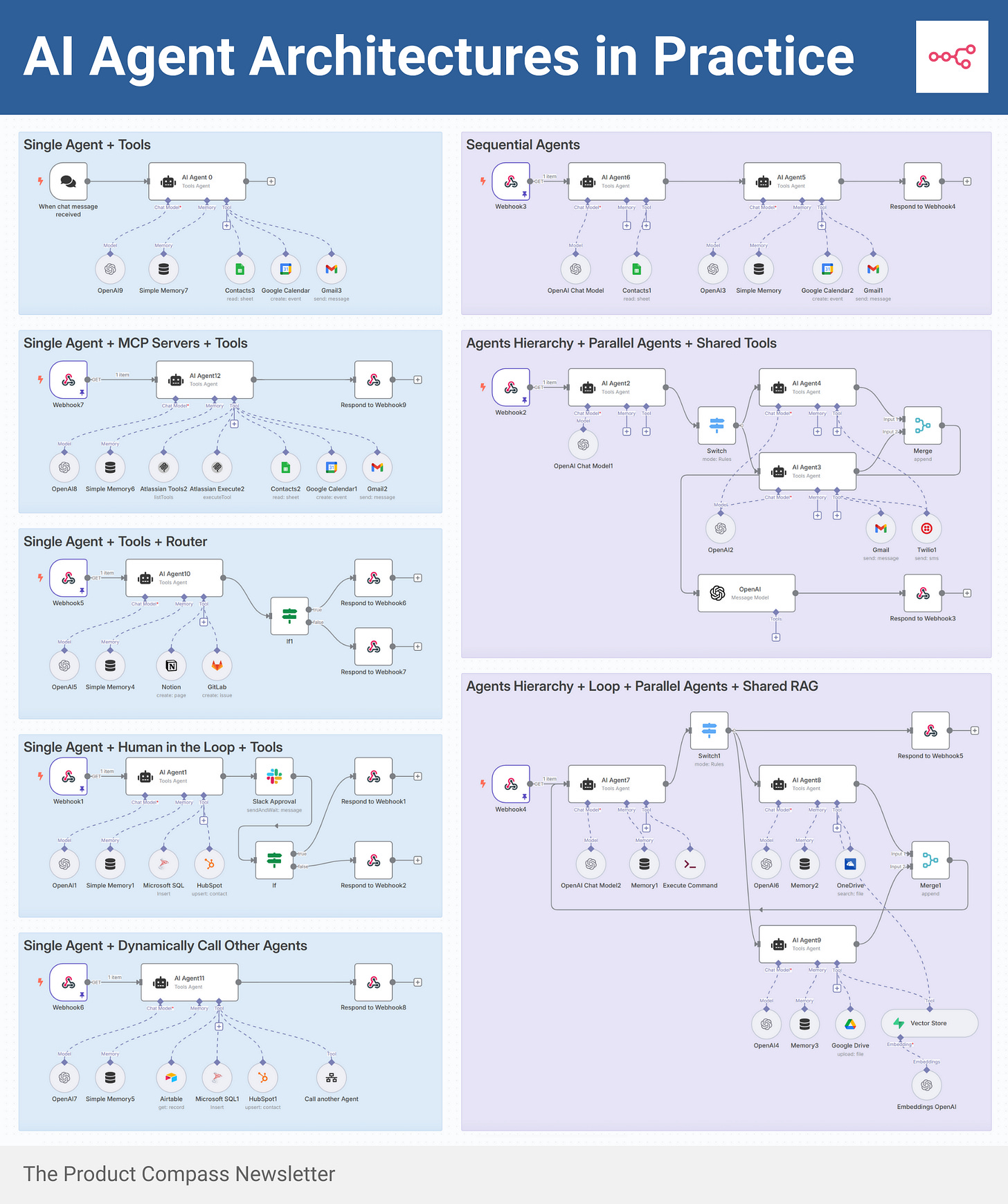
We can group these patterns into a few key categories. The following video provides a developer-focused perspective on these architectures, comparing them to concepts like microservices and ETL pipelines.
What do Multi-Agent Architectures look like?
The video "What do Multi-Agent Architectures look like?" breaks down three fundamental organizational models for multi-agent systems.
Watch the following three segments to understand the distinct characteristics of each architecture: The hierarchical/orchestrator model from this section. The network/swarm model from this part. The sequential/pipeline model from the final part. Pay close attention to how tasks are distributed and how agents communicate in each model.
Let's consolidate what we've learned from these resources. The main architectural patterns you will encounter are:
-
Sequential (Pipeline): Agents operate in a fixed sequence, like an assembly line. The output of one agent becomes the input for the next. This is simple and predictable but slow and inflexible, as each step must wait for the previous one to complete. It's best suited for linear, multi-stage processes like data transformation (ETL).
-
Network (Swarm): Agents communicate in a decentralized, peer-to-peer fashion. Any agent can potentially talk to any other agent. This allows for emergent, collaborative behavior, but as noted in the LangChain video, it can be "too loose," unreliable, and costly for production systems that require predictable outcomes. Decision-making can be complex, often requiring voting or consensus mechanisms.
-
Supervisor (Orchestrator-Worker): A central "supervisor" or "orchestrator" agent is responsible for decomposing a task and routing subtasks to appropriate "worker" agents. This introduces a clear, centralized control flow. Workers are specialists that focus on their assigned tasks without needing to know about the overall workflow.
-
Hierarchical: This is an extension of the supervisor pattern. When the number of worker agents becomes too large for a single supervisor to manage effectively, you can introduce intermediate managers. A top-level orchestrator might delegate to team supervisors, who in turn manage teams of specialized workers. This mirrors organizational structures in large companies and is highly scalable.
Trade-off Analysis for Your Production System
Your goal is to build a robust, multi-tenant, production-grade service. This context makes the choice of architecture critical. Let's analyze the trade-offs of each pattern with your specific requirements in mind.
| Architecture | Coordination Model | Pros | Cons | Suitability for Your Goal |
|---|---|---|---|---|
| Single-Agent | Centralized (LLM) | Simple to implement for basic tasks. | Fails to scale, poor at complex reasoning, context window limits, difficult to maintain. | Low. Unsuitable for a complex, production system. |
| Sequential | Pipeline | Predictable, easy to debug the flow. | Inflexible, slow (fully synchronous), not suitable for tasks requiring parallel work or dynamic routing. | Low. Too rigid for dynamic client requests. |
| Network / Swarm | Decentralized | Highly flexible, can produce novel solutions through emergent collaboration. | Unpredictable, difficult to control and debug, potentially high cost/latency due to excessive communication. | Low. The lack of control is unacceptable for a reliable production service. |
| Supervisor / Hierarchical | Centralized & Hierarchical | Scalable, controllable, maintainable (separation of concerns), allows for both parallel and sequential execution, supports high specialization. | More complex to set up initially, potential bottleneck at the orchestrator if not designed well. | High. This model directly supports all your requirements for a scalable, reliable, and manageable system. |
Justifying the Hierarchical Model
Based on this analysis, the Hierarchical / Supervisor architecture is the clear choice for your project. It provides the perfect balance of flexibility and control.
- Scalability & Control: Your system needs to handle various client requests (tenants). A hierarchical model allows you to define a core workflow managed by an orchestrator, which can dynamically route tasks to the correct agents. As your service grows, you can add new specialized agents or even entire sub-hierarchies without redesigning the core logic.
- Maintainability: As a senior developer, you know the value of clean, modular code. By assigning each agent a specific role (e.g.,
DataRetriever,ReportGenerator,EmailFormatter), you create a system that is far easier to test, debug, and extend. This separation of concerns is a cornerstone of robust software engineering. - Performance: The orchestrator can execute independent tasks in parallel, significantly reducing wall-clock time compared to a purely sequential approach.
The following article provides further evidence and practical examples that support this decision.
From Prompts to Production: A Playbook for Agentic Development
This article from InfoQ, "From Prompts to Production," discusses core architectural patterns for agentic development. It provides excellent descriptions and real-world examples that align with our discussion.
Please read the following sections: Start with the section on core patterns. Focus on the descriptions of the Supervisor Agent Pattern and the Hierarchical Agent Pattern. The e-commerce fulfillment example is a great illustration of a hierarchical system in practice. Then, jump to the subsection on Hierarchical Orchestration. The research cited here provides strong empirical evidence for the superior performance of hierarchical architectures over "flat-agent" systems for complex tasks.
The key takeaway, echoed by experts like Andrew Ng and validated by research, is that building custom, hierarchical "cognitive architectures" is the most reliable path to creating powerful and production-ready agentic systems.

Conclusion
In this lesson, we have established the "why" behind your project's architecture. We started by understanding the scaling limitations of single-agent systems and then explored the landscape of multi-agent designs. Through a trade-off analysis, we've confirmed that a hierarchical architecture managed by a central orchestrator provides the necessary scalability, control, and maintainability for a production-grade service. This model isn't just a theoretical preference; it's a battle-tested pattern that underpins many successful, complex AI systems in the real world.
Key Takeaways:
- Single-agent systems are simple but do not scale well with complexity, tool count, or context length.
- Multi-agent architectures (Sequential, Network, Hierarchical) offer solutions by distributing work among specialized agents.
- Decentralized network/swarm models are often too unpredictable for reliable production services.
- A hierarchical, orchestrator-led model provides the best combination of scalability, control, and maintainability for complex applications.
In our next lesson, we will zoom in on this chosen architecture and describe the role of each key component—the orchestrator, supervisors, workers, tools, prompts, and memory—and map out how they interact. This will give us the blueprint we need before we start writing code.