Recommended resources
The freely available resources this lesson will direct you to.
Hello! Welcome to your first lesson.
This course is designed to explore the psychology of decision-making in everyday life, a topic that sits at the intersection of your professional work in product design and your interests in human behavior and psychology.
Today, we'll begin with the foundational concept of the entire course. Our goal is to distinguish between System 1 (automatic, intuitive) and System 2 (deliberate, analytical) thinking processes. This two-system model, popularized by Nobel laureate Daniel Kahneman, is a powerful framework for understanding the "machinery of thought." Grasping this distinction will be essential as we move on to topics like heuristics, biases, and choice architecture in later modules.
Let's get started.
1. Experiencing Your Two Systems
Before we dive into definitions, let's try a quick experiment.
First, take a look at this simple math problem:
An answer came to your mind automatically, without any real effort.
Now, consider this one:
This is different. You likely know you can solve it, but it requires deliberate effort. You'd have to retrieve a method from memory, focus your attention, and work through a series of steps. Your heart rate might even increase slightly.
You've just experienced your two systems of thinking in action. The first problem was handled by your fast, automatic System 1. The second requires your slow, effortful System 2.
To get a formal introduction from the source himself, please watch this short clip of Daniel Kahneman.
Daniel Kahneman: Thinking Fast vs. Thinking Slow | Inc. Magazine
In this video from Inc. Magazine, Daniel Kahneman provides a concise and clear definition of the two systems.
From the very start of the video, watch the System 1/2 definitions. Focus on how he defines each system and the key difference he highlights: one is automatic and involuntary, the other is effortful and deliberate.
2. Defining the "Characters"
As Kahneman explained, our mental life is defined by the interplay of these two "characters." Let's solidify their definitions.
Daniel Kahneman Explains The Machinery of Thought
This article from Farnam Street, 'Daniel Kahneman Explains The Machinery of Thought,' provides an excellent written summary of the two systems, drawing directly from Kahneman's book.
Please read the section titled 'The Two Systems of Thinking,' which appears below the introductory paragraphs. In that section, read System 1 and 2 definitions — it offers clear, bullet-pointed definitions that are useful to remember.
To summarize these core distinctions, here is a helpful visual chart.
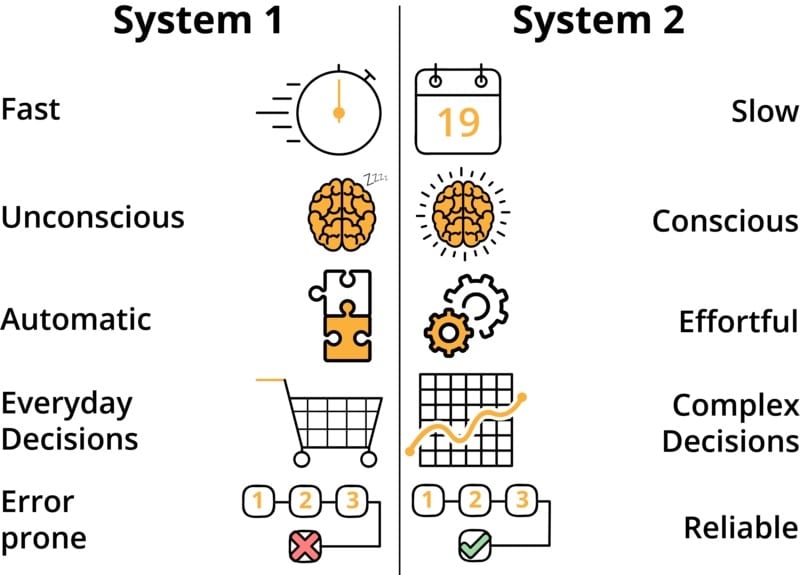
3. A Deeper Look at Each System
Now let's explore the specific attributes and functions of each system.
System 1: The Automatic Hero
System 1 is the star of the show. It operates continuously and effortlessly, handling the vast majority of our daily tasks. It's the source of our impressions, intuitions, and gut feelings.
Its capabilities include:
- Innate skills we share with other animals (e.g., perceiving the world around us, avoiding losses).
- Learned associations that have become automatic (e.g., knowing the capital of France, reading words).
- Highly practiced skills (e.g., a chess master seeing a strong move, an experienced designer recognizing a common UI pattern).
Of 2 Minds: How Fast and Slow Thinking Shape Perception ...
This excerpt from Kahneman's book, published in Scientific American, provides a great list of typical System 1 activities.
In the 'TWO SYSTEMS' section, which follows the opening examples of the angry woman and the multiplication problem, read the two systems overview — the first half of the section, down through the list of System 1 bullet-point examples. Notice the variety of tasks that fall under System 1, from simple perception to understanding sentences.
System 2: The Deliberate Analyst
System 2 is who we think we are: the conscious, reasoning self that makes choices and solves problems. However, it's lazy. It only gets mobilized when necessary because its work is mentally expensive.
Engaging System 2 requires attention and effort. As Kahneman notes, this effort is physiological—your pupils dilate, your heart rate increases, and your muscles tense. This is why you can't solve a complex math problem while making a difficult left turn in traffic; both tasks demand the limited resources of System 2.
Of 2 Minds: How Fast and Slow Thinking Shape Perception ...
Now, let's look at the other side. The same Scientific American article lists activities that demand System 2.
Near the end of the discussion of the two systems, just after the list of automatic System 1 activities, read System 2 activities and review the list of examples. Pay attention to the common theme: they all require focused attention.
4. The Interplay: A Division of Labor
System 1 and System 2 are not independent; they have a highly efficient working relationship.
- System 1 runs automatically, continuously generating suggestions for System 2: impressions, intuitions, intentions, and feelings.
- System 2 is normally in a low-effort mode. It monitors the output of System 1. If everything seems fine, it endorses System 1's suggestions with little to no modification.
- When System 1 runs into difficulty or encounters something surprising, it calls on System 2 for more detailed processing to solve the problem.
A classic example of this interplay is the "bat and ball" riddle. Watch Kahneman explain it.
Thinking, Fast and Slow | Daniel Kahneman | Talks at Google
In this clip from his talk at Google, Kahneman uses a simple riddle to brilliantly demonstrate how System 1 jumps to an intuitive but incorrect conclusion, and why System 2's deliberate check is necessary.
About nine minutes in, watch the bat-ball riddle. Notice the number that first comes to your mind. The key insight is not just getting the answer wrong, but understanding why the wrong answer feels so right at first.
As the riddle shows, System 2 has the final say and can overrule System 1, but it often doesn't bother if the initial suggestion from System 1 feels plausible. This efficient—but sometimes flawed—division of labor is central to understanding human judgment.
To get a more detailed description of this dynamic, please read the following section.
Daniel Kahneman Explains The Machinery of Thought
The Farnam Street article provides an excellent summary of how the two systems work together.
In the section titled 'The Division of Labour Between System One and Two,' which follows the discussion of System 2's deliberate thinking, read the division of labour. Focus on the idea of System 1 generating 'suggestions' and System 2's role as a monitor that takes over when things get difficult.
A Quick Note on Terminology: It's important to remember that "System 1" and "System 2" are, as Kahneman calls them, "useful fictions." They aren't two separate systems physically located in the brain. They are conceptual labels for two different modes of processing, and using them as "characters" makes it easier to talk and think about how our minds work.
5. Application to Your World
This framework is directly applicable to your work in product design and user experience. When a user interacts with a digital product, they are constantly shifting between these two systems.
For you to consider: Think about a standard e-commerce checkout flow.
- Where is the user likely relying on the automatic, fast System 1? (e.g., clicking a familiarly shaped "Continue" button, entering their address).
- At what points might they need to engage the deliberate, slow System 2? (e.g., comparing shipping options, reading the fine print of a return policy, deciding whether to apply a discount code now or save it for later).
Recognizing this shift is the first step toward designing experiences that reduce unnecessary cognitive friction.
Conclusion
In this lesson, we introduced the two fundamental modes of thinking that will guide our journey through the psychology of decision-making.
Key Takeaways:
- System 1 is our fast, automatic, and intuitive mode of thinking. It operates effortlessly and is responsible for most of our day-to-day judgments and impressions.
- System 2 is our slow, deliberate, and analytical mode. It requires effort and attention and is engaged for complex computations, difficult choices, and self-control.
- The two systems work together in a highly efficient division of labor: System 1 generates quick suggestions, and System 2 monitors them and steps in when needed. This arrangement is effective but can lead to predictable errors.
In our next lesson, we will build directly on this foundation. We will explore how to identify the characteristics of System 1 and System 2 thinking in everyday user interactions, moving from the abstract concept to its concrete application in the digital world.