Recommended resources
The freely available resources this lesson will direct you to.
Hello! Last lesson, the child asked and answered questions about favorite things. Today, she will take a favorite toy—or any toy she enjoys—and say something about it. By the end of this roughly 40-minute lesson, aim to hear her say sentences such as “This is my red ball” and “This is my small car” while showing the toy she means. Keep the lesson centered on speaking; she does not need to read the sentence frame.
Have a few familiar toys ready, ideally including two of different sizes, along with a bag or box. A toy she brings or chooses herself will make my feel meaningful.
Start with a toy worth talking about — about 9 minutes
Briefly revisit the previous conversation: ask, “What is your favorite toy?” Once she answers, invite her to hold up that toy. Say, “Let’s tell someone about it.”
Put another familiar toy in a bag. Without showing it, give one or two clues: “It’s small. It’s a car.” Let her guess, then reveal it. The hidden toy makes small useful information rather than a word to repeat in isolation. Keep the guessing brief; today’s main task is describing a visible toy in a full sentence.
For a teacher-facing model of this approach, read the two short activities below.
Toys | TeachingEnglish | British Council
In “Toys,” the British Council uses a hidden-toy game and show-and-tell to make descriptions purposeful. Read these two activities for ideas you can adapt to one child.
Under “The bag of goodies,” read the bag activity, from its opening instruction through the suggestion to let children handle the toys. Focus on how a clue gives the listener a reason to pay attention. Then, under “Show and tell,” read the show-and-tell activity, from the invitation to bring a toy through the explanation of how descriptions support listening.
You can use a child’s home-language name for an unfamiliar toy to establish what she means, then supply its English name for the speaking turn. There is no need to interrupt her description for a long vocabulary explanation.
Make color and size visible — about 8 minutes
Place two noticeably different toys side by side, or use the picture below. Point and say the toy names first: “truck … truck.” Then contrast one feature at a time: “big … small.” If using the picture, point to the larger truck’s yellow front and the smaller truck’s red front to revisit color words.
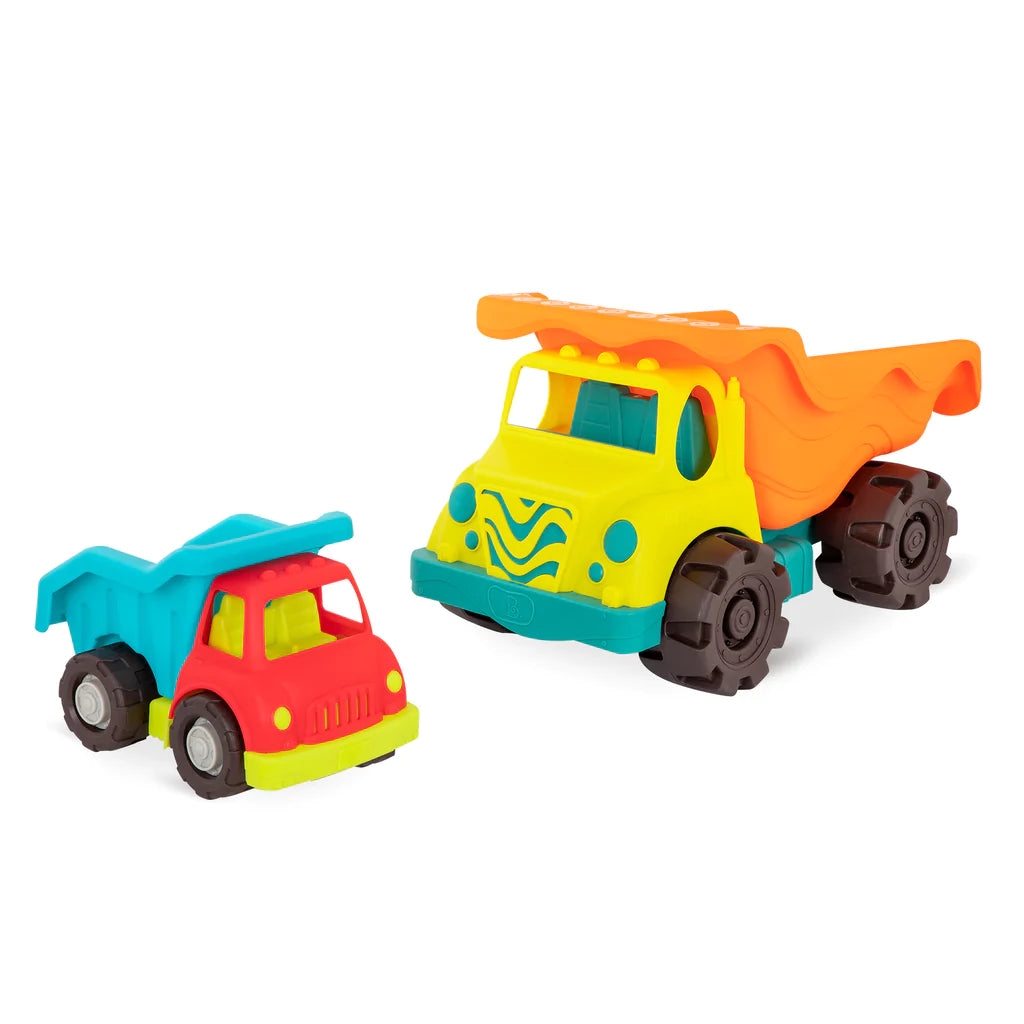
With real toys, let her choose one and hold it. Model “This is my big truck” or “This is my red truck.” If you use the picture instead, invite her to pretend one pictured truck is hers before using my. A genuine toy she owns or a toy she has chosen for the game makes the sentence more natural.
Stay with familiar words: big, small, red, blue, yellow, green and toy names she can already say or learn quickly. One accurate describing word is enough.
Build one complete spoken sentence — about 7 minutes
Say the sentence as a single, natural utterance while pointing to the toy:
“This is my blue ball.”
Then change only the last part. Hold up a different toy: “This is my small car.” Invite her to choose a toy and finish your spoken beginning, “This is my …” After one supported turn, pause and let her try the whole sentence herself.
In this frame, the describing word goes before the toy name: my red ball, my big doll, my small truck. You do not need to explain adjective order. If she says, “This is my ball red,” acknowledge what she meant and recast it: “Yes—this is my red ball.” Give her an opportunity to say the complete sentence again, without turning the moment into a correction drill.
If she says only “red ball,” first accept the description, then gesture toward the toy and offer the beginning: “This is my …” Reduce that support as soon as she can supply the sentence herself.
Give her an audience — about 9 minutes
Set out two or three toys. Invite her to choose one you will not look at yet. She shows it and tells you about it: “This is my small teddy bear.” Respond to its meaning—“Oh, it is small!”—rather than merely saying that the sentence was correct. Take a turn yourself, then let her choose again.
A toy with more than one noticeable feature can invite a richer sentence, such as “This is my big yellow truck.” Treat two describing words as an option, not a requirement. If finding the toy’s English name is the difficult part, give her the name so she can concentrate on producing the full description.
To check what she can say independently, move the models aside and invite her to show two different toys. Listen for “This is my …” followed by an accurate color or size word and toy name. A picture cue or the opening words are reasonable supports; try not to supply the entire sentence before she has a chance to speak.
Leave a small record — about 4 minutes
Let her draw one of the toys she described. Ask her to tell you its sentence once more while she points to the drawing. You may write her sentence beneath it as a record of her speech, using American spelling if you write a color word. Copying or spelling it independently is not the goal today.
Close
The child has moved from naming a favorite toy to showing and describing a particular toy: “This is my …” plus a color or size word before the toy name. Real objects, a listener, and a reason to choose between big and small help the sentence carry meaning. Next, the course turns to early sound play and print direction, while continuing to make room for spoken English.