Recommended resources
The freely available resources this lesson will direct you to.
Welcome back. In our last lesson, we established the Non-Aggression Principle (NAP) as the core ethical rule of libertarianism. We also saw its crucial limitation: to know if aggression has occurred, we first need a clear theory of property rights. If I ask you to leave a piece of land, am I aggressing against you, or am I defending my property? The answer depends entirely on who rightfully owns the land.
This lesson directly addresses that question. We will bridge the gap from the principle of self-ownership to the ownership of external goods like land, tools, and natural resources. Your goal is to understand the main justifications that libertarians offer for the institution of private property. This is a vital step in your journey to rigorously evaluate libertarian thought, as almost all of its conclusions about justice and economics rest on this foundation.
From Self-Ownership to Owning the World
We begin where we started two lessons ago: with the axiom of self-ownership. You own yourself—your body, your mind, your talents. But to survive and flourish, you must use things outside of yourself. You need food to eat, water to drink, and land to stand on. How can a self-owner come to justly own these external resources?
The classic answer, which forms the bedrock of libertarian property theory, comes from the 17th-century English philosopher John Locke. His "labor theory of property" provides the crucial link between owning yourself and owning things in the world.
The core idea is a logical chain:
- Every person owns their own body.
- Therefore, every person owns the labor of their body.
- When a person mixes their labor with an unowned part of nature, they join something they own (their labor) with something nobody owns.
- By doing so, they remove that part of nature from the common state and make it their property.
To see this theory explained in detail, let's turn to a video that breaks down Locke's original argument.
The Labor Theory of Property (Locke, Pt. 6)
This video from Professor Barth, which we've encountered before, clearly explains Locke's reasoning and provides intuitive examples.
Please watch the following segments: First, watch the section from self-ownership to property. This part lays out the fundamental logical sequence from owning your body to owning the fruit of your labor. Next, watch from mixing labor with nature. Here, the video explains the central mechanism of appropriation, using the famous examples of picking acorns, gathering apples, hunting a deer, and catching a fish. Finally, watch how Locke applies this theory to land, from the ownership of land. This is a critical and often contentious part of the argument, showing how improving unowned land makes it one's property.
Locke's argument is that by applying your effort—the physical act of picking, hunting, or cultivating—you transform an unowned resource into your own. It is the act of doing something with the resource that establishes your unique claim to it. To take the apple you picked or the deer you hunted would be to steal your labor.
The Homesteading Principle: First Use, First Right
More recent libertarian thinkers, particularly in the tradition of Murray Rothbard, have refined Locke's idea into what is known as the homesteading principle, or the "first-user rule." This principle states that the first person to discover, use, and establish control over an unowned resource becomes its rightful owner.
The justification is rooted in conflict avoidance, the very purpose of property norms.
- The first user (the homesteader) takes the resource from no one; it was previously unowned.
- Anyone who comes later and tries to seize the resource from the first user is initiating a conflict.
The following reading explains this principle with rigorous, step-by-step logic, deriving it directly from the Non-Aggression Principle we studied in the last lesson.
Homesteading and Property Rights | The Fundamentals of ...
This article provides a systematic defense of the homesteading principle as the only just means of initial appropriation.
Please read the following three sections: Start with The Homesteading Principle to get the core definition. Next, read about the Derivation from the Non-Aggression Principle. The Crusoe and Friday thought experiment is key here; it shows why giving preference to the "latecomer" is logically contradictory. Finally, read The Criteria for Property Borders. This adds a crucial practical element: to be legitimate, the act of homesteading must create an objective, observable border that communicates your claim to others. Simply declaring ownership is not enough.
The homesteading principle provides a clear, non-arbitrary rule for how ownership begins. It doesn't depend on the decree of a king or a vote by a committee. It depends on an objective, observable fact: who was the first to put the resource to use?
A Fork in the Road: Two "Labor Theories"
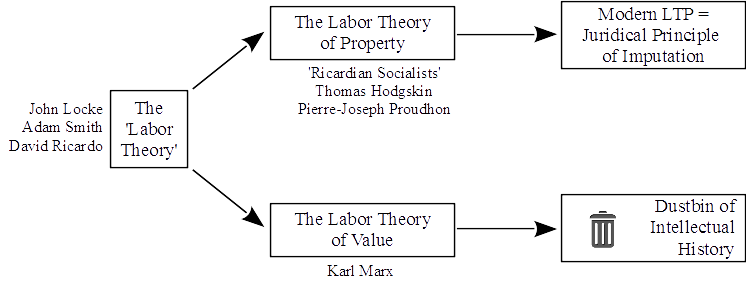
It's important to pause here and clarify a major point of confusion in the history of economic and political thought. The early classical economists, like John Locke and Adam Smith, talked about a "labor theory." As the diagram below shows, this idea split into two very different, and ultimately opposing, theories.
-
The Labor Theory of Property: This is the Lockean/libertarian theory we've been discussing. It's a theory of justice that explains how ownership is first established. It's about who has the right to control a good.
-
The Labor Theory of Value: This is a theory of economics, most famously associated with Karl Marx. It claims that the economic value of a good is determined by the amount of labor required to produce it. Libertarians (and most modern economists) reject this theory, arguing that value is subjective and determined by supply and demand. We will examine the Labor Theory of Value in detail when we discuss socialist critiques in Module 11.
For now, the key takeaway is that when libertarians speak of labor justifying property, they are talking about the right of ownership, not the economic price.
Nozick's Entitlement Theory: A Complete Framework
The 20th-century philosopher Robert Nozick, whose work we will explore in depth later, synthesized these ideas into a comprehensive framework called the Entitlement Theory of Justice. He argued that whether a distribution of property is just depends entirely on how people came to possess it. His theory has three parts:
- A Principle of Justice in Acquisition: This addresses how unowned things become owned. This is precisely the Lockean/homesteading principle we've just covered.
- A Principle of Justice in Transfer: This governs how owned things can pass from one person to another (e.g., through voluntary exchange, gift, or inheritance).
- A Principle of Rectification of Injustice: This explains how to deal with property that was acquired or transferred in violation of the first two principles (e.g., through theft or fraud).
This short video explains Nozick's three principles with a simple, memorable example.
Nozick's Entitlement Theory: The Philosophy of the Free Market - Debate
This video from Philosophy Vibe provides a clear, concise overview of Nozick's three principles of justice in holdings.
Watch the segment from the three principles, which covers justice in acquisition, transfer, and rectification using the example of pear and apple trees. Pay attention to how each principle builds on the last to create a complete historical account of ownership.
Nozick’s theory provides a powerful structure: any distribution of wealth, no matter how unequal it looks at a glance, is just if it arose from a series of just steps—legitimate first acquisition followed by legitimate voluntary transfers.
The Consequentialist Justification: The Tragedy of the Commons
So far, we have focused on the rights-based (or deontological) case for private property: it is a just extension of self-ownership. However, there is another powerful line of argument that libertarians often use: the consequentialist case. This argument states that private property, regardless of its moral origin, is justified because it leads to the best outcomes for society.
The most famous version of this argument is the "Tragedy of the Commons." The tragedy describes how resources that are owned in common (or by no one) are prone to overuse and depletion.
Imagine a pasture open to all herders. Each herder has an incentive to graze as many of his own cattle as possible. He receives the full benefit from his own animals, but the cost of overgrazing (a depleted pasture) is shared by everyone. Since every herder faces the same incentive, they will collectively graze the pasture into ruin, leaving everyone worse off.
The solution is private property. If the pasture is divided into privately owned plots, each owner must bear the full cost of their own actions. The owner of Plot A has a strong incentive not to overgraze, because doing so would destroy the value of his own asset. Private property forces people to internalize the costs of their actions, leading to responsible stewardship.
This section from the Internet Encyclopedia of Philosophy provides a classic explanation of the Tragedy of the Commons, including how it functions as a "Prisoner's Dilemma."
Please read the subsection titled Tragedy of the Commons. Focus on how common ownership creates a perverse incentive structure, and how private property solves this problem by aligning individual self-interest with the long-term preservation of the resource.
This consequentialist argument is a cornerstone of the economic case for free markets. Libertarians argue that private property isn't just a moral right; it's the institutional foundation for prosperity, innovation, and sustainable resource use.
Conclusion
In this lesson, we have explored the libertarian answer to the fundamental question of how we come to own parts of the world. We've seen that the justification rests on two pillars, which most libertarians believe are mutually reinforcing.
Here are the key takeaways:
- The primary justification for private property is rights-based, stemming from the principle of self-ownership. The Lockean labor theory of property and the homesteading principle argue that the first person to use an unowned resource becomes its just owner.
- Nozick's Entitlement Theory provides a complete framework for just property, based on just acquisition, just transfer, and rectification of injustice.
- A second, powerful justification is consequentialist. Private property provides the necessary incentives for individuals to use resources efficiently and act as responsible stewards, thus avoiding the Tragedy of the Commons and creating widespread prosperity.
You now have a solid understanding of the libertarian theories of self-ownership, non-aggression, and the origin of property rights. These three concepts form the essential grammar of libertarian political philosophy.
With this foundation in place, we are ready to explore the second part of Nozick's entitlement theory: "justice in transfer." Our next lesson will focus on the principle of voluntary exchange, the engine that drives a free-market economy and the primary way property moves from one person to another in a just society.