Recommended resources
The freely available resources this lesson will direct you to.
Hello! Last time, you worked on capitalization in sentences and titles. Earlier, you learned to recognize complete sentences and repair sentence boundaries. Both skills matter here: a comma can make a sentence easier to read, but it cannot replace a period or semicolon between two complete thoughts.
In this lesson, you’ll use commas in three common places: after introductory elements, between items in a list, and before a conjunction that joins two complete sentences. These are choices you will make often when drafting articles, emails, and other professional writing.
Introduce the sentence, then let the main point begin
An introductory element gives context before the main part of a sentence. It may tell the reader when something happened, set a condition, or signal how the new sentence relates to the previous one. A comma marks where that opening ends and the main statement begins:
After reviewing the brief, the writer drafted an outline.
If the audience changes, the introduction may need to change.
However, the deadline remains the same.
In each example, the words after the comma carry the main statement. The opening prepares the reader for it. This is especially useful when an opening contains a dependent clause—a group with a subject and verb that cannot stand alone. If the audience changes has a subject (the audience) and a verb (changes), but it leaves the reader waiting for what happens next.
Watch this short explanation of independent and dependent clauses. You have met the distinction before; pay particular attention to what changes when a dependent clause comes before the main clause.
English Writing Skills 2: Commas and Capital Letters
Watch “English Writing Skills 2: Commas and Capital Letters” by English with Jennifer for a visual explanation of why an opening dependent clause needs a comma before the main statement.
Watch the clause explanation. It begins by defining a clause, then compares a clause that can stand alone with one that cannot. Near the end, focus on the explanation of the comma when the dependent clause comes first.
Compare the order in these two sentences:
When the editor clarified the audience, the writer changed the opening.
The writer changed the opening when the editor clarified the audience.
The first sentence needs a comma after its introductory clause. In the second, the when clause follows the main statement; it usually needs no comma.
Not every introduction is a full clause. A word such as however or first commonly takes a comma: First, identify the intended reader. An opening phrase can take one too: Before publication, check every link. With a very short phrase, the comma is sometimes optional when the meaning remains clear: On Monday the draft goes live. In professional writing, a comma is often a helpful, consistent choice: On Monday, the draft goes live.
A comma is not simply a mark for wherever you pause while speaking. Look for the sentence’s structure instead. Nor should you place one between a subject and its verb: The final version of the article needs a headline, not The final version of the article, needs a headline.
Make lists easy to scan
When a sentence names three or more items, commas separate them so the reader can see each item:
The brief specifies the audience, the length, and the deadline.
Before submitting, check the facts, revise the opening, and proofread the final draft.
The comma before the final and is called the serial comma (or Oxford comma). Some publications omit it in simple lists. For your own drafts, using it consistently is a sound default; if a client provides a style guide, follow that instead. It is particularly helpful when list items are long or could otherwise be mistaken for one another.
Read the short list section of this handout for a second look at simple and longer lists.
Read the University of North Carolina Writing Center’s guidance on lists to see how comma placement changes when list items become more complex.
In the “Commas” handout, find subsection “5. X,Y, and Z.” Read the list guidance, from its opening rule through the “BUT ALWAYS” example. Notice the difference between a simple three-item list and a list of longer actions; stop before subsection “6. Describers.”
A two-item list does not normally need a comma: The writer drafted and revised the article. Be careful, though, not to treat every nearby and as a list marker. In The writer drafted the article and revised the headline, one person performs two actions, and no comma is needed before and. We will compare that pattern with two complete thoughts next.
Join complete thoughts with a comma and a connector
Recall the sentence-boundary test from an earlier lesson: can the words on each side stand as sentences? If they can, and you choose to join them with a coordinating conjunction, place a comma before that conjunction:
The outline is ready, but the introduction needs work.
The outline is ready can stand alone. So can the introduction needs work. The comma and but join them into a compound sentence while showing their relationship.
The common coordinating conjunctions are for, and, nor, but, or, yet, so—often remembered as FANBOYS. You do not need to memorize the acronym to make the decision. Test what follows the connector:
The editor reviewed the draft and sent comments.
The editor reviewed the draft, and the client approved it.
In the first sentence, sent comments is not a complete sentence on its own. It shares the subject the editor, so there is no comma before and. In the second, the client approved it has its own subject and verb and stands alone. Put a comma before and.
The image below marks the same distinction in two examples. Notice that each side of but or so expresses a complete thought.
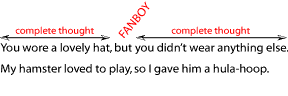
A comma by itself is not enough to join those complete thoughts. This is the comma splice you learned to repair in the sentence-boundaries lesson:
Comma splice: The outline is ready, the introduction needs work.
With a connector: The outline is ready, but the introduction needs work.
A period or semicolon would also repair the boundary. Choose the comma-plus-conjunction form when the connector helps express the relationship between the ideas—contrast with but, for example, or a result with so.
For a closer explanation of the complete-thought test and the comma-splice warning, read these two adjoining sections.
Return to the University of North Carolina Writing Center’s “Commas” handout to connect the punctuation rule to the complete-sentence test.
Find subsection “2. FANBOYS,” then continue into “3. The dreaded comma splice.” Read the connector explanation, ending after the two “BAD” comma-splice examples. Focus on the advice to read the words after the conjunction by themselves: if they form a complete thought, the comma belongs before the conjunction.
Check what each comma is doing
In a draft, commas can appear close together for different reasons. Consider this short passage:
Before submitting the article, the writer checked the headline, the links, and the formatting. The links worked, but the headline needed another revision.
The first comma closes an introductory phrase. The commas in the middle separate three things being checked. The last comma comes before but because The links worked and the headline needed another revision are each complete thoughts. None of those commas is there merely because the sentence feels long.
A useful editing pass is to ask three questions in order:
- Does the sentence open with context before its main statement? Mark the end of that opening, especially if it is a dependent clause.
- Does it contain a list of three or more items? Separate the items, following the requested style for the final comma.
- Does a coordinating conjunction join two complete thoughts? If so, put a comma before it. If there is no conjunction, a comma alone will not fix the boundary.
This structure-based check is more dependable than adding commas wherever you hear a pause.
Takeaways
Use a comma after an introductory clause or other opening that needs a clear boundary. Separate three or more list items, and be consistent about the serial comma. Before and, but, so, or another coordinating conjunction, use a comma when both sides are complete thoughts—not when one subject simply performs two actions.
Next, you’ll work on apostrophes in contractions and possessives, another small mark that can change what a sentence means.