Recommended resources
The freely available resources this lesson will direct you to.
Welcome to the first module of your algebra course. We begin with algebraic language: the small distinctions that determine what kind of mathematical task you are doing. Before solving equations, proving identities, or working with inequalities, you must be able to recognize whether a line of symbols is asking for a value, asserting a universal fact, or merely describing a quantity.
This lesson distinguishes expressions, equations, identities, and inequalities. The central habit is to ask: Is this a quantity to evaluate or simplify, or is it a statement that can be true or false? If it is a statement, for which values is it true?
Expressions: mathematical quantities, not claims
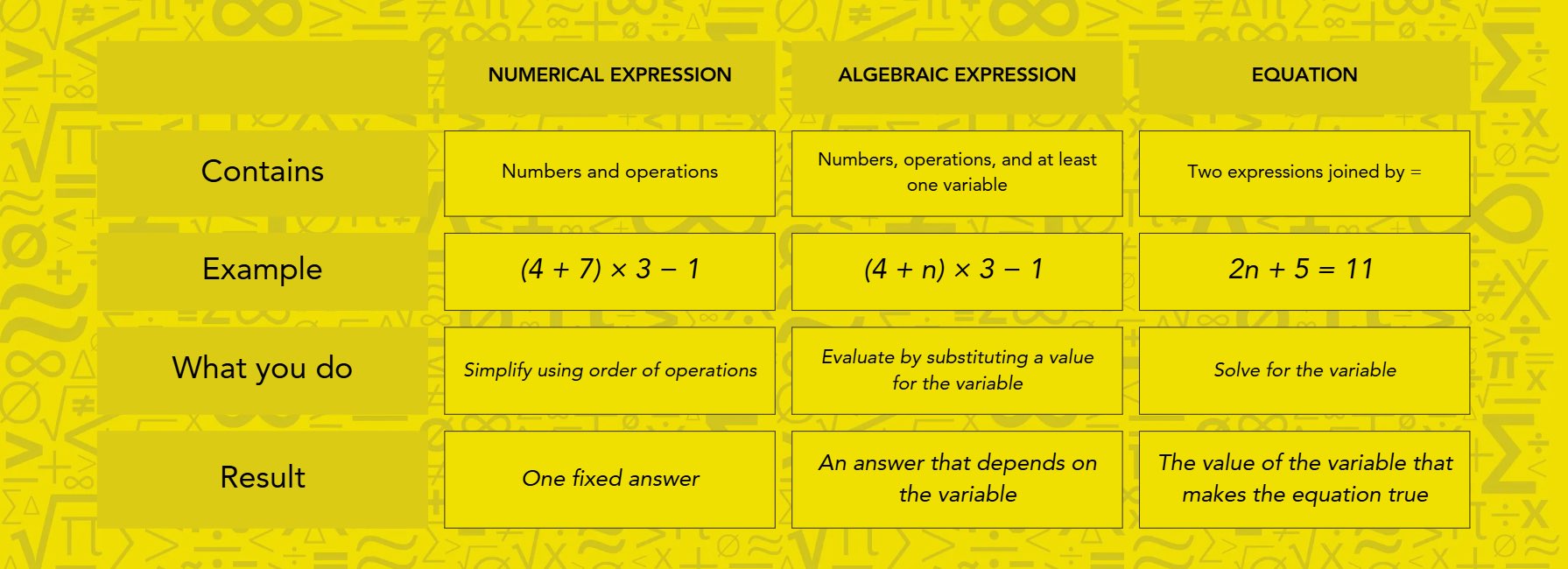
An algebraic expression is a meaningful combination of numbers, variables, and operations. For example,
is an expression. It represents a quantity whose value depends on . It does not claim that this quantity equals, exceeds, or is less than anything else.
Expressions have no truth value. It makes no sense to say that is “true” or “false”; it is like a noun phrase rather than a complete assertion. You may:
- evaluate it after assigning a value to ;
- simplify it by rewriting it in an equivalent form;
- compare it with another expression only once a relation symbol is introduced.
For instance, if , then
That calculation evaluates the expression; it does not solve it.
Expressions vs. Equations vs. Identities
Watch “Expressions vs. Equations vs. Identities” by Eddie Woo for a concise conceptual comparison. Its emphasis on truth values is especially useful: it separates a mathematical quantity from a mathematical statement.
Begin with expressions and equations, noting the distinction between simplifying an expression and solving an equation. Then watch identities and truth. Focus on the claim that an identity holds for every permitted value, whereas an ordinary equation may hold only for selected values.
The form of an expression can change without changing its value. For example,
Here the equality says the two expressions have the same value for every real . The expression on the left is not literally the same string of symbols as the one on the right, but they are equivalent expressions.
A useful first test is therefore:
No comparison symbol means expression.
If there is no , , , , or , you are looking at an expression rather than a statement.
Equations: equality claims with possible solutions
An equation asserts that two expressions are equal:
For example,
is an equation. It is a claim whose truth depends on . Substituting gives , a true statement, while substituting gives , a false statement. Thus is a solution: it makes the equation true.
1.4.11: High School Algebra Standards - Mathematics LibreTexts
Read the sections “Expressions” and “Equations and inequalities” from Mathematics LibreTexts. They give a careful account of expressions as records of computation and equations as statements that may be true for particular variable values.
In the section “Expressions,” read from the definition of an expression, including the discussion of rewriting an expression to reveal structure. Then, in “Equations and inequalities,” read from the comparison of equations and identities. Focus on the difference between finding values that satisfy an equation and recognizing a statement that holds for all allowed values.
An equation need not have exactly one solution. It may have:
| Type of equation | Example | Values that make it true |
|---|---|---|
| Conditional equation | only | |
| Contradiction | No real values | |
| Identity | Every real value |
All three are equations because each uses an equals sign to make a claim. What distinguishes them is their solution set.
For the contradiction,
expanding the left side gives
Subtracting from both sides would produce , which is false. No value of can make the original equality true.
This is a useful warning: an equation is not automatically solvable in the sense of producing one number. It may have one solution, many solutions, every permissible value, or no solutions.
Identities: equalities true throughout their domain
An identity is an equation that is true for every value in its domain. For example,
is an identity over the real numbers. The left-hand side simplifies as follows:
This is not a problem asking “which works?” Every real works. Instead, the mathematical task is to prove or justify that both sides always agree.
The distinction is especially important because equations and identities usually use the same symbol, . You cannot classify one merely by seeing an equals sign. You must determine the scope of its truth.
Compare:
This is an identity over the reals: expanding the left-hand side produces the right-hand side for every real .
This is an ordinary equation. It is true only for certain values of , not for every real number.
Domains matter
“True for all values” always means all values for which the statement is defined. Consider
It is true whenever , but it is not even defined at . Therefore, the accurate statement is:
This is an identity on the domain of nonzero real numbers, not an unrestricted identity over all real numbers. Keeping track of such restrictions will become essential when rational expressions and radicals appear later in the course.
A proof-minded way to organize the four main tasks is:
| Object | What it is | Appropriate goal |
|---|---|---|
| Expression | A quantity | Evaluate or simplify |
| Equation | Equality claim | Find all values that make it true |
| Identity | Equality claim true on its domain | Prove it holds for every permitted value |
| Inequality | Ordered comparison | Find all values that make the comparison true |
Inequalities: comparisons of size or order
An inequality compares two expressions by order rather than asserting equality. Its common symbols are:
| Symbol | Read as | Boundary included? |
|---|---|---|
| less than | No | |
| greater than | No | |
| less than or equal to | Yes | |
| greater than or equal to | Yes |
For example,
is an inequality. It asks for values of for which the left side is less than the right side.
Testing individual values shows the basic idea:
so , which is true. Thus satisfies the inequality.
But
so , which is false. Thus does not satisfy it.
Unlike a single-solution equation, an inequality often has infinitely many solutions. Notice also the role of the boundary: makes the two sides equal, so it does not satisfy the strict inequality . If the relation were
then would be included.
Math Antics - Basic Inequalities
Watch the opening of Math Antics’ “Basic Inequalities” for a visual review of the ordered comparison symbols. It reinforces how the direction of a strict inequality changes when the compared quantities are reversed.
Watch comparison symbols and then inclusive symbols. Focus on reading each symbol from left to right and on the difference between a strict comparison and one that permits equality.
A small precision is worth retaining: the phrase “inequality” commonly refers to these order relations, including and , even though those two symbols allow equality. The symbol says “not equal,” but it does not say which quantity is larger.
For now, distinguish an inequality from an equation by its relation symbol. Later, you will learn the special rules required when solving inequalities, particularly why multiplying or dividing by a negative number reverses the comparison.
A dependable classification method
When you encounter unfamiliar algebraic notation, classify it in this order.
-
Look for a relation symbol.
If there is none, it is an expression. -
If the symbol is , call it an equation first.
Then ask whether it is true for some values, no values, or every permitted value. The last case is an identity. -
If the symbol compares order, such as , , , or , it is an inequality.
-
Check the domain before claiming “all values.”
Denominators, roots, and other operations can exclude inputs.
Here are representative examples:
| Mathematical object | Classification | Why |
|---|---|---|
| Expression | It is a quantity; no claim is made. | |
| Equation | It asserts equality, which may hold for selected values. | |
| Identity | Both sides agree for every real . | |
| Inequality | It compares the values of two expressions in order. | |
| Identity on | It holds wherever the left side is defined. |
The words used in algebra now become more exact:
- Evaluate an expression at a specified input.
- Simplify an expression into an equivalent form.
- Solve an equation by finding its solution set.
- Prove an identity by showing its equality throughout the stated domain.
- Solve an inequality by determining all inputs that make the comparison true.
The key takeaway is that symbols alone give the first classification, but truth across a domain gives the deeper distinction. An expression represents a quantity; an equation asserts equality; an identity is an equality that always holds on its domain; and an inequality compares values by order.
Next, you will build directly on expressions by evaluating them carefully through substitution, including the use of parentheses to avoid sign and order-of-operations errors.