Recommended resources
The freely available resources this lesson will direct you to.
Hello! Welcome back to your course on advanced scuba diving theory.
Introduction
In our last lesson, we analyzed the complex factors that influence how your body absorbs and releases inert gas, such as perfusion, temperature, exercise, and the specific properties of gases like helium and nitrogen. We saw that on-gassing and off-gassing are dynamic, asymmetrical processes that vary throughout the body.
This raises a critical question: if the real-world physiology is so complex, how do our dive computers and decompression tables manage it? The answer is that they use mathematical models, or algorithms, which are necessarily simplifications of reality.
This lesson directly addresses that simplification. In line with the learning outcome, you will evaluate the theoretical limitations and conservatism adjustments in modern decompression algorithms. We will explore:
- Why decompression models are approximations, not perfect physiological replicas.
- The inherent limitations of foundational concepts like M-values.
- How individual and environmental factors create a gap between the model and the diver.
- The practical tools and strategies, like Gradient Factors, used to add safety margins and bridge this gap.
By the end of this lesson, you'll understand why there are "no guarantees" in decompression and how to use modern tools to intelligently manage your risk.
Part 1: The Model Is Not Reality
The first and most important limitation to understand is that a decompression algorithm is just a set of mathematical rules. It's a "recipe" that attempts to predict a safe ascent, not a minute-by-minute simulation of your actual body.
Decompression Theory (1/2) ~ New Jersey Scuba Diving
To frame this idea, let's read a short introduction from an article explaining the Bühlmann algorithm. It perfectly captures the concept of a model versus reality.
Read the first few paragraphs of the article, down to the end of the third paragraph which begins 'It is important to realize...'. Focus on the distinction the author makes between a mathematical model and the actual physical processes in the body.
This distinction is crucial. The model works with theoretical "compartments," not your actual spleen or femur. Because it's a simplified approximation, it has inherent limitations.
Limitation 1: The "Silent Bubble" Problem
As we discussed in a previous lesson, classic dissolved gas models like Bühlmann are based on the idea of keeping inert gas in the dissolved state and preventing bubble formation. However, we now know this isn't what actually happens.
Decompression Theory (1/2) ~ New Jersey Scuba Diving
Let's read another section from the same article that discusses this fundamental limitation.
Read the section titled 'Modern Ideas'. Pay attention to the discovery of 'silent bubbles' through Doppler studies and what this implies about the assumptions of the Bühlmann algorithm.
The discovery that bubbles form on most dives, even asymptomatic ones, revealed a major limitation in models that only consider dissolved gas. This is a key reason why bubble models (like VPM and RGBM) were developed. But even for dissolved gas models, it underscores that their core premise is an idealization.
Limitation 2: M-Values are a "Fuzzy Gray Area"
The central rule of a Haldanian model is to never let the calculated gas pressure in a compartment exceed its M-value (Maximum Tolerable Pressure). This sounds like a hard-and-fast safety line. The reality is more probabilistic.
Deco Myths by Mark Powell (Diving Presentation)
Dive industry expert Mark Powell gives an excellent presentation on decompression myths. In this first clip, he explains why the M-value is not the binary 'safe/unsafe' line we might imagine.
Watch the video from 09:19 to 12:25. Focus on the analogy of the M-value as a 'fuzzy gray area' or a transition from green to red, rather than a solid line. Note the implications for risk.
This is a profound point: an M-value represents a level of risk, not a guarantee of safety. Two divers on the same profile might be on opposite sides of the "true" line for their individual physiology on that specific day. Because the model's limits are statistical averages, not absolute truths, we cannot treat them as such.
Part 2: Individual Variability and External Factors
The original decompression tables were developed for a very specific population, but the diving world is far more diverse.
How Does Your Dive Computer Work | Basics of Decompression Scuba Diving
In this short clip, explorer Jill Heinerth explains why the 'one-size-fits-all' approach of early tables necessitated a move towards more conservative and adaptable models.
Watch from 08:18 to 09:18. Note the description of the divers for whom the original Navy tables were designed and the 'messy, inconclusive data' from the wider diving population.
The algorithm in your dive computer has no knowledge of your age, body fat percentage, fitness level, or state of hydration. It also doesn't know if you are warm or cold. As we learned in the last lesson, these factors significantly affect gas exchange.
Decompression Theory (1/2) ~ New Jersey Scuba Diving
This section of the 'New Jersey Scuba Diving' article provides a good list of the many real-world factors that can affect your susceptibility to DCS, none of which are included in the basic Bühlmann equations.
Read just the bulleted list in the section 'Modifications for the Real World'.
The sheer number of these un-modeled factors means there will always be a potential gap between the computer's calculation and your body's reality. Some factors have a greater impact than others.
Deco Myths by Mark Powell (Diving Presentation)
Let's return to Mark Powell's talk, where he discusses the relative impact of some of these factors, challenging some common beliefs.
Watch from 25:47 to 34:55. Pay attention to the discussion around hydration, exercise, and especially thermal status (being cold at depth vs. warm on ascent). Note the slide that visually represents the different components of decompression risk.
The finding that thermal status can have an order of magnitude greater impact than hydration is a powerful example of the limitations of a simple mathematical model. It highlights the need for divers to add their own "wet-ware" intelligence to the "hard-ware" of the computer.
Part 3: Conservatism Adjustments in Practice
Given that models are imperfect and divers are variable, how do we create an adequate safety margin? The answer is conservatism. This is done in three main ways: built-in adjustments, user-configurable tools, and diver behavior.
1. Built-in and Simple Adjustments
Dive computer manufacturers are aware of these limitations. They often build in conservatism that isn't immediately obvious to the user.
The article "Decompression Theory (1/2)" that you read earlier mentions several of these under the hood modifications in its "Modifications for the Real World" section, such as using slightly more conservative a and b values (creating the ZH-L16B and C variants) or using longer half-times for off-gassing.
Many recreational computers offer simple settings like "low/medium/high" conservatism, which apply these kinds of adjustments for you.
2. Gradient Factors (GF)
For technical diving, the most common and powerful tool for adjusting conservatism is Gradient Factors. This method gives the diver direct control over how close they want to get to the model's M-value limits.
The Wikipedia article on Decompression Theory provides a clear and concise definition of Gradient Factors.
Read the paragraph in the 'The critical supersaturation approach' section that begins 'Gradient factors are a way of modifying the M-value...'. Focus on understanding the GF Low / GF High notation.
In essence, Gradient Factors redefine the decompression ceiling, making it deeper than the original M-value line.
- GF Low (GF L): Sets the conservatism of your first decompression stop. A lower number (e.g., 30) forces a deeper first stop, farther away from the M-value line.
- GF High (GF H): Sets the conservatism as you approach the surface. A lower number (e.g., 80) means you will surface with a larger safety margin.
A setting of GF 30/80 is more conservative than GF 40/90.
This graph provides a clear visual representation:
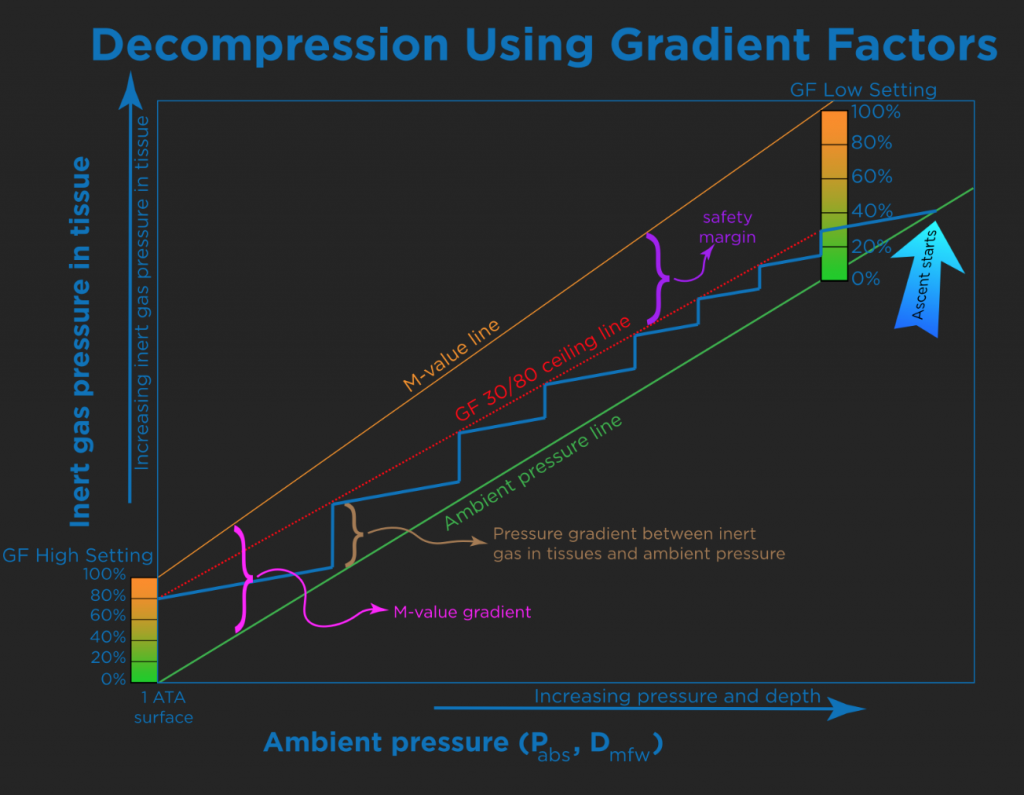
By adjusting GFs, a diver can tailor the algorithm's output based on the dive's demands, their personal physiology, and external factors. For a cold, strenuous dive, you might choose a more conservative GF setting (e.g., 30/70) than for a warm, relaxed dive (e.g., 40/85).
3. Diver Behavior
Finally, conservatism is added through your actions in the water. These behaviors add a safety margin regardless of what the computer says.
Deco Myths by Mark Powell (Diving Presentation)
A simple safety stop is a perfect example of behavioral conservatism. Let's watch one last clip from Mark Powell's presentation showing the profound impact this simple action has on post-dive bubbles.
Watch from 12:34 to 17:22. Observe the dramatic difference in bubble scores between divers who did a direct ascent versus those who did even a short safety stop.
The data is clear: a 3-5 minute safety stop, even when the computer says it's not required, significantly reduces your post-dive bubble load and decompression stress. Other conservative behaviors include:
- Maintaining a slow, controlled ascent rate.
- Avoiding heavy exercise immediately before and after a dive.
- Staying well-hydrated and warm.
- Adding extra "padding" to your last stop.
Conclusion
Today, we've confronted the reality that our decompression models are powerful but imperfect tools. They are mathematical approximations of a chaotic and variable biological process.
Key Takeaways:
- Decompression algorithms are models, not reality. Their fundamental assumptions (e.g., dissolved-gas only, hard M-value lines) are known to be simplifications.
- The models do not account for the vast individual and environmental factors (age, fitness, temperature, etc.) that influence decompression risk.
- We manage this uncertainty by adding conservatism.
- Conservatism is applied through built-in algorithm tweaks, user-configurable tools like Gradient Factors (which create a more cautious ascent ceiling), and prudent diver behavior like performing safety stops and maintaining slow ascent rates.
Preview of the Next Lesson:
Understanding decompression models and their limitations is the cornerstone of planning safe dives. Now that we have a grasp on managing our ascent profile, we can turn our attention to the other half of the equation: the gas we breathe. In the first lesson of the next module, we will begin our study of technical dive planning by learning how to apply gas density limits to determine safe breathing gas compositions at target depths. This will be our first step in learning how to choose the right gas for the right depth.