Recommended resources
The freely available resources this lesson will direct you to.
Hello again. In the previous lesson, you turned mock-test outcomes into precise error events: concept, interpretation, calculation, carelessness, and decision errors. That diagnosis matters only if it changes what you do next. An error log that is never revisited is a record of frustration, not a revision system.
This lesson converts each useful log entry into a small, scheduled cycle of active recall and reattempts. The aim is not to reread solutions repeatedly. It is to make yourself retrieve the rule, recognize its conditions, and solve a comparable GATE-style problem after enough time has passed that recall is effortful.
By the end, you should be able to take an entry such as “COA cache mapping: concept error” and turn it into dated review sessions with a clear task for each date.
Spacing determines when; active recall determines what
Spaced retrieval works because you return to material after some forgetting has occurred. That makes the next successful recall more demanding than immediate rereading. But the schedule alone is not the method: reviewing a highlighted solution every few days can feel familiar without proving that you can solve a question in a mock.
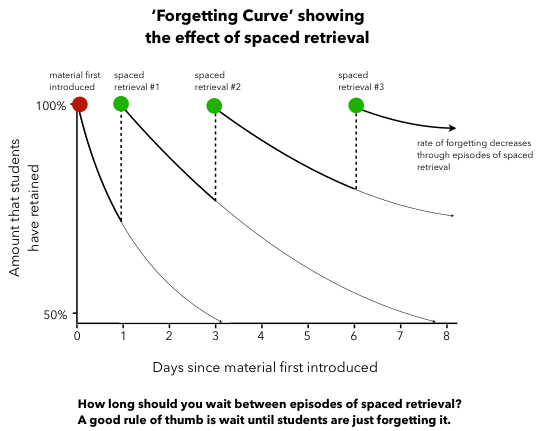
For GATE preparation, a review is successful only when you can do both of these without notes:
- Retrieve the governing idea. State the rule, condition, invariant, definition, or procedure that the question needs.
- Use it. Reattempt the original question or solve a structurally similar one correctly, preferably under a small time limit.
For example, recalling “Dijkstra finds shortest paths” is insufficient. A useful retrieval prompt is:
“Under what edge-weight condition is Dijkstra valid, and what goes wrong when a negative edge is present?”
Then the application step is a short graph question in which you must decide whether Dijkstra is appropriate before tracing it.
The distinction is worth making explicit:
| Activity | What it tells you | Use it for |
|---|---|---|
| Rereading a solution | “This looks familiar.” | Initial repair only |
| Looking at a flashcard answer immediately | “I recognize the answer.” | Not a valid recall test |
| Explaining the rule with notes closed | “I can retrieve the idea.” | Active recall |
| Solving a related question with notes closed | “I can apply the idea.” | GATE-relevant active recall |
For your preference of roughly 70% problem solving and 30% concept review, each scheduled review should be mostly retrieval and reattempt—not note reading.
Notetaking Formats — The Learning Scientists
Read the relevant parts of “Notetaking Formats” from The Learning Scientists. It gives a practical foundation for using recall prompts, expanding intervals, and a simple record of previous attempts.
In the “Flashcards” section, read the guidance on accurate recall and expanding intervals. Then read the following discussion of repeated passes through difficult cards, focusing on why items recalled incorrectly receive more attention. Finally, in “Final Thoughts,” read the tracking-sheet suggestion. While reading, translate “cards” into your own units: a rule prompt plus a short GATE-style reattempt.
Step 1: Turn a vague error-log row into a reviewable unit
Do not schedule broad labels such as:
- “Revise CN”
- “Practice DBMS”
- “COA weak”
Those labels are too large to retrieve and too vague to mark complete. Your unit should be small enough that you can test it in about 5–12 minutes.
A good review unit has four parts:
| Part | Example: COA cache error |
|---|---|
| Trigger | “Direct-mapped cache, 16 lines, block number given” |
| Recall prompt | “How are tag, index, and offset obtained? Why is the line index block number modulo 16?” |
| Application task | Reattempt the original cache question, then solve one changed-value variant |
| Safeguard or takeaway | “Count cache lines, not bytes, when finding the number of index values.” |
Compare the two error-log entries below.
| Not yet schedulable | Schedulable unit |
|---|---|
| “DBMS closure weak” | “Attribute closure: continue applying FDs until no new attributes are added; test whether is a candidate key for a specified FD set.” |
| “Made silly mistake in CN” | “Usable IPv4 hosts: distinguish total addresses from usable host addresses; perform a final ‘asked quantity’ check.” |
| “Time management issue” | “Two-mark MCQ rule: if no first step and no option can be eliminated after the initial scan, defer rather than continue.” |
One mock may contain several questions that expose the same exact misconception. In that case, create one unit and attach multiple question IDs. But do not merge items merely because they belong to the same subject. “CN” is a subject; “TCP sequence-number arithmetic after retransmission” is a retrievable unit.
The repair date is your starting date
Let the repair date be the day on which you actually understand and correct the issue for the first time. It is not necessarily the day you took the mock.
On the repair date:
- Review the exact missing idea or official solution briefly.
- Write one closed-book recall prompt in your own words.
- Complete one short application attempt.
- Immediately book the later dates.
The repair itself is allowed to involve notes. Every later scheduled session begins with notes closed.
Step 2: Choose the review task from the error type
The previous lesson classified the error. Now use that classification to decide what retrieval will actually repair it.
| Error type | What to retrieve first | What to reattempt | What to record |
|---|---|---|---|
| Concept | Rule, definition, assumptions, and boundary cases | A same-topic problem with changed values or context | The exact rule you initially lacked |
| Interpretation | Requested quantity, qualifiers, output type, and constraints | A wording-heavy question; restate “Asked / Given / Output” before solving | The phrase you missed |
| Calculation | The correct method and an independent validity check | Similar computation with all intermediate work written | The vulnerable step and check |
| Carelessness | The required process safeguard | A short trace or calculation using that safeguard | Whether you applied the safeguard |
| Decision | Your attempt/defer/skip rule | A timed mini-set in which you must make and justify decisions | Time spent, confidence, and decision quality |
Notice that a decision error cannot be fixed by memorizing a definition. If you spent seven minutes on a low-confidence MCQ, your review task should include a timed setting where you practice stopping at the right point.
Likewise, a careless marking error is not repaired by reading more COA theory. You need to rehearse the concrete safeguard: for example, writing the final option beside your scratch result, then comparing it with the submitted option.
Step 3: Use an expanding, realistic GATE schedule
With roughly four months before GATE, you need intervals that grow, but not so much that a weak point disappears until the exam. Use this practical default for a red-priority unit: a wrong, blank, repeatedly missed, or high-cost error.
| Review | Timing after repair | Purpose |
|---|---|---|
| Repair | Day | Understand, create prompt, complete first corrected attempt |
| R1 | Day | Reattempt original problem closed-book |
| R2 | Day | Recall rule and solve a changed-value or isomorphic variant |
| R3 | Day | Timed reattempt within a mixed mini-set |
| R4 | Day | Mixed-subject retrieval and application |
| R5 | Day | Check for durable retention |
| R6 | Day | Final long-gap check; keep only if genuinely secure |
This is a default, not a memory law. The important features are:
- the first review is soon enough to catch a fragile repair;
- later gaps expand;
- difficult items are reviewed more often;
- the task becomes increasingly exam-like.
For an amber-priority unit—for example, a one-off calculation slip, a missed qualifier, or a correct-but-slow question—use a lighter schedule:
| Review | Timing after repair |
|---|---|
| R1 | Day |
| R2 | Day |
| R3 | Day |
| R4 | Day |
A unit should earn green status only after successful retrieval and correct application on at least two later dates. A correct answer reached by looking at the solution, guessing, or using a memorized answer pattern does not count.
11 Ways to Spaced Repetition in 11 Minutes
Watch selected parts of “11 Ways to Spaced Repetition in 11 Minutes” by Mike and Matty. The useful ideas here are increasing review gaps and the distinction between spaced scheduling and the active-recall work performed during a review.
Watch expanding schedules for the Leitner-style promotion and planned expanding intervals. Then watch the active-recall warning. Apply its central distinction directly: your calendar specifies when a review happens; your closed-book explanation and reattempt specify what happens in it.
Step 4: Put actual dates into the error log
A schedule does not exist until it has dates. Suppose you repaired the following errors on 1 October 2026.
| ID and error-log entry | Priority | R1 | R2 | R3 | R4 | R5 | R6 |
|---|---|---|---|---|---|---|---|
| FLT-4 Q42: COA direct-mapped cache index; concept error | Red | 2 Oct | 5 Oct | 11 Oct | 22 Oct | 12 Nov | 3 Dec |
| FLT-4 Q17: CN usable-host count; interpretation error | Amber | 3 Oct | 8 Oct | 22 Oct | 15 Nov | — | — |
| FLT-4 Q51: recurrence expansion; calculation error | Amber | 3 Oct | 8 Oct | 22 Oct | 15 Nov | — | — |
| FLT-4 Q29: continued low-confidence MCQ for 6 min; decision error | Red | 2 Oct | 5 Oct | 11 Oct | 22 Oct | 12 Nov | 3 Dec |
The date columns alone are not enough. Add a review prompt and an evidence field beside them.
| Unit | Closed-book prompt | Required evidence of success |
|---|---|---|
| Cache mapping | “For a direct-mapped cache, what determines tag, index, and offset?” | Correctly map at least three blocks; explain why the index formula applies |
| Usable hosts | “When do I subtract network and broadcast addresses, and what did the question ask for?” | Restate the requested quantity and solve two subnet questions |
| Recurrence | “What is the cost at level , and how do I check the final series?” | Derive the bound and verify it using the dominant-term or geometric-series check |
| Decision rule | “What evidence allows me to continue an MCQ after the initial scan?” | During a timed mini-set, defer items lacking a first step or justified elimination |
A minimal spreadsheet structure is:
| Question ID | Unit | Error type | Repair date | Prompt | R1 | R2 | R3 | R4 | Result history |
|---|
Use calendar dates, not just labels such as “Review later.” For example, write 5 Oct, not “Day 4.” A specific date gives the item a place in your daily revision queue.
Step 5: Run each review session correctly
When a date arrives, use this compact protocol.
The 8–12 minute reattempt protocol
- Hide notes and solutions. Begin with only the prompt and problem.
- Retrieve aloud or on paper. State the governing idea, conditions, and common trap.
- Solve. Reattempt the original question for early reviews; use a structurally similar question for later reviews.
- Check only after committing. Compare with the answer or solution.
- Record one result. Mark the review as green, amber, or red and write why.
Use these status definitions consistently:
| Result | Meaning | Scheduling action |
|---|---|---|
| Green | Correct rule, correct application, and reasonable confidence | Keep the next planned interval |
| Amber | Correct after hesitation, needed a hint, took too long, or safeguard was not automatic | Add a short review in 2–4 days; keep the later date |
| Red | Rule missing, wrong method, wrong answer, or unsupported guess | Treat today as a new repair point; reschedule an early review for tomorrow |
If you fail a unit on 22 October, do not merely write “wrong” and wait until 12 November. The failure itself is evidence that the interval was too long for current mastery. Create a new early review cycle beginning from that day.
This is the useful part of a retrospective system: the schedule adjusts to evidence rather than pretending that every topic needs equal treatment.
Keep the daily workload sustainable
A full mock can generate many entries. Scheduling every error as a long session would collapse under its own weight. Instead, keep the units small and batch items by due date.
A practical daily structure within your six focused study hours is:
- 20–30 minutes: due active-recall reviews and reattempts;
- 30–60 minutes: repair red items from the latest mock;
- the remaining problem-solving time: topic practice, PYQs, and timed sets.
On a heavy day, prioritize in this order:
- Red items due today.
- Items that failed their previous review.
- Weak-subject items: Digital Logic, COA, CN, TOC, and Compiler Design.
- Amber items due today.
- Green maintenance reviews.
Do not postpone all review work until a weekend. That recreates cramming, even if the spreadsheet has many colored cells.
A useful cap is to create no more than 5–8 new red review units from one mock on the same day. If there are more, identify repeated causes and schedule the highest-score-impact items first. The aim is repeated correction, not building an impressive but abandoned error database.
A worked conversion from one error-log entry
Consider this entry from your mock analysis:
FLT-4 Q42, COA—direct-mapped cache, wrong, 4:40, low confidence
Primary error: concept
Evidence: used block number modulo 7 despite an 8-line cache.
Contributor: formula not retrieved under test pressure.
Repair seed: reconstruct cache fields; practice mapping blocks to lines.
Convert it as follows.
1. Make the unit precise
Direct-mapped cache mapping with number of lines a power of two.
2. Write the recall prompt
“Given block size and number of cache lines, how do I find offset bits, index bits, tag bits, and the line for a memory block?”
3. Define success
Without notes, derive the fields and map three given block addresses correctly in under four minutes.
4. Schedule it
If repaired on 1 October 2026, book: 2 Oct, 5 Oct, 11 Oct, 22 Oct, 12 Nov, and 3 Dec.
5. Vary the reviews
- 2 Oct: Reattempt the original question closed-book.
- 5 Oct: Change the cache to 32 lines and a different block size; derive the fields again.
- 11 Oct: Place one cache question among a short COA set, with a time limit.
- 22 Oct: Mix it with a virtual-memory question so you must identify whether the task concerns cache indexing or page translation.
- 12 Nov and 3 Dec: Perform a cold recall and one short variant. If either is red, restart the shorter interval cycle.
The later mixed reviews matter because GATE questions often hide a familiar mechanism inside a different surface context. Recognition of the topic is part of the skill being trained.
Key takeaways
An error log becomes a revision system when every meaningful entry is converted into:
- a small retrieval unit, not a broad subject label;
- a closed-book recall prompt;
- a problem reattempt or variant;
- specific calendar dates with expanding gaps;
- a recorded result that changes the next review when necessary.
Use the repair date as the schedule’s anchor. For red-priority errors, begin with reviews after 1, 4, 10, 21, 42, and 63 days; use a lighter 2, 7, 21, and 45-day pattern for amber items. If a review fails, shorten the interval immediately rather than waiting for the old date.
Next, you will use the confidence, time cost, and negative-marking risk recorded in this system to decide whether a GATE question should be attempted, deferred, or skipped.