Recommended resources
The freely available resources this lesson will direct you to.
Introduction
In our previous module, we successfully engineered a multi-tenant architecture, ensuring that each tenant interacts with a version of your agentic system tailored specifically to them, with access only to their permitted tools and prompts. This isolation is a cornerstone of a secure, scalable SaaS platform. However, building a complex, distributed system introduces new challenges, particularly around reliability. Your agent's intelligence is powered by remote LLM APIs, and its capabilities are delivered through tool calls to other services—all of which are dependencies that can, and will, occasionally fail.
This lesson marks our entry into Module 8, where we shift our focus from functionality to resilience. We begin with the most common and disruptive class of problems: transient network failures. You will learn how to implement robust retry logic with exponential backoff for your LLM API calls. This is a non-negotiable requirement for any production-grade system, transforming it from a fragile prototype into a reliable service that can automatically recover from temporary glitches like rate limits, network hiccups, or brief server-side issues.
The Problem with Unreliable Connections
When your agent makes a call to an LLM or a tool, it's crossing a network boundary. This operation can fail for many reasons that have nothing to do with your code:
- Rate Limiting: The API provider (like OpenAI) might temporarily block your requests if you exceed your usage tier (a
429 Too Many Requestserror). - Server-Side Issues: The provider's servers might be momentarily overloaded or down for maintenance (a
5xxerror). - Network Flakiness: A temporary issue anywhere between your server and the provider's can cause a request to time out or fail.
A naive approach might be to simply fail the entire operation, but that leads to a poor user experience. Another common but flawed approach is to immediately retry the request in a simple loop. Let's explore why that's a dangerous strategy.
Retries & Exponential Backoff - Deep Dive
This video, "Retries & Exponential Backoff - Deep Dive," provides an excellent explanation of why simplistic retry mechanisms are problematic in distributed systems.
Watch the segment from the analysis of a simple retry. The speaker explains how, at scale, multiple clients retrying simultaneously can create a "deluge of requests" that overwhelms the very service trying to recover, a phenomenon often called a "thundering herd" or "retry storm."
As you saw, simply hammering a failing service with immediate retries only makes the problem worse. We need a more intelligent approach.
The Solution: Exponential Backoff and Jitter
The industry-standard solution to this problem is exponential backoff with jitter. Let's break down these two components.
-
Exponential Backoff: Instead of retrying immediately, we wait for a period of time, and with each subsequent failure, we exponentially increase the waiting period. A common formula for the delay is . This gives the struggling service an increasing amount of "breathing room" to recover.
-
Jitter: If multiple instances of your application experience a failure at the same time, exponential backoff alone could cause them all to retry on the same schedule, leading to synchronized, spiky traffic. To prevent this, we add jitter—a small, random amount of time—to each backoff delay. This spreads the retry attempts out over time, smoothing the load on the downstream service.
The following segment of the video provides a clear visualization and explanation of these concepts.
Retries & Exponential Backoff - Deep Dive
Continuing with the same video, these sections explain the mechanics and rationale behind exponential backoff and jitter.
First, watch from the formula explanation to understand how the exponential delay is calculated. Then, continue from the jitter section to see why randomization is the final, critical piece for creating a truly robust retry strategy at scale.
This combination of strategies allows your system to gracefully handle transient failures by backing off during outages and gently probing for recovery.
Implementing a withRetry Wrapper in TypeScript
While the Vercel AI SDK provides a basic maxRetries setting, building a production-grade system benefits from a more controllable and observable implementation. We will create a higher-order async function, withRetry, that wraps any promise-based operation (like an LLM call) and imbues it with sophisticated retry logic.
This approach gives us fine-grained control over:
- The number of retries and initial delay.
- Distinguishing between retriable errors (like
503 Service Unavailableor429 Rate Limit Exceeded) and non-retriable errors (400 Bad Request). - Respecting
Retry-Afterheaders sent by services during rate limiting. - Adding detailed logging for observability.
The diagram below illustrates this flow. When a request fails with a retriable error, instead of immediately failing, the system enters a delay-and-retry loop.
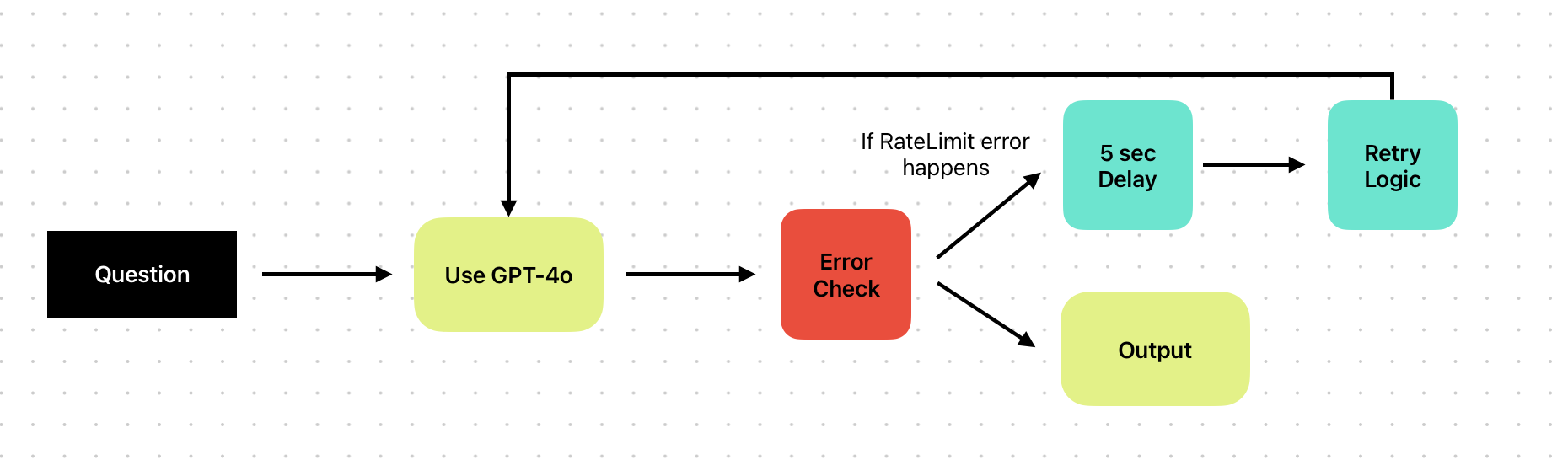
Let's study a production-ready implementation of this wrapper.
Error Handling and Resilience | Vercel Academy
The Vercel Academy article on "Error Handling and Resilience" provides a complete, well-documented TypeScript implementation of a withRetry wrapper function.
Please read the code provided in the solution section, starting from the file path retry-wrapper.ts. As you read, focus on these key implementation details: Error Type Guard (isHttpError): Notice how it checks if an error has a status property to differentiate HTTP errors from other exceptions. Fail-Fast Logic: The first if block inside the catch is critical. It checks for client-side errors (4xx) but explicitly excludes 429. Why? Because a 400 Bad Request will never succeed on a retry, so it's best to fail immediately to save time and resources. Exponential Backoff Calculation: let delayMs = initialDelayMs * Math.pow(2, attempt - 1);. This is the core backoff formula in action. Rate Limit Handling: The code specifically checks for error.status === 429 and looks for a retry-after header. If present, it overrides the calculated backoff with the delay requested by the service. This is a crucial sign of a well-behaved client application. Logging: Observe how structured logs are generated at each key decision point. This is invaluable for debugging in a production environment.
This withRetry function is a powerful, reusable utility that you can apply to any fallible, promise-based operation in your application, not just LLM calls.
Integrating the Retry Wrapper with Vercel AI SDK
Now, let's put our withRetry wrapper to use. We will integrate it into the respondToMessage function we've been working on, wrapping the generateText call from the Vercel AI SDK.
This creates a robust "inner loop" of resilience. Before the application considers the LLM call a total failure, our wrapper will automatically handle several retries with intelligent backoff.
Error Handling and Resilience | Vercel Academy
This part of the article shows how to apply the withRetry function to an LLM call.
Now, study the respond-to-message.ts file provided in the same solution. Focus specifically on the for (const model of models) loop and find the call to withRetry. Notice how the entire async () => { ... } block containing the generateText call is passed as the first argument to withRetry. The options object with maxRetries and initialDelayMs is passed as the second. This elegantly decorates the AI call with our retry logic without cluttering the core business logic.
As you can see, the integration is clean and declarative. The logic for retrying network failures is now neatly encapsulated, while the surrounding code can focus on higher-level concerns, such as trying a different model if the primary one fails completely (a concept we'll explore in the next lesson).
Beyond LLM Calls: Retrying Tool Calls
The need for resilience doesn't stop at LLM calls. The tools your agents use are often wrappers around other external APIs, which are subject to the same transient failures. The retry pattern is equally applicable here.
Frameworks like LangChain, which work alongside the Vercel AI SDK, provide built-in middleware for this exact purpose, reinforcing the importance of this pattern.
Production-Ready Agents: Automatic Tool Retries with Exponential Backoff
This video from LangChain, "Production-Ready Agents: Automatic Tool Retries," demonstrates how to apply the same retry principles to agent tool calls.
Watch from the beginning to the introduction to understand the problem of flaky tools. Then, review the configuration options from the middleware setup, where you'll see familiar parameters like maxRetries, backoffFactor, initialDelay, maxDelay, and jitter. Finally, watch the code example from the sandbox to see it in action.
This demonstrates that retry logic is a fundamental pattern for building reliable agentic systems, applicable to any external dependency. The withRetry wrapper you've just studied can, and should, be used to protect your tool implementations as well.
Conclusion
In this lesson, you've taken a massive step toward making your agentic infrastructure production-ready. You have moved beyond simply making API calls and started to engineer a system that anticipates and gracefully handles the inevitable failures of a distributed environment.
Key Takeaways:
- Transient failures are a fact of life in systems that rely on network communication.
- Simple, immediate retries are counter-productive and can lead to "thundering herd" problems that worsen outages.
- The professional standard for handling transient errors is exponential backoff with jitter, which gives services time to recover while preventing synchronized retry storms.
- A custom
withRetrywrapper provides fine-grained control and observability, allowing you to handle specific error codes (like429), respectRetry-Afterheaders, and log crucial debugging information. - This resilience pattern is not limited to LLM calls; it's a fundamental technique that should be applied to all external dependencies, including tool APIs.
You have now built the first layer of defense against failure. But what happens when an operation fails even after all retries are exhausted? In our next lesson, we will build the second layer: designing fallback strategies. You'll learn how to make your system degrade gracefully by switching to a backup model or using a simpler tool when the primary option is unavailable.