Recommended resources
The freely available resources this lesson will direct you to.
- Why does complex number multiplication cause rotation?www.youtube.com
- Multiplying complex numbers graphically example: -1-i | Precalculus | Khan Academywww.youtube.com
- 2.7: Polar Form of Complex Numbers - Mathematics LibreTextsmath.libretexts.org
- An Introduction to Complex Numbers | NRICHnrich.maths.org
Hello! Last lesson, you wrote nonzero complex numbers in modulus–argument form: a distance from the origin and a direction. Today, those two pieces of information will tell you what multiplication and division do on an Argand diagram. This is useful when an exam question asks for an image point or an unknown multiplier without explicitly suggesting polar form.
Multiplication moves a point in two ways
Start with a fixed complex number . Multiplying another number by changes both its distance from the origin and its direction. Watch this graphical example first:
Multiplying complex numbers graphically example: -1-i | Precalculus | Khan Academy
“Multiplying complex numbers graphically example: -1-i” from Khan Academy shows how a multiplier determines a rotation and a scale factor.
Watch the rotation, then the scaling. The video describes the argument of -1-i as 225^\circ. Under our principal-argument convention it is -135^\circ: those are two descriptions of the same rotation.
To establish the rule, write the two nonzero numbers in the form from last lesson:
The trigonometric addition identities give
Consequently,
There are two simultaneous geometric effects. The distance of from the origin is multiplied by , and its direction changes by , an argument of . A positive means an anticlockwise rotation; a negative means a clockwise rotation. If , the point moves farther from the origin; if , it moves closer. Dilation always has a positive scale factor—a negative real multiplier achieves its half-turn through its angle, not through a negative scale factor.
For the algebra behind this interpretation, read the product rule and its short derivation:
2.7: Polar Form of Complex Numbers - Mathematics LibreTexts
Mathematics LibreTexts derives the polar product rule from the sine and cosine addition identities. Read it to connect the diagram to an algebraic justification.
In “2.7: Polar Form of Complex Numbers”, find the subsection “Products, Powers and Quotients Complex Numbers in Polar Form”, immediately after the four numbered conversions. Read the stated rules, focusing on the product and quotient lines. Then follow the product proof, noting where its real and imaginary parts become cosine and sine of the sum. Stop before the paragraph beginning “Moving right along”; its proof about powers belongs to the next lesson.
This picture summarises the effect. Its multiplier is labelled ; for this lesson, read that as .
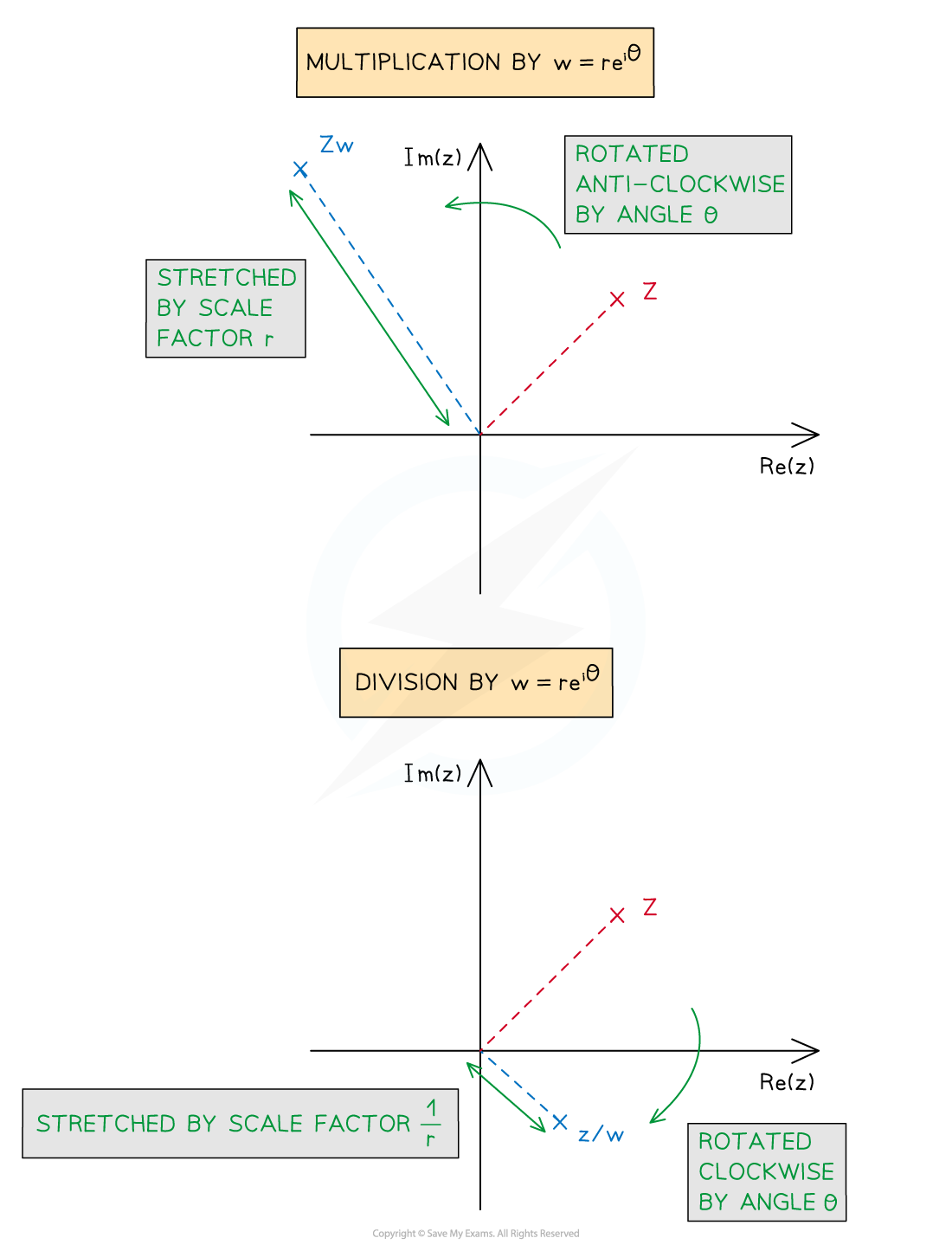
The order in which you imagine the rotation and dilation does not affect the result: both are centred at the origin. The formulas tell you the final distance and direction directly.
Division reverses the transformation
Division by must undo multiplication by . If multiplying by scales distances by and rotates through , dividing by it scales distances by and rotates through . Thus, for nonzero ,
You can justify this without memorising a separate geometric rule. Let , so . The product rule requires , hence . It also requires the angle of , followed by the angle of , to give the direction of . An angle for is therefore .
Be careful with the words clockwise and shrink. They describe division only when and , respectively. Dividing by a multiplier with a negative argument rotates anticlockwise; dividing by one with modulus less than one enlarges distances.
For example, let
Then
Here division doubles the distance of from the origin and rotates it anticlockwise through . That is the opposite of the shrink-and-clockwise example in the lower diagram, but it follows exactly the same rule.
Angles may cross the principal-argument boundary
The angle or gives the correct direction, but it need not be the principal argument. As in the previous lesson, angles differing by a full revolution describe the same point.
Suppose
Multiplication gives
The first angle records the total turn accurately. The second is the principal argument, because lies in . In contrast, division gives
this time the angle difference already lies in the principal interval.
So avoid writing without qualification. Arguments add or subtract up to a full revolution; principal arguments must then be adjusted into . At the negative real axis, that interval chooses , not .
There are two boundary cases worth keeping distinct. Multiplying by any still gives , and dividing by nonzero still gives ; neither result has an argument. Division by is undefined.
When the multiplier is hidden
In an unfamiliar question, you may be told where a point starts and ends rather than being given the multiplier. Suppose multiplication by a fixed complex number takes to . What geometric action occurred?
The starting distance is ; the final distance is . The scale factor is therefore . On an Argand diagram, a quarter-turn anticlockwise takes the direction of to the direction of . Scaling by then gives . The multiplier should have modulus and argument , namely .
Cartesian arithmetic verifies the deduction:
If the rotation is not obvious from a sketch, you can recover the multiplier by division. Calling it ,
This suggests a useful exam strategy: compare distances and directions first when a diagram makes the transformation clear; use the quotient to confirm it or to determine a less familiar angle. For a nonzero starting point, the quotient also shows that the multiplier is unique.
Key takeaways
Multiplying by dilates distances from the origin by and rotates through . Dividing by nonzero dilates by and rotates through . Neither operation translates the origin, and any calculated angle must be adjusted if a principal argument is requested.
The next lesson uses repeated multiplication—and therefore repeated scaling and turning—to evaluate integer powers with De Moivre’s theorem.