Recommended resources
The freely available resources this lesson will direct you to.
- Opportunistic Fungi | Aspergillus, Mucormycosis, P jirovecii, Candida & Cryptococcus |STEP1|www.youtube.com
- Candidal Infections: Osmosis Study Videowww.youtube.com
- Global incidence and mortality of severe fungal diseasefungalinfectiontrust.org
- [PDF] WHO fungal priority pathogens list to guide research, development ...iris.who.int
Hello! This course will help you move from a clinical question—why are new antifungal agents needed?—to a defensible comparison of potential drug targets. We begin with the infections that make the question urgent. By the end of this lesson, you should be able to write the opening of your report with accurate burden estimates, a clear account of who develops invasive disease, and an appropriately cautious discussion of drug-resistant Candida auris.
First, define the problem you are counting
“Fungal infection” covers very different conditions. Oral thrush, for example, is not interchangeable with invasive candidiasis, in which Candida enters the bloodstream or deep tissues. Likewise, exposure to airborne Aspergillus spores is common, but invasive aspergillosis is a serious disease concentrated in susceptible patients. Cryptococcal infection may begin in the lungs and become life-threatening when it reaches the central nervous system.
This distinction matters in a postgraduate introduction. A striking mortality estimate has little meaning unless the reader knows which disease, population, and measure of mortality it describes. Crude mortality counts deaths among people with the infection, including deaths influenced by underlying illness. Attributable mortality estimates the deaths caused by the fungal disease itself. Neither should automatically be presented as the fatality rate of patients who receive timely treatment.
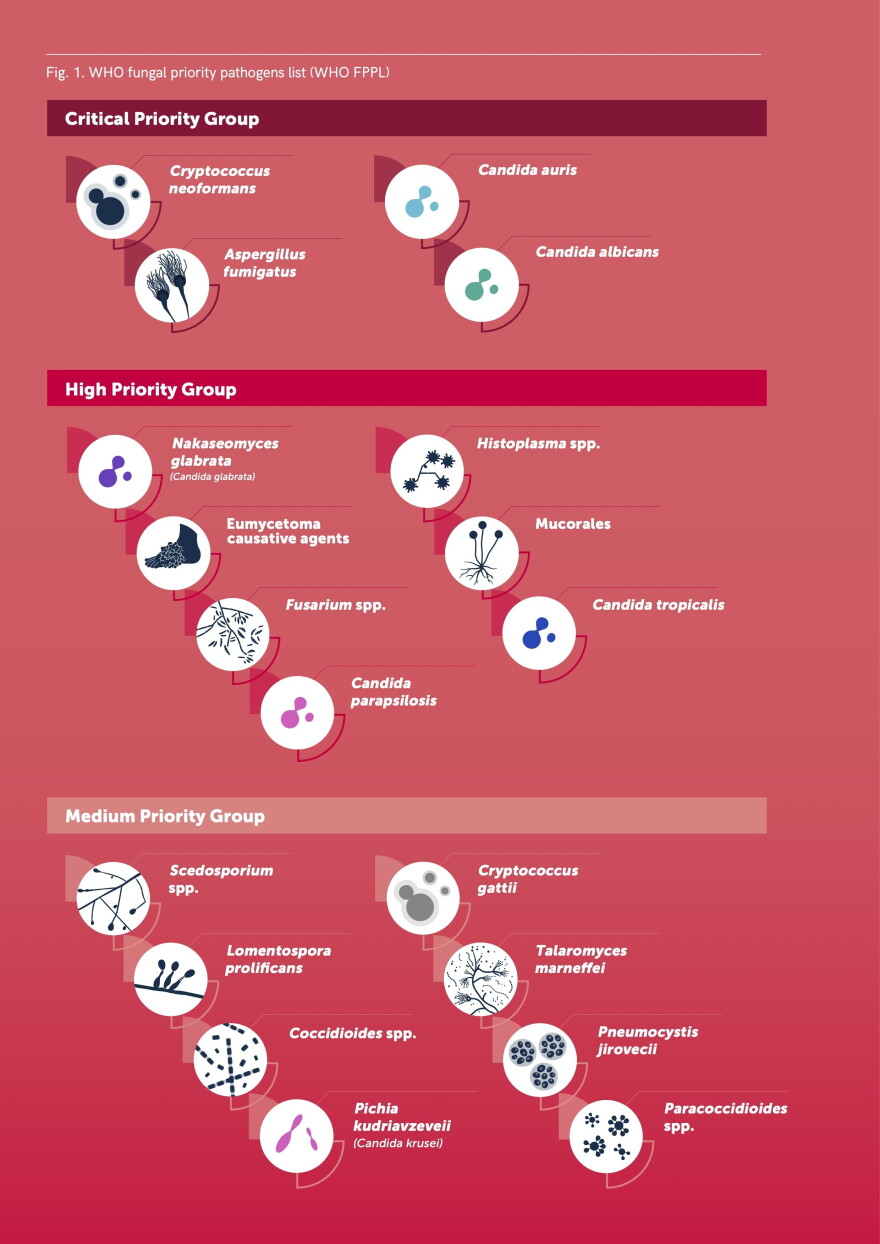
The World Health Organization (WHO) prioritizes fungi using more than case numbers. Its fungal priority pathogens list considers resistance, deaths, treatment options, diagnostic access, and other factors. It places Cryptococcus neoformans, Candida auris, Aspergillus fumigatus, and Candida albicans in its critical priority group. “Critical” therefore signals a combined public-health and research need; it does not mean that the four organisms have equal incidence or the same clinical presentation.
[PDF] WHO fungal priority pathogens list to guide research, development ...
Read the WHO executive summary and ranking criteria to see why these pathogens are priorities—and why priority rank is not simply a league table of case counts.
In the “Executive summary” (p. vii), begin with the discussion of rising invasive fungal disease and diagnostic limitations. Read the burden context. Later in the same summary, read the priority groups. Then go to “7. Final ranking of pathogens” (p. 6): read the ranking criteria, noting the prominent weight given to antifungal resistance.
Three infections, three epidemiological patterns
A useful opening for your report compares the settings in which invasive infections arise, rather than presenting a disconnected list of organisms.
Invasive candidiasis is closely associated with healthcare and critical illness. C. albicans can be part of the normal human microbiota, yet Candida species can cause bloodstream or deep-tissue infection when host defenses are impaired or medical devices provide a route into the body. Bloodstream infection is called candidaemia. Importantly, invasive candidiasis also occurs without a positive blood culture, so candidaemia counts alone understate its estimated burden.
This short video makes the difference between harmless colonization and invasive disease concrete. Use it for the clinical picture, not for global burden estimates.
Candidal Infections: Osmosis Study Video
Watch “Candidal Infections: Osmosis Study Video” from Medscape for a visual explanation of colonization and device-associated invasive infection.
In colonization versus infection, focus on why finding Candida on a body surface does not by itself establish disease. Then watch device-associated spread for the role of a colonized central line and biofilm in bloodstream and distant-organ infection.
Invasive aspergillosis has a different route of exposure. A. fumigatus is an environmental mould whose spores are inhaled. Invasive infection usually involves the lungs and may spread elsewhere. It is important in people with haematological malignancies or transplants, but its at-risk population also includes people with chronic lung disease and critically ill patients. Do not confuse invasive aspergillosis with allergic aspergillosis or chronic pulmonary aspergillosis: they are distinct disease categories.
Cryptococcal meningitis is a particularly consequential form of cryptococcosis. C. neoformans is acquired from the environment through inhalation; infection can then spread to the brain. Advanced HIV disease is a major risk factor, although cases also occur outside that population. Access to prompt diagnosis and effective treatment substantially affects outcomes.
To anchor these descriptions in numbers, read the following parts of a global burden review. The figures are modelled annual estimates, not a count of every laboratory-confirmed case.
Global incidence and mortality of severe fungal disease
Read David W. Denning’s 2024 review in The Lancet Infectious Diseases for estimates you can cite in your report. Pay particular attention to how case definitions, missed diagnoses, and treatment assumptions affect the totals.
Start with the abstract on p. e428: read the overall estimates. In “Results” around p. e431, read the paragraph beginning “Four population groups were used” through the COPD estimate; then find the concluding invasive-aspergillosis paragraph beginning “In summary” and read its interpretation. Around p. e432, read the two paragraphs beginning “The previous estimate of annual incidence” through the Candida estimates. Finally, in the cryptococcal-meningitis discussion immediately before Table 3 (around pp. e433–e434), read the incidence and mortality discussion.
Here are the figures to retain. All three rows describe estimated annual global burden, and the death column is crude, not attributable, mortality.
| Disease | Estimated cases per year | Estimated deaths among those cases per year |
|---|---|---|
| Invasive aspergillosis | Over 2.1 million | About 1.8 million |
| Candida bloodstream infection or other invasive candidiasis | About 1.565 million | About 995,000 |
| Cryptococcal meningitis | About 194,000 | About 147,000 |
Source: Denning (2024). Figures are rounded from the review.
Two qualifications make these numbers more useful, not less. First, the invasive-aspergillosis estimate is much larger than older estimates partly because the review includes substantial, often undiagnosed, disease in people with chronic obstructive pulmonary disease (COPD) and in intensive care. Its very high modelled crude mortality must not be described as the expected outcome for every diagnosed, treated patient. Second, only about 626,000 of the estimated 1.565 million invasive Candida cases are bloodstream infections; the rest are estimated invasive infections without a positive blood culture. That second group is especially uncertain because it is difficult to detect and count.
For cryptococcal meningitis, Denning estimates approximately 152,000 cases associated with AIDS and a further 41,000 cases outside AIDS annually. The AIDS-associated estimate has fallen with wider access to antiretroviral therapy. This is an epidemiological trend specific to cryptococcal meningitis in that population—not evidence that invasive fungal disease has ceased to be a major problem.
Why Candida auris changes the discussion
Candida auris deserves attention even though you should not assign it the entire invasive-candidiasis burden in the table. Those totals cover Candida infections collectively, caused by multiple species. C. auris is especially concerning because it can cause invasive disease in vulnerable hospitalized patients, spread in healthcare settings, produce outbreaks, and be difficult to identify using some conventional methods.
Resistance adds to that concern, but precise language is essential. The WHO reports very high fluconazole-resistance proportions among isolates in the studies it reviewed, while reported resistance to echinocandins was much lower. Susceptibility therefore varies by drug and isolate; calling every C. auris infection “resistant to all antifungals” would be false. Isolates resistant to all major treatment classes have been described, making the possibility of severely limited options clinically important.
The same WHO pathogen profiles help distinguish this resistance-and-transmission problem from those of the other two infections. They also show why A. fumigatus azole resistance matters, while access to treatment remains a major concern for cryptococcal meningitis.
[PDF] WHO fungal priority pathogens list to guide research, development ...
Return to the WHO report, this time to “Annex 2. Brief description of each fungal pathogen.” Read the four relevant profiles selectively so that your report distinguishes species, syndromes, and resistance patterns.
Under “Cryptococcus neoformans” (p. 15), read the “Overview” from environment to host. Under “Candida auris” (p. 16), read the “Overview” from clinical setting and outbreaks; later in that profile, read resistance by drug class. Under “Aspergillus fumigatus” (p. 17), read exposure and risk groups, then the resistance concern. Under “Candida albicans” (p. 18), read colonization and invasion.

Read that figure cautiously. A person colonized with C. auris carries the organism but does not necessarily have invasive disease. Moreover, reported counts depend on whether laboratories can identify it and whether surveillance captures it. The figure supports a statement about its documented international distribution and growing reports; it does not establish a reliable global annual incidence of invasive C. auris infection.
Turning the evidence into a report opening
An effective introduction can accomplish three tasks in two paragraphs: establish the scale of severe fungal disease, distinguish the major clinical settings, and state the treatment problem that motivates investigation of new targets. For example:
Invasive fungal infections impose a substantial, incompletely measured global burden. One modelling review estimated more than 2.1 million annual cases of invasive aspergillosis, approximately 1.565 million cases of invasive candidiasis, and 194,000 cases of cryptococcal meningitis (Denning, 2024). These estimates require careful interpretation: invasive aspergillosis may go undiagnosed in patients with chronic lung disease or critical illness, while many invasive Candida infections lack a positive blood culture.
The pathogens also present distinct treatment challenges. Candida species cause healthcare-associated bloodstream and deep-tissue infection; inhaled Aspergillus can cause invasive pulmonary disease; and Cryptococcus neoformans can cause life-threatening meningitis, particularly in people with advanced HIV disease. The WHO places C. albicans, C. auris, A. fumigatus, and C. neoformans in its critical priority group. Outbreak-prone, frequently fluconazole-resistant C. auris illustrates why new antifungal approaches are sought, alongside better diagnosis and access to existing treatments (WHO, Fungal priority pathogens list).
The wording is deliberately restrained. It does not treat estimates as exact counts, imply that C. auris causes all invasive candidiasis, or claim resistance is the sole reason patients die. Those distinctions will make your later argument for particular drug targets more credible.
Conclusion
The central comparison is between healthcare-associated invasive candidiasis, predominantly pulmonary invasive aspergillosis in susceptible hosts, and cryptococcal meningitis, strongly associated with advanced HIV disease but not confined to it. All carry substantial estimated mortality, yet their routes of exposure, at-risk populations, diagnostic blind spots, and resistance concerns differ. C. auris adds an urgent outbreak and resistance dimension without standing for every Candida infection.
Next, you will use this clinical framing to judge what makes a good antifungal drug target: fungal specificity, importance for survival, ability to be inhibited by a drug, and usefulness across relevant pathogens.