Recommended resources
The freely available resources this lesson will direct you to.
Hello! Welcome back to our study of nodal analysis.
In our last lesson, you learned the complete workflow for nodal analysis: formulating KCL equations, solving the system of equations for the node voltages, and then using those voltages to find any current or voltage in the circuit.
However, as I hinted at, there's a common scenario where our current method hits a snag. Today, we address that head-on. The learning outcome for this lesson is to: Handle voltage sources in nodal analysis using the supernode technique and explain the reasoning behind it.
This technique is a clever and essential extension of nodal analysis. It’s not more difficult, just a different way of applying the same fundamental laws.
1. The Challenge: A "Floating" Voltage Source
So far, we've only seen voltage sources connected to our reference node (ground). This is convenient because it directly sets the voltage of another node.
But what happens if an ideal voltage source is placed between two non-reference nodes, like the 22V source in the circuit below?
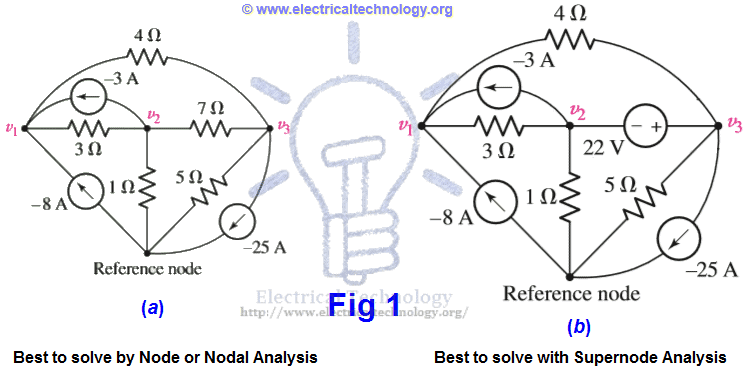
Consider node v2 in Figure (b). To write the KCL equation, we need to sum the currents leaving the node. We can write expressions for the currents through the resistors connected to v2, but what is the expression for the current flowing from v2 to v3 through the 22V source?
We can't use Ohm's law because an ideal voltage source has zero internal resistance. The current is determined by the rest of the circuit, not by the source itself. We have an unknown current without a direct way to express it in terms of the node voltages. This introduces an extra unknown, complicating our system.
2. The Solution: Encapsulating the Problem
The core idea of the supernode technique is elegant: If a component is causing a problem, draw a boundary around it and the two nodes it connects, and treat that entire region as a single "super" node.
The physical justification for this comes directly from the law of conservation of charge.
Circuit Analysis with the Node Method
These lecture notes from MIT provide a concise and physically-grounded explanation for why the supernode concept works. It frames KCL as a law that applies to any enclosed region, not just a single point.
Please read the section titled 'Supernode' on page 3. Focus on the idea that Kirchhoff's current law can be applied to a 'subcircuit' boundary. The current flowing into any enclosed region must equal the current flowing out.
As the notes explain, because charge cannot accumulate inside the boundary, the total current entering the supernode must equal the total current leaving it. The problematic current through the voltage source is now internal to the supernode, so we don't need to include it in our KCL equation at all.
3. The Supernode Method: A Two-Part Recipe
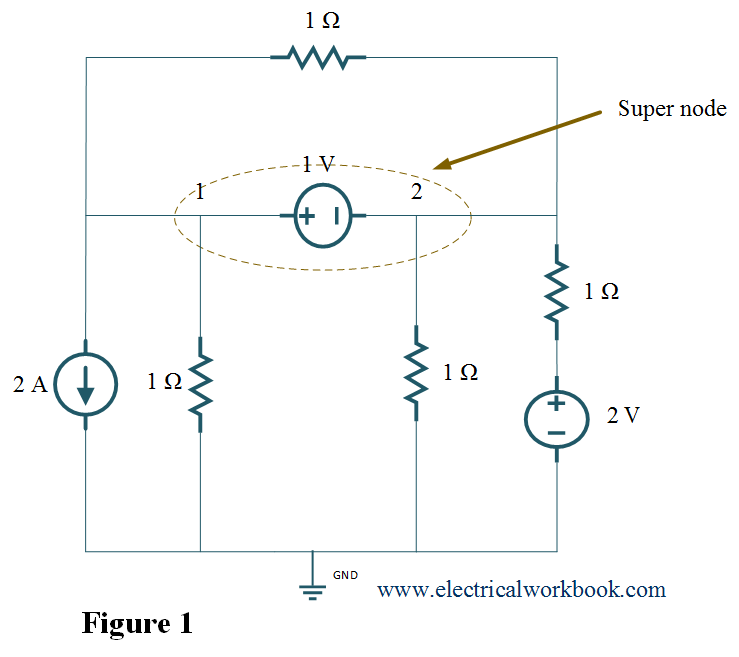
When we create a supernode, we are still trying to solve for two unknown node voltages (e.g., and in the image above). Therefore, we need to generate two independent equations.
-
The KCL Equation: Write a single KCL equation for the supernode boundary. Sum all currents entering or leaving the boundary from external components. Ignore any components inside the boundary. This gives you one equation relating and .
-
The Constraint Equation: The voltage source itself provides the second equation. It creates a fixed relationship, or a "constraint," between the voltages of the two nodes it connects. For the circuit above, if the positive terminal of the 1V source is at node and the negative terminal at node , the constraint is simply:
With these two equations, we have a complete system that we can solve using the algebraic methods from our previous lesson.
4. A Step-by-Step Walkthrough
Let's watch a video that puts this all together. It demonstrates precisely how to identify a supernode and apply this two-equation recipe to solve a circuit.
Supernode Analysis Explained for Circuits
This video from Engineer4Free provides a very clear and practical demonstration of supernode analysis.
Watch the video from the beginning to 6:18. Pay close attention to these key steps: Why a supernode is needed (0:00 - 2:01): The presenter first shows a standard nodal analysis problem and then modifies it to create a situation requiring a supernode. Forming the KCL equation (2:01 - 2:55): Notice how the KCL equation is written for the entire dashed-line boundary, summing the four external currents. Forming the constraint equation (2:55 - 3:40): He derives the second, simpler equation directly from the voltage source within the supernode. Solving the system (3:40 - 6:18): The rest of the video is the algebra of solving the two equations for the two unknown node voltages.
This process gives us a robust algorithm:
- Identify nodes and a reference.
- If a voltage source floats between two non-reference nodes, enclose them in a supernode.
- Write the KCL equation for the supernode boundary.
- Write the voltage constraint equation for the source inside the supernode.
- Solve the resulting system of equations.
5. An Alternative Perspective: Direct Substitution
Given your interest in abstract and efficient methods, there's another way to think about this that might appeal to you. This approach is less about a formal "supernode" and more about leveraging the constraint from the beginning.
The core insight is that a floating voltage source makes one node voltage dependent on another. If we know and there's a 5V source between and (with the positive terminal at ), then we immediately know that .
Instead of treating as a separate unknown, we can simply label it as on our circuit diagram from the start. This automatically reduces the number of variables in the system by one. Now you can proceed with writing standard KCL equations for each node, and you'll find that the system is already simplified.
This is conceptually equivalent to the supernode method, but it can feel more direct and is often how experienced engineers think about such circuits.
The following video from Neso Academy implicitly demonstrates this by first showing how individual KCL equations are linked, and then formalizing the constraint.
This video provides a slightly more formal derivation that clearly shows how the constraint equation arises and is used.
Watch the segment from 9:31 to 10:55. The presenter has already derived the main KCL equation (what we called the supernode equation). Here, he explains the need for a second equation and derives it directly from the voltage source that was 'neglected' to form the supernode. This is a perfect illustration of the 'constraint equation'.
6. Practice Problem
Time to apply the technique. For the circuit below, use the supernode method to find the node voltages and . Then, find the current flowing through the 6Ω resistor.
Practice circuit with a floating 2V source.
- Identify the supernode.
- Write the KCL equation for the supernode boundary.
- Write the voltage constraint equation provided by the 2V source.
- Solve the system for and .
- Calculate the current through the 6Ω resistor.
Click here to see the step-by-step solution
1. Identify the Supernode
The 2V voltage source is floating between non-reference nodes and . We will enclose , , and the 2V source in a supernode.
2. Formulate the Supernode KCL Equation
We sum the currents leaving the supernode boundary. There are four branches leaving the boundary: through the 2Ω, 4Ω, 6Ω, and 8Ω resistors. The 7A source is entering the boundary.
Sum of currents leaving = Sum of currents entering
To simplify, let's find a common denominator, which is 24.
3. Formulate the Constraint Equation
The 2V source connects and . The positive terminal is at and the negative terminal is at .
Therefore:
4. Solve the System
We have a simple system to solve. We can use substitution. Substitute Equation 2 into Equation 1:
Now find using Equation 2:
5. Calculate the Current
The current is the current flowing down through the 6Ω resistor. We can find this with Ohm's Law:
Conclusion
Today you've added a crucial technique to your circuit analysis toolkit. You now understand not just how, but why the supernode method works.
Key Takeaways:
- A "floating" ideal voltage source between two non-reference nodes creates a problem for standard nodal analysis because the current through it is unknown.
- The supernode technique solves this by enclosing the source and its two nodes, creating a larger boundary to which KCL (conservation of charge) is applied.
- Solving a supernode problem requires two equations: a KCL equation for the supernode boundary and a voltage constraint equation from the source itself.
Preview of the Next Lesson:
We have now thoroughly explored nodal analysis, which is based on node voltages and KCL. But what if we approached circuit analysis from a different perspective? In the next lesson, we will begin exploring Mesh Analysis. This is an equally powerful, alternative systematic method that focuses on "mesh currents" flowing in loops and is based on Kirchhoff's Voltage Law (KVL). You will learn to see circuits in a whole new way.