Recommended resources
The freely available resources this lesson will direct you to.
Hello! Welcome to the first lesson of our new module, "Advanced Spanish Tax and Ownership Structures."
In the previous module, we built a Python model to calculate the taxes incurred during a property sale—specifically, the IRPF Capital Gains tax and plusvalía municipal. Those are transactional taxes. Now, we shift our focus to the ongoing costs of holding a real estate portfolio.
This lesson addresses the learning outcome: Calculate wealth tax (Impuesto sobre el Patrimonio) liability for real estate holdings in Spain.
The Spanish Wealth Tax is a unique and often misunderstood tax that applies to the net value of your assets, not your income. Understanding its mechanics is crucial for accurately projecting long-term investment returns. We will break down the calculation process step-by-step, paying close attention to the specific rules for real estate and the significant variations across Spain's autonomous communities.
1. Understanding the Spanish Wealth Tax
The Wealth Tax (Impuesto sobre el Patrimonio, or IP) is a direct tax levied on the net worth of individuals.
To start, let's get a clear, structured overview of what this tax is, who it applies to, and how it works.
Watch this video from UPF Barcelona School of Management for a foundational explanation of the Wealth Tax. It covers the core concepts, including the taxpayers, the valuation date, and the basic principle of calculating net worth.
Watch the video from the beginning until timestamp 03:44. Focus on these key points: Who is subject to the tax (individuals, not companies). The difference between residents (taxed on worldwide assets) and non-residents (taxed on Spanish assets). The specific date of tax accrual: December 31st of each year. The definition of net worth: all economic assets and rights minus debts.
As the video explains, the two key principles are:
- It is an individual tax: It is calculated per person. For a jointly owned property, each owner is responsible for their share.
- It is a snapshot on December 31st: Your liability is based on your net worth on the last day of the year.
This tax is fully devolved to the Autonomous Communities, which means the rules, exemptions, and rates can vary dramatically from one region to another. This is a critical point we will return to.
2. The Wealth Tax Calculation Framework
The calculation follows a clear, multi-step process. The diagram below provides an excellent roadmap for the entire calculation. We will follow these phases.
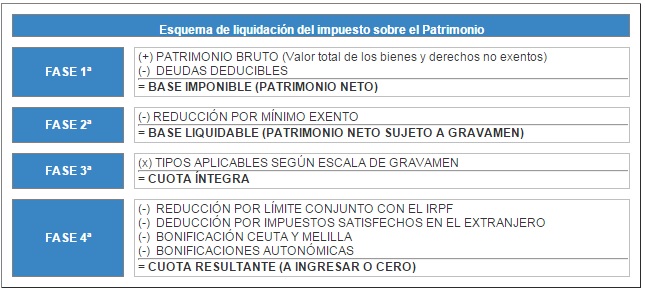
Let's break down each phase.
3. Phase 1: Determining Net Wealth (Base Imponible)
Your Net Wealth is the value of your assets (Patrimonio Bruto) minus your deductible debts.
Net Wealth = Gross Wealth - Deductible Debts
Step 3.1: Valuing Your Assets (Patrimonio Bruto)
You must sum the value of all your assets, including real estate, bank accounts, stocks, cars, etc. For real estate investments, the valuation rule is very specific.
The Spanish Tax Agency (Agencia Tributaria) provides clear rules for valuing real estate. Please read this short official guide.
Read the section 'Regla general de valoración'. This explains the three key values to consider. We will use this rule in our examples.
As the guide states, the value of a property for wealth tax purposes is the highest of the following three:
- Valor Catastral: The cadastral value, which you can find on your IBI (property tax) receipt.
- Valor de Adquisición: Your purchase price, including all associated taxes and costs (e.g., ITP/IVA, notary, registry fees).
- Valor Determinado o Comprobado: Any value determined by the tax administration for other taxes. This notably includes the new
valor de referenciafor properties acquired since January 1, 2022.
Step 3.2: Subtracting Deductible Debts
From your Gross Wealth, you can subtract your outstanding debts. For real estate investors, the most significant deductible debt is the principal amount of any outstanding mortgage on your properties.
Manual práctico de Patrimonio 2024.
Now, let's look at the official rules for deductible debts from the Spanish Tax Agency's 2024 practical manual for Wealth Tax.
Navigate to 'Capítulo 3. Determinación de la base imponible (patrimonio neto)' and read the subsection titled 'Deudas deducibles' (pages 54-55 in the PDF). Focus on what constitutes a deductible debt and, importantly, what is not deductible (e.g., interest on loans, debts associated with exempt assets).
Key points on debts:
- You deduct the outstanding principal of the loan as of December 31st.
- Interest is not deductible.
- If a property is exempt (like the primary residence, discussed next), the mortgage associated with the exempt portion of that property is not deductible.
4. Phases 2, 3, & 4: Applying Exemptions, Rates, and Bonifications
Once you have your Net Wealth, the next steps involve applying exemptions and tax rates to find the final amount due.
Step 4.1: Key Exemptions and the Minimum Exempt Amount
Before applying the tax rates, several important deductions apply.
- Primary Residence (
Vivienda Habitual): Your primary home is exempt up to a value of €300,000. If your home is worth more, the excess is included in your gross wealth. - Minimum Exempt Amount (
Mínimo Exento): A general reduction is applied to your Net Wealth. The standard state-level minimum is €700,000.
However, both the minimum exempt amount and the tax rates are ceded to the Autonomous Communities. This leads to massive differences. For example:
- Aragón: €700,000
- Cataluña: €500,000
- Comunitat Valenciana: €500,000
- Illes Balears: €3,000,000
(Source: Manual práctico de Patrimonio 2024, pages 57-60)
Step 4.2: Tax Rates and Regional Bonifications
The tax is calculated using a progressive scale on the remaining taxable base (Base Liquidable). Here is the standard state-level scale.

The most significant regional variation is the bonification (bonificación), which is a percentage reduction of the final tax bill. The communities of Madrid and Andalusia have a 100% bonification, meaning residents there effectively pay no wealth tax.
This created a political and fiscal debate, leading the central government to introduce the temporary Solidarity Wealth Tax (Impuesto Temporal de Solidaridad de las Grandes Fortunas). This is a parallel national tax that applies only to net worths exceeding €3 million, effectively overriding the 100% regional bonifications for very high-net-worth individuals.
This next video explains these regional complexities using Andalusia as a case study.
Wealth Tax in Spain Explained by Expert Lawyer | Property & Investors Guide 🇪🇸
Watch this clip from Hi Homes to understand the crucial role of regional variations, bonifications, and the new Solidarity Tax. This is where the theory meets real-world application.
Watch from 00:16-04:02 and then from 08:35-09:33. Pay close attention to: How the tax varies by 'autonomía'. The interplay between the old €700,000 exemption, the regional 100% bonification, and the new national Solidarity Tax threshold of €3 million. The explanation of the progressive tax scale.
5. Calculation Example
Let's put it all together. Imagine an investor, resident in Valencia, with the following portfolio on Dec 31, 2024:
- Assets:
- Primary Residence: Valued at €400,000 (highest of the 3 criteria).
- Rental Property 1: Valued at €350,000.
- Rental Property 2: Valued at €500,000.
- Stocks & Bank Accounts: €150,000.
- Debts:
- Mortgage on Primary Residence: €100,000 outstanding principal.
- Mortgage on Rental Property 1: €150,000 outstanding principal.
- Mortgage on Rental Property 2: €200,000 outstanding principal.
Calculation Steps:
-
Calculate Taxable Gross Wealth:
- Primary Residence: €400,000 value - €300,000 exemption = €100,000
- Rental Property 1: €350,000
- Rental Property 2: €500,000
- Stocks & Bank Accounts: €150,000
- Total Gross Wealth = €1,100,000
-
Calculate Deductible Debts:
- Mortgage on Primary Residence: The property is 75% exempt (€300k/€400k). So, 75% of the mortgage is not deductible.
- Deductible portion = €100,000 * (1 - 0.75) = €25,000
- Mortgage on Rental Property 1: €150,000
- Mortgage on Rental Property 2: €200,000
- Total Deductible Debt = €375,000
- Mortgage on Primary Residence: The property is 75% exempt (€300k/€400k). So, 75% of the mortgage is not deductible.
-
Calculate Net Wealth (
Base Imponible):- €1,100,000 (Gross Wealth) - €375,000 (Deductible Debt) = €725,000
-
Calculate Taxable Base (
Base Liquidable):- The investor is in Valencia, where the minimum exemption is €500,000.
- €725,000 (Net Wealth) - €500,000 (Minimum Exemption) = €225,000
-
Calculate Tax Liability (
Cuota Íntegra):- We apply the Valencian tax scale to €225,000.
- According to the scale in the Manual Práctico de Patrimonio 2024:
- First €167,129.45 at 0.25% = €417.82
- Remaining amount: €225,000 - €167,129.45 = €57,870.55
- Tax on remainder at 0.37% = €214.12
- Total Tax = €417.82 + €214.12 = €631.94
Test your understanding!
What would the tax liability be for the same investor if they were a resident of Madrid?
Show answer
The tax liability would be €0. Although the calculated tax (Cuota Íntegra) would be the same (€631.94, since Madrid uses the state scale and has a €700k exemption resulting in a small tax), Madrid applies a 100% bonification. This reduces the final bill to zero. The investor's net worth is also well below the €3 million threshold for the Solidarity Tax.
Conclusion
You now have a comprehensive understanding of how to calculate the Spanish Wealth Tax for real estate holdings. This process is highly rules-based, making it a perfect candidate for the kind of modeling you're skilled at.
Key Takeaways:
- Wealth Tax is an annual tax on your net worth as of December 31st.
- Real estate valuation follows the "highest of three" rule: cadastral, acquisition, or assessed value.
- Mortgage principals are the primary deductible debt for property investors.
- The tax liability is extremely sensitive to your Autonomous Community due to variations in minimum exemptions, tax rates, and bonifications.
- For very high net worths (over €3M), a national Solidarity Tax can override regional 100% bonifications.
Preview of the Next Lesson:
In our next session, we will tackle the learning outcome: Model the combined annual tax impact of IRPF and wealth tax on investment returns. We will take the calculation logic we learned today and integrate it with our existing IRPF rental income models. This will allow us to build a more complete picture of the annual tax drag on a buy-and-hold investment portfolio in Spain.