Recommended resources
The freely available resources this lesson will direct you to.
- Adapting to the Tropical Rainforest | AQA GCSE Geography | Tropical Rainforests 2www.youtube.com
- Rainforest Plant Adaptations | Learning Made Funwww.youtube.com
- Plant adaptations in tropical rainforests for GCSE Geography – Cognitocognito.org
- Conditions and vegetation adaptations - Tropical rainforest regions of the world - 4th level Geography Revision - BBC Bitesizewww.bbc.co.uk
Hello! This part of your revision moves from rainforest environments to global population patterns. Today the focus is flora—plant life—in the Amazon rainforest. You will learn to explain not just what a plant adaptation looks like, but which environmental challenge it helps the plant overcome. That link is what turns a named feature into a strong geography answer.
Why do rainforest plants need adaptations?
The Amazon rainforest is hot and wet, but that does not mean every plant has easy access to what it needs. A dense canopy intercepts much of the sunlight, so plants below it compete for light. Frequent heavy rain leaves surfaces wet and washes some nutrients out of the soil. Meanwhile, the tallest trees need support even though many of their nutrient-absorbing roots are close to the soil surface.
An adaptation is a feature that helps an organism survive in its environment. As you study each example, keep the same question in mind: What problem does this feature solve?
Read BBC Bitesize’s “Conditions and vegetation adaptations” for a compact overview of the rainforest conditions and the plant features that respond to them.
On the “Conditions and vegetation adaptations” page, begin with the paragraph starting “Plants in tropical rainforests have adapted” and read the adaptation overview through the final “Drip tips” paragraph, just before “1 of 5”. Pay particular attention to the named subsections “Buttress roots”, “Epiphytes”, “Lianas”, and “Drip tips”. The “Carnivorous plants” subsection is a general tropical-rainforest example; you do not need it for the Amazon examples in this lesson.
Notice the apparent puzzle in the reading: a rainforest contains abundant vegetation, yet its soil can be poor in nutrients. Nutrients are released when fallen leaves and other material decompose, but heavy rainfall can carry nutrients away. Plants often take them up quickly near the surface rather than relying on a deep, nutrient-rich layer of soil.
Heavy rain: drip tips and waxy leaves
Look closely at the leaf below. Its long, pointed end is a drip tip, and the surface is waxy. Both features help rainwater drain off the leaf rather than remain on it.
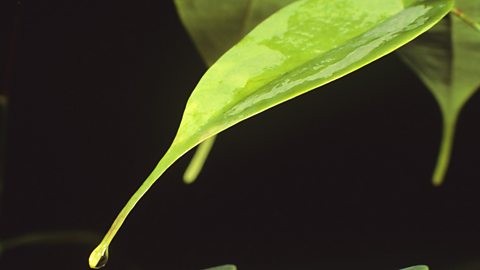
Why does drainage matter when rain supplies water to the plant? Water sitting on a leaf for a long time can encourage fungal growth or decay. Growth on the leaf surface may also obstruct the light the leaf needs for photosynthesis. The useful explanation is therefore more than “the leaf stays dry”: heavy rainfall is the challenge; rapid drainage reduces prolonged wetness and helps keep the leaf healthy.
Some plants growing in shade also have broad leaves that capture more of the limited light reaching them. Do not assume that every rainforest leaf is large. The point is to match a particular feature to the conditions where that plant grows.
Watch the short video extract below to see these features alongside the other adaptations in this lesson.
Adapting to the Tropical Rainforest | AQA GCSE Geography | Tropical Rainforests 2
Watch “Adapting to the Tropical Rainforest” from tutor2u to connect leaf features, roots, and climbing plants to the conditions they face.
In leaf features, look for the glossy surface and drip tip that shed water. In buttress roots, focus on how the raised roots support a tall tree. In reaching light, distinguish lianas climbing from the ground from epiphytes growing on branches.
Shallow roots and tall trees: buttress roots
A tall tree faces a structural problem. Its trunk and branches rise high above the ground, but much of the useful nutrient supply is near the soil surface. Many rainforest trees therefore have shallow, spreading root systems. How can a very tall tree remain stable?
Buttress roots are large, flared roots extending out from the base of a trunk. They brace the tree and help support its great height. Their spread also places roots across a wider area of the nutrient-containing surface layer. This does not mean that all rainforest trees have identical roots, or that roots can never grow deeper; it explains why broad support near the surface is useful.
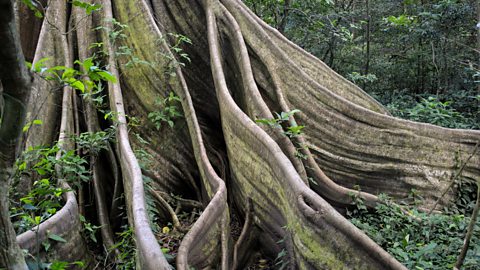
In the photograph, follow one of the raised ridges from the trunk outward. Its width is the important clue: a buttress is not simply a root with a memorable name. Its shape helps steady a large tree. In an answer, connect that shape to tall growth and shallow surface roots, rather than writing only “buttress roots help trees survive”.
Competition for light: lianas and epiphytes
Near the forest floor, the canopy blocks much of the sunlight. Some plants cope by growing upward using other trees for support—but there are two distinct ways to do this.
A liana is a woody climbing plant. It is rooted in the ground and climbs tree trunks to reach brighter light in the canopy. Using an existing tree for support means it does not need to build a thick, self-supporting trunk to reach that height. Its leaves can then receive more sunlight for photosynthesis.
An epiphyte, such as some orchids, grows on a tree’s trunk or branches, often high above the ground. This position gives it access to more light without growing a tall trunk from the forest floor. It takes in water from rain and moisture around it, and obtains nutrients without rooting in the ground—for example, from material caught around its roots. An epiphyte is not a parasite: it uses the tree chiefly as a place to grow, rather than taking food from the tree.
The distinction is worth remembering. A liana starts in the soil and climbs; an epiphyte grows on the tree and is not rooted in the soil. Both gain a better position for light, but they do so differently.
Turning knowledge into an explanation
In a short-answer assessment, naming an adaptation is a start, not a complete explanation. Aim to include three connected parts: the named feature, the rainforest challenge, and how the feature helps.
For example:
Amazon rainforest trees can have buttress roots: wide roots that flare out from the trunk. They help steady a very tall tree even though many roots spread near the soil surface, where nutrients are available.
That answer explains why the roots matter. The same approach works for drip tips, lianas, and epiphytes. Keep the challenge specific: “lots of rain”, “nutrients near the surface”, or “little light below the canopy” tells your reader more than “the harsh environment”.
The key takeaways are that drip tips and waxy leaves shed heavy rain, buttress roots support tall trees with widespread surface roots, and lianas and epiphytes reach brighter positions despite competition for light. In the next lesson, you will shift from the Amazon to a different geographical pattern: how life expectancy varies around the world.