Recommended resources
The freely available resources this lesson will direct you to.
Introduction
Welcome back! In our previous lesson, we reconstructed Bertrand Russell's Theory of Descriptions, exploring it as a paradigm of philosophical analysis. We saw how Russell distinguished between the surface grammatical form of a sentence and its underlying logical form, allowing him to dissolve several persistent philosophical puzzles. The core of his theory is a method for translating sentences containing definite descriptions—phrases like "the present King of France"—into the precise language of first-order logic.
Today, we shift from theory to practice. Our learning outcome is to apply the Theory of Descriptions to analyze sentences containing definite descriptions. Just as in mathematics where understanding a theorem is one thing and applying it to solve problems is another, today's goal is to build your practical skill in using this powerful analytical tool. We will work through several examples, starting with the basic form and moving on to more complex cases involving negation and multiple descriptions.
Let's briefly recap the central analysis from last time. A sentence with the structure "The F is G" is analyzed as making three claims:
- Existence: There is at least one F.
- Uniqueness: There is at most one F.
- Predication: Whatever is F is also G.
In first-order logic, this translates to:
Now, let's put this into practice.
1. The Method of Analysis
The best way to learn the application is to work through it. The textbook chapter below provides a clear, formal walkthrough of Russell's analysis and how to symbolize sentences using it.
Chapter 28 Definite descriptions
Please read the following section from the 'forall x' logic textbook. It introduces Russell's analysis and shows how to break down a sentence into its logical components.
Read section 28.2, 'Russell’s analysis'. Pay close attention to how the sentence 'The F is G' is broken down into three logical conjuncts, and how this is then formalized in first-order logic.
As you saw in the reading, the process involves identifying the description and the predicate, then constructing the logical formula. Let's walk through an example together.
Sentence: "The author of On Denoting is a pipe smoker."
- Identify "the F": The definite description is "the author of On Denoting". So, the property F is "is an author of On Denoting". Let's represent this as .
- Identify "is G": The main predicate is "is a pipe smoker". The property G is "is a pipe smoker". Let's represent this as .
- Construct the logical parts:
- Existence: There is at least one author of On Denoting.
∃x(A(x)) - Uniqueness: There is at most one author of On Denoting.
... ∧ ∀y(A(y) → y=x) - Predication: That person is a pipe smoker.
... ∧ P(x)
- Existence: There is at least one author of On Denoting.
- Combine them:
This formula asserts that there exists some individual x who wrote On Denoting, is the only individual to do so, and who also smokes a pipe. Notice the original phrase "the author of On Denoting" has been completely analyzed away.
The following video provides a similar walkthrough, which can help solidify the translation process.
Russell's Theory of Definite Descriptions (Philosophy of Language)
This clip from Carneades.org shows the formal representation of 'The present King of France is bald'. It's a great visual reinforcement of the logical structure we just discussed.
Watch from 00:58 to 02:03. Focus on how the natural language sentence is mapped directly onto the symbols of predicate logic, breaking it into the existence, uniqueness, and predication clauses.
Test your understanding!
Let's try a straightforward application. Using the symbolization key below, translate the sentence into first-order logic using Russell's theory.
Symbolization Key:
- Domain: People
K(x):xknows the combination to the safe.V(x):xis a vegetarian.
Sentence: "The person who knows the combination to the safe is a vegetarian."
Show answer
The correct symbolization is:
∃x(K(x)...): There is at least one person who knows the combination....∧ ∀y(K(y) → y=x)...): That person is unique....∧ V(x)): That person is a vegetarian.
2. The Crucial Role of Scope: Negation and Empty Descriptions
As we saw in the last lesson, one of the most powerful features of Russell's theory is how it handles sentences that are negative or contain "empty" descriptions (descriptions that refer to nothing). The key concept here is the scope of the negation.
Consider the famous sentence: "The present King of France is not bald."
The ambiguity of natural language allows for two distinct logical interpretations, which Russell's theory makes precise:
-
Inner Negation (Narrow Scope): The negation applies only to the final predicate. This is also called the primary occurrence of the description.
- Meaning: "There is a unique present King of France, and he is not bald."
- Symbolization:
∃x(Kx ∧ ∀y(Ky → y=x) ∧ ¬Bx) - Truth Value: False, because the existence claim (
∃x(Kx)) is false.
-
Outer Negation (Wide Scope): The negation applies to the entire proposition. This is the secondary occurrence.
- Meaning: "It is not the case that there is a unique, bald, present King of France."
- Symbolization:
¬[∃x(Kx ∧ ∀y(Ky → y=x) ∧ Bx)] - Truth Value: True, because it is the negation of a false statement.
This distinction resolves the puzzle of the Law of Excluded Middle. Given the false proposition "The present King of France is bald," its true negation is the wide-scope reading. The ambiguity was in our language, not in logic.
This concept is clearly explained in the following resource.
Chapter 28 Definite descriptions
Please read this section from the 'forall x' textbook, which explains how Russell's analysis handles empty descriptions and the distinction between inner and outer negation.
Read section 28.3, 'Empty definite descriptions'. Focus on the example of 'I am dating the present king of France' and how the 'inner negation' and 'outer negation' yield different truth conditions.
For someone with your mathematical background, a visual representation of these logical relationships can be very helpful. The following diagram shows how these different sentence forms relate to one another in a classic "square of opposition."
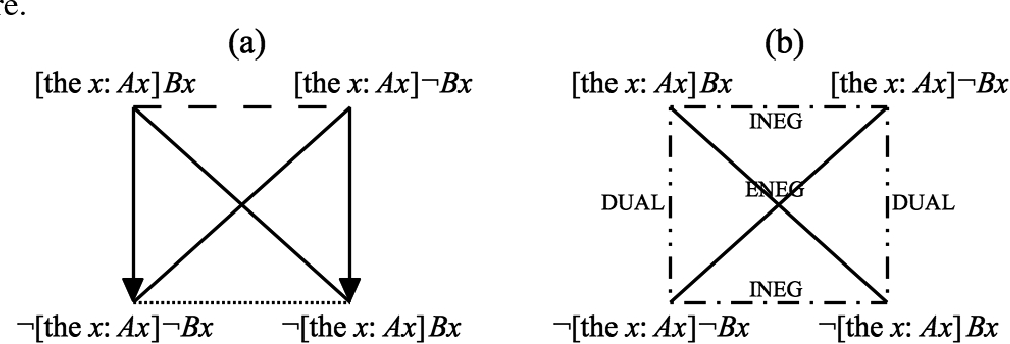
To see a dynamic explanation of this, let's revisit the Hawkins video.
Bertrand Russell: On Denoting Explained
This video segment explains how Russell's theory deals with the 'King of France' puzzle by introducing the distinction between primary and secondary occurrences (what we've been calling inner and outer scope).
Watch from 15:31 to 19:20. Pay attention to how the different placements of the negation sign (¬) in the logical formula correspond to the two different meanings of 'The King of France is not bald'.
Test your understanding!
Consider the true statement: "The round square does not exist."
How does Russell's theory account for the truth of this sentence? Which scope of negation is being used here?
Show answer
The sentence is an example of a negative existential. To make sense of it, we must interpret it as having a wide scope (outer) negation.
Let R(x) be "x is round" and S(x) be "x is a square." The definite description "the round square" corresponds to the predicate R(x) ∧ S(x).
The sentence is not asserting the existence of a round square that also has the property of non-existence. That would be the narrow-scope reading and would be self-contradictory.
Instead, the sentence is asserting the negation of the existence claim itself:
- Meaning: "It is not the case that there is a unique object that is a round square."
- Symbolization:
¬[∃x((R(x) ∧ S(x)) ∧ ∀y((R(y) ∧ S(y)) → y=x))]
This statement is true because its existential claim is false (no such object exists), and the negation of a false existential is true.
3. Applying the Analysis to More Complex Cases
Now that we have the basic form and the handling of negation, let's apply the theory to sentences with other common linguistic structures.
Possessives
Singular possessives like "Smith's murderer" can be paraphrased as definite descriptions: "the person who murdered Smith."
Sentence: "Smith’s murderer is insane."
- Paraphrase: "The person who murdered Smith is insane."
- Symbolization: (Let
M(x,y)be "x murdered y,"sbe Smith, andI(x)be "x is insane.")
Multiple Descriptions
What about sentences with more than one definite description? We analyze them step-by-step.
Sentence: "The traitor is the deputy."
This means: There is a unique traitor, there is a unique deputy, and they are the same person.
- Identify the two descriptions: "the traitor" (
T(x)) and "the deputy" (D(x)). - Construct the analysis: We need to assert the unique existence of both and then state their identity.
This formula says: there exists anxand there exists aysuch thatxis the unique traitor,yis the unique deputy, andxis identical toy.
The lecture slides from Oxford provide another excellent example of this process.
Lecture 8 Identity and Definite Descriptions
These lecture slides demonstrate how to formalize a sentence with multiple descriptions by breaking the task into smaller parts.
Read the slides under the heading '8.4 Uses of identity Multiple descriptions'. Follow the two-step process for analyzing 'The author of Ulysses likes the author of the Odyssey'.
Now it's your turn to apply what you've learned to a few more examples.
Final Practice Problems
Using the symbolization keys provided, translate the following sentences into first-order logic.
Problem 1
- Key: Domain: cards;
D(x): x is a deuce;C(x): x is a club;B(x): x is black. - Sentence: "The deuce of clubs is a black card."
- Hint: The property "is the deuce of clubs" is a conjunction of two predicates.
Show answer
Let the property F be "is a deuce and a club," or D(x) ∧ C(x).
Let the property G be "is a black card," or B(x).
Symbolization:
This says: "There is a unique card that is both a deuce and a club, and that card is black."
Problem 2
- Key: Domain: people;
K(x): x knows the combination;S(x): x is a spy. - Sentence: "The person who knows the combination is not a spy."
- Hint: Natural language context suggests this sentence asserts the existence of a unique secret-knower. Which scope of negation is most appropriate?
Show answer
The most natural reading of this sentence implies that there is someone who knows the combination, and that person is not a spy. This calls for an inner negation (narrow scope).
Symbolization:
This says: "There is a unique person who knows the combination, and that person is not a spy."
The outer negation, ¬∃x(K(x) ∧ ∀y(K(y)→y=x) ∧ S(x)), would mean "It's not the case that there is a unique spy who knows the combination." This is a weaker claim and likely not what is intended.
Conclusion
In this lesson, you have moved from understanding the theory of descriptions to actively applying it. This skill is fundamental to the practice of analytic philosophy, as it allows for the precise clarification of statements that are often ambiguous in natural language.
Key Takeaways:
- Analyzing a sentence of the form "The F is G" involves breaking it down into three logical components: existence, uniqueness, and predication.
- The logical form
∃x (Fx ∧ ∀y(Fy → y=x) ∧ Gx)eliminates the definite description, revealing the sentence's underlying commitments. - Negative sentences involving definite descriptions are ambiguous. The distinction between inner (narrow) scope and outer (wide) scope negation is crucial for resolving this ambiguity and determining the sentence's truth value.
- This method can be extended to analyze more complex structures like possessives and sentences containing multiple descriptions.
Preview of the next lesson:
Having spent significant time with Frege and Russell's formal, logic-driven approach, we will next turn to another founding figure of analytic philosophy who took a very different path: G.E. Moore. In the next lesson, we will describe G.E. Moore's defense of common sense and his critique of idealism. This will provide a fascinating contrast and show that the "analytic" project was never a single, monolithic program.