Recommended resources
The freely available resources this lesson will direct you to.
- Russell's Paradox - A Ripple in the Foundations of Mathematicswww.youtube.com
- The paradox that broke mathematics - Russell's Paradox | Joel David Hamkins and Lex Fridmanwww.youtube.com
- Russell's paradox - Stanford Encyclopedia of Philosophyplato.stanford.edu
- Russell, His Paradoxes, and Cantor's Theorem: Part Ipeople.umass.edu
Introduction
In our last lesson, we explored Gottlob Frege's monumental logicist project: the attempt to prove that arithmetic is nothing but a branch of logic. You'll recall his strategy was to define numbers as specific logical objects—extensions of concepts, which are akin to classes or sets. This crucial step, which was meant to solve the "Julius Caesar Problem," was guaranteed by a fundamental axiom of his system, Basic Law V. Frege believed he had finally placed arithmetic on the unshakeable foundation of pure reason.
Today's lesson addresses the dramatic turning point in this story, a moment that shook the foundations of mathematics. Our learning outcome is to explain Russell's Paradox and its devastating impact on Frege's foundational project.
We will first build an intuition for the paradox using a simple analogy. Then, we will examine its formal structure and its deep connection to Cantor's work in set theory—a connection your mathematics background will help illuminate. Finally, and most importantly, we will trace the precise way this paradox infected and destroyed Frege's system, turning his life's work into what he himself called a failure.
1. An Intuitive Glimpse: The Barber Paradox
Paradoxes of self-reference can be mind-bending. To get a feel for the kind of logical knot we're about to encounter, it's helpful to start with a famous, non-mathematical analogy devised by Bertrand Russell himself.
Russell's Paradox - A Ripple in the Foundations of Mathematics
This video from Up and Atom, titled 'Russell's Paradox - A Ripple in the Foundations of Mathematics', begins with a clear and simple explanation of the Barber Paradox. It serves as a perfect warm-up for the more formal concepts to come.
Please watch the first 1 minute and 33 seconds (00:00 - 01:33). Focus on the structure of the riddle: 'A barber shaves all and only those who do not shave themselves.' Try to articulate for yourself exactly why the question 'Does the barber shave himself?' leads to a contradiction.
The Barber Paradox illustrates how a seemingly straightforward rule can become contradictory when applied to itself. The problem isn't with the people in the town, but with the very existence of such a barber. The definition is self-contradictory. As we'll see, Russell's paradox shows that a similarly self-contradictory set is licensed by what seemed to be a perfectly innocent principle of logic.
2. The Paradox in Set Theory
The issue at the heart of Russell's paradox lies in an assumption that seems completely intuitive: for any property we can clearly state, there must exist a set of all things that have that property. This is known as the Naïve or Unrestricted Comprehension Principle.
For example:
- The property "is a prime number" defines the set of all prime numbers: .
- The property "is a teacup" defines the set of all teacups.
- The property "is not identical to itself" defines the empty set, .
This seems straightforward. But in 1901, Russell considered a peculiar property: the property of a set not being a member of itself.
Most sets we think of have this property.
- The set of all teacups is not itself a teacup.
- The set of all prime numbers is not itself a prime number.
But some sets might be members of themselves. For example, the "set of all things that are not teacups" is not a teacup, so it is a member of itself.
Russell's brilliant move was to ask: what about the set of all sets that are not members of themselves?
Let's call this set . Formally, we define it as:
Now, let's ask the critical question, just as we did for the barber: Is a member of itself?
- Assume . If is a member of itself, it must satisfy the condition for membership in . That condition is . So, if , it must be that . This is a contradiction.
- Assume . If is not a member of itself, then it satisfies the condition for being a member of (the condition is precisely "not being a member of itself"). Therefore, it should be in . So, if , it must be that . This is also a contradiction.
We are forced into the conclusion:
This is a logical impossibility. The Unrestricted Comprehension Principle, which seemed so obvious, allows us to derive a contradiction. This means the principle must be false. The set cannot exist.
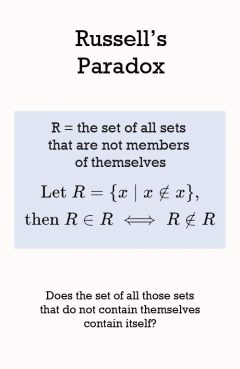
For a more rigorous written account of how the paradox follows from the Unrestricted Comprehension Principle, the following resource is excellent.
Russell's paradox - Stanford Encyclopedia of Philosophy
The Stanford Encyclopedia of Philosophy article on 'Russell's paradox' gives a precise and formal introduction to the problem. This will solidify your understanding of the logical mechanics.
Please read Section 1, 'The Paradox'. It lays out the Naïve Comprehension Principle and walks through the derivation of the contradiction.
3. The Deeper Source: Cantor's Diagonalization
Russell's discovery was not just a clever logical trick. It emerged from his deep engagement with Georg Cantor's revolutionary work on set theory. Specifically, the logic of the paradox is identical to the logic of Cantor's diagonal argument, which proves that a set's power set is always larger than the set itself.
Given your background in mathematics, exploring this connection will be particularly insightful. The argument shows that there cannot be a one-to-one correspondence between the elements of a set and all of its subsets. Russell's paradox can be seen as a special case of this: if a "set of all sets" existed, its subsets would also be its elements, creating the kind of self-referential loop that Cantor's proof shows is impossible.
The paradox that broke mathematics - Russell's Paradox | Joel David Hamkins and Lex Fridman
In this clip, mathematician and philosopher Joel David Hamkins gives an exceptionally clear explanation of this connection to Lex Fridman. He first explains Cantor's theorem and then shows how the very same logic leads directly to Russell's Paradox.
First, watch from 00:27 to 03:20. In this part, Hamkins explains the logic of Cantor's theorem using a diagonal argument. Pay close attention to the construction of the 'diagonal' set D. Then, skip ahead and watch from 07:15 to 08:25. Here, Hamkins applies the exact same reasoning to the 'class of all sets that are not elements of themselves' to derive Russell's Paradox.
As Hamkins demonstrates, the paradox is not just a quirk; it reveals a fundamental structural fact about the hierarchy of sets, a fact uncovered by Cantor's diagonal method.
4. The Collapse of Frege's System
So, an abstract principle of set theory is flawed. Why was this so personally and professionally devastating for Gottlob Frege?
The answer lies in Frege's Basic Law V. As we saw in the last lesson, Frege needed this law to treat the "extensions of concepts" as logical objects, which was the cornerstone of his definition of number. Basic Law V states that two concepts have the same extension if and only if they apply to exactly the same objects.
The catastrophic consequence is that Basic Law V logically implies the Unrestricted Comprehension Principle. It guarantees that for any well-defined concept, a corresponding extension (set) must exist.
Russell's paradox presented a concept that was perfectly well-defined in Frege's system: being an extension of a concept under which it does not itself fall. By Basic Law V, this concept must have an extension. But as we've just seen, that extension is the paradoxical set .
Therefore, Russell had demonstrated that a contradiction could be derived from the axioms of Frege's own system. In logic, a system from which a contradiction can be derived is called inconsistent. An inconsistent system is worthless as a foundation for anything, because from a contradiction (), any proposition whatsoever can be proven. The entire edifice of arithmetic that Frege had so painstakingly constructed on his logical foundation came crashing down.
The story of Russell communicating this to Frege is one of the most famous and poignant moments in intellectual history.
The paradox that broke mathematics - Russell's Paradox | Joel David Hamkins and Lex Fridman
Let's return to the video with Joel David Hamkins, who beautifully recounts the historical context.
Watch from 08:25 to 11:51. This segment describes Frege's project, the moment he received Russell's letter, and the profound impact it had. Note Frege's heartbreakingly graceful response in the appendix to his book.
To see the technical details of how the contradiction is derived specifically within Frege's formal system, the SEP article is again the best resource.
Russell's paradox - Stanford Encyclopedia of Philosophy
The SEP article 'Russell's paradox' provides a section dedicated to how the paradox manifests within Frege's system via Basic Law V.
Please read Section 2.5, 'The Paradox in Frege’s System'. This is a more formal section, but it precisely demonstrates how Basic Law V commits Frege's logic to the existence of the paradoxical class. This is the technical core of the 'devastating impact'.
Test your understanding!
In the previous lesson, we saw that Frege introduced extensions of concepts (via Basic Law V) primarily to solve the 'Julius Caesar Problem'. We now see this led to a contradiction.
Some philosophers (known as neo-logicists) have argued that Frege should have just used Hume's Principle (The number of Fs = the number of Gs if and only if F and G are equinumerous) as his foundation, as it has been proven to be consistent. Why did Frege himself consider Basic Law V, despite its risks, to be a more fundamental and necessary law for his project than Hume's Principle?
Show answer
Frege believed that a proper foundation for arithmetic required an explicit definition of what numbers are. He wanted to show they were logical objects.
Hume's Principle only provides a criterion for identity for numbers. It tells you when #F is the same object as #G, but it doesn't define the object #F itself. It leaves open questions like "Is the number 2 the same object as Julius Caesar?" This was the Julius Caesar Problem.
Basic Law V was Frege's tool for creating the very objects that numbers were supposed to be. It allowed him to move from a concept to a corresponding object (its extension). He could then explicitly define the number 2 as "the extension of the concept 'equinumerous to the concept F', where F has two things falling under it."
For Frege, Hume's Principle was a theorem to be derived from a more fundamental law (Basic Law V) and an explicit definition of number. He could not simply assume it, because doing so would not have secured his philosophical goal of demonstrating precisely what kind of logical objects numbers are. The tragedy is that the very tool he used to guarantee their status as objects was logically flawed.
Conclusion
Today, we've dissected one of the most significant paradoxes in the history of thought. It represents a critical failure, but also a profound discovery that spurred a century of work in logic, set theory, and the philosophy of mathematics.
Key Takeaways:
- Russell's Paradox arises from applying the seemingly intuitive Unrestricted Comprehension Principle to the property "is a set that is not a member of itself." The resulting set, , would be a member of itself if and only if it is not, a logical contradiction.
- This proves that the Unrestricted Comprehension Principle is false and that the set cannot exist.
- The paradox's logical structure is a variant of Cantor's diagonal argument, revealing a deep truth about the nature of collections.
- The paradox was devastating for Frege because his foundational axiom, Basic Law V, logically committed his system to the Unrestricted Comprehension Principle. This made his entire system inconsistent, undermining his life's work of providing a secure logical foundation for arithmetic.
Preview of the next lesson:
The discovery of the paradox did not end the philosophical quest for foundations. On the contrary, it began a new one. In our next lesson, we will examine Bertrand Russell's own attempt to navigate the crisis he had uncovered. We will explore his Theory of Descriptions, a powerful new method of philosophical analysis designed to untangle linguistic confusions and avoid commitment to paradoxical entities. This theory became a paradigm for how much of analytic philosophy would be done in the 20th century.