Recommended resources
The freely available resources this lesson will direct you to.
Hello again. Last lesson selected Oatly as a provisional case brand because it appears possible to investigate a bounded customer-choice question using public sources. That choice was about research feasibility, not a finding that the brand has a particular problem.
This final lesson in the module turns that starting point into a one-page strategic brief. The brief will define the context, the decision to investigate, the boundaries of the case, its constraints, and what success would mean. It is a working agreement with yourself about the question—not a polished answer written before the research.
A strategic brief is a decision frame
A one-page brief is useful precisely because it cannot contain everything. If you have to state the decision in one or two sentences, you quickly discover whether you have a strategic question or merely a topic. “Oatly’s marketing” is a topic. “Which benefit should Oatly prioritize for a defined group choosing among milk alternatives?” is a decision that evidence might help you resolve.
The Brand Brief vs Creative Brief discussion in monday.com’s Brand Brief Template: Free Examples And How To Use Them distinguishes broad brand direction from instructions for a specific campaign or asset. Read the distinction, then its guidance on choosing a lean format.
Brand Brief Template: Free Examples And How To Use Them
This monday.com article helps establish what belongs in a strategic brief—and what can wait for a creative or production brief.
In “Brand brief vs creative brief: key differences,” read the comparison, including “When do brand brief templates work best?” and “When do creative brief templates take priority?” Then, under “Choosing the right template format,” read the lean-format guidance. Focus on the purpose and audience of each document rather than trying to import every suggested field into this one-page case brief.
Your document is a brief for an independent brand-strategy case. It is narrower than a finished brand strategy: you have not yet researched customers, selected a positioning, or secured organizational agreement. It is broader than a creative brief: you are not commissioning an advertisement, writing a tagline, or specifying designs. Its immediate reader might be someone assessing your strategic judgment in a portfolio. That reader should be able to tell what you intend to decide and how you will avoid claiming more than public evidence supports.
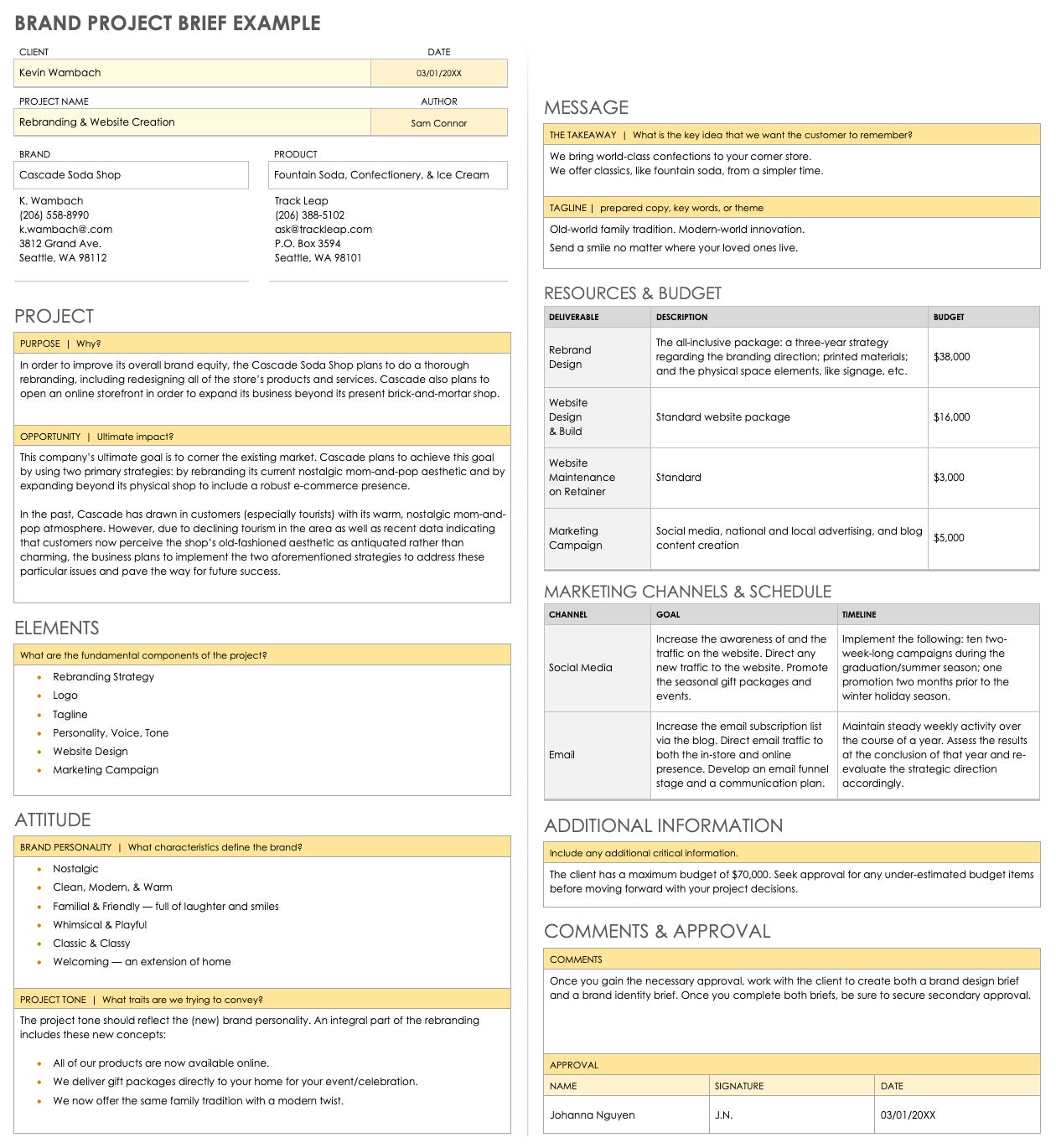
The project-brief example below shows why this distinction matters. Its purpose and opportunity sections help explain why a project exists, but much of the page specifies elements, messaging, channel schedules, budgets, and approval. Those details suit a commissioned rebrand and website project; they would crowd out the unresolved question in your case brief. You can borrow its discipline of making scope and constraints visible without copying its production plan.
Keep the question open without making it vague
A useful brief has enough specificity to guide research, but not so much certainty that research becomes a search for supporting quotes. Julian Cole’s How To Write A Creative Strategy In 1 Hour – Example Eucalyptus shows a fast “strategy on a page” process. Watch how he narrows a broad business to one issue and labels his early thinking as a hypothesis; then examine the finished page and its caveat.
How To Write A Creative Strategy In 1 Hour - Example Eucalyptus
In this Strategy Tips video, Julian Cole demonstrates how a single-page structure can focus an investigation. Use his draft-and-challenge approach, not his proposed consumer insight, as the model for your case brief.
Watch the initial narrowing: note the move from several offerings to one issue and the explicit intent to challenge early hypotheses. Then watch the completed page: identify its business problem, proposed customer obstacle, goal, and qualification. His numerical goal is a rough estimate for that example, not a verified target to reuse. For your brief, leave the customer obstacle and solution open until later research tests them.
The distinction is between a decision and a proposed answer. For Oatly, “make a campaign about taste” already chooses a solution and an execution. A better early decision is: For people comparing milk options for everyday drinks, should the brand lead with everyday taste and usability, or with a different, purpose-based benefit—if evidence shows either matters and is credible? You might ultimately reject both options. Naming them now makes the investigation sharper; treating them as hypotheses keeps it honest.
You can build the page with five fields:
| Field | What the reader needs to know |
|---|---|
| Context | The brand and category, the commercial ambition being examined, and the customer choice at issue. Separate a company-stated goal from an ambition you have set for the case. |
| Decision | The one strategic choice the analysis should inform, including plausible alternatives or a trade-off. |
| Scope | The product, customer occasion, market, and outputs included; name important exclusions. |
| Constraints | Evidence gaps, limits of authority, time or resource limits, and material unknowns. Do not invent a budget to make the page look complete. |
| Success criteria | How you will judge the quality of the recommendation, plus what customer and commercial outcomes would matter if they could later be measured. |
This structure also preserves the boundary from earlier lessons. A business ambition concerns growth or performance. The brand decision concerns what the brand should mean and for whom. A later marketing plan may decide where to invest; a later communications brief may decide what a particular campaign says. Your page should connect these levels without collapsing them.
An illustrative one-page brief for the provisional case
The following is a working case brief, not an account of Oatly’s internal plans. Its market boundary and alternatives are choices for the analysis. The proposed obstacle and outcomes still need evidence.
Case: Oatly plant-based milk | Working strategic brief
Context. This independent case examines how Oatly might strengthen customer choice of its plant-based milk in United Kingdom grocery retail, focusing on purchases for everyday drinks. Increased selection among shoppers considering milk options is the case ambition, not a stated company target. Shoppers may compare dairy and other plant-based alternatives; which comparisons matter most remains to be established.
Decision. Which customer group and primary benefit should Oatly prioritize in this choice occasion? Test whether leading with everyday taste and usability, a purpose-based benefit, or another evidence-supported benefit offers the strongest combination of relevance, differentiation, and credibility. Do not assume that communications alone can overcome a product, price, or availability barrier.
Scope. Examine this product category, retail market, and purchase occasion—not Oatly’s entire business, every market, or a global rebrand. The case will produce an evidence-led diagnosis, a recommended strategic direction, and a clear account of alternatives rejected. Campaign concepts and design specifications are out of scope.
Constraints. Analysis will rely on public company, category, competitor, and customer-facing sources. Internal sales, research, budget, and approval processes are unavailable. Company claims will not be treated as proof of customer beliefs; individual comments will not be treated as representative. If credible evidence for this market or occasion proves insufficient, narrow or revise the question.
Success criteria. The recommendation should identify the priority customer choice, substantiate its claimed benefit, explain a consequential trade-off, and state remaining uncertainties. If the brand could test it, relevant signals would include the intended association among the priority group, consideration and selection relative to alternatives, and—subject to suitable data—commercial performance. No numerical improvement or causal impact is claimed before a baseline and measurement plan exist.
Notice what the brief does not say. It does not assert that shoppers currently distrust Oatly, that taste is their chief barrier, or that a positioning change will increase sales. It makes each of those a question that could be supported, revised, or rejected. It also distinguishes success in this public-source case—a defensible decision—from success for the business—a change in customer behaviour and performance that would require appropriate measurement.
Draft for decision-making, then cut to one page
When drafting your own version, begin with the decision sentence, even if it is imperfect. Use it to select only the context needed to understand the choice. Add scope next: one category, one market, and one customer choice are often enough for a portfolio case. Then state the most consequential constraints, especially unavailable evidence. Write success criteria last so they test the decision you have actually framed.
An editing pass can catch common errors:
- If the decision reads like “create a campaign,” ask what choice about audience, benefit, or brand meaning the campaign would be serving.
- If the context states a customer belief as fact, identify its source or relabel it a hypothesis.
- If the scope says “everyone” or “all markets,” reduce it until the available evidence and eventual presentation can support it.
- If constraints list a budget or deadline you do not know, state that it is unavailable rather than supplying a plausible number.
- If success means only “deliver the deck,” add criteria for the quality of the reasoning and specify which customer or commercial signals would matter later.
Aim for roughly 250–350 words on the page. That is a writing constraint, not a substitute for judgment: retain a consequential trade-off and the caveats needed to make the work trustworthy. Keep source references in your research notes so the brief remains readable, while ensuring you can trace material claims when you present the case.
What to carry forward
A strong one-page strategic brief tells a reader what decision is at stake, where its boundaries lie, what you do not yet know, and how you will recognize a defensible answer. It is neither a disguised campaign request nor a premature positioning statement. Its job is to focus the work while leaving room for evidence to change your mind.
This completes the first module’s progression from distinguishing levels of strategy to framing a researchable brand decision. The next module begins the evidence-led diagnosis: you will evaluate public sources for relevance, credibility, and recency before using them to test the assumptions in your brief.