Recommended resources
The freely available resources this lesson will direct you to.
Hello! Welcome to the third lesson in our course on advanced feature engineering.
Introduction
In our previous lesson, we diagnosed and treated multicollinearity, a problem concerning relationships between features. We learned to use tools like VIF and Principal Component Regression to handle redundant information.
Today, we pivot from feature-feature relationships to a more fundamental question: what is the relationship between a given feature and the target variable we are trying topredict? We'll move beyond simple correlation and explore this from a first-principles perspective using the powerful language of information theory.
The learning outcome for this lesson is to analyze the role of information theory (mutual information, entropy) in quantifying feature relevance and interaction. By the end of this lesson, you'll be able to precisely measure how much "information" a feature contains about the target, even if their relationship is highly non-linear, and understand how this forms the basis for sophisticated feature selection algorithms.
From Uncertainty to Information: Core Concepts
At the heart of information theory, developed by Claude Shannon, is the idea of quantifying uncertainty. Let's start with a foundational concept: entropy.
In the context of data science, entropy, denoted as , is a measure of the uncertainty or unpredictability associated with a random variable .
- A variable with high entropy is very unpredictable. Think of a fair coin flip; the outcome is maximally uncertain. For a feature, this would be a near-uniform distribution.
- A variable with low entropy is very predictable. If a coin is biased to always land on heads, there is zero uncertainty and thus zero entropy.
The video below provides an excellent introduction to these core concepts and how they are applied in machine learning. It carefully builds the intuition from uncertainty to information, entropy, and mutual information.
Entropy & Mutual Information in Machine Learning
This video, 'Entropy & Mutual Information in Machine Learning' by Rami Khushaba, will serve as our guide for the first part of this lesson. It explains the foundational ideas of information theory and demonstrates how to calculate these quantities.
Please watch the first part of the video (up to 06:50). Focus on these key ideas: Information as a reduction of uncertainty (00:00 - 02:25). Self-information, which quantifies the 'surprise' of a single event based on its probability (02:25 - 05:20). Shannon Entropy, defined as the expected self-information over all possible outcomes of a variable. Pay attention to the formula: $H(X) = -\sum p(x) \log p(x)$ (05:20 - 06:50).
As the video explains, entropy gives us a number to describe the "messiness" of a single variable. But feature engineering is about relationships. To quantify them, we need to extend this idea to multiple variables.
Quantifying Shared Information
Let's consider two variables, a feature and our target . Information theory gives us a toolkit to describe their relationship.
-
Joint Entropy, : The total uncertainty contained in the pair of variables . If and are independent, . If they are dependent, the total uncertainty is less than the sum of the parts.
-
Conditional Entropy, : The uncertainty that remains about after we have observed . This is a crucial concept. If knowing feature makes target very predictable, then will be low.
-
Mutual Information, : This is the star of the show. It measures the reduction in uncertainty about that results from knowing . It's the information they share. It can be defined in several equivalent ways:
The relationship between these quantities is beautifully illustrated by a Venn diagram.
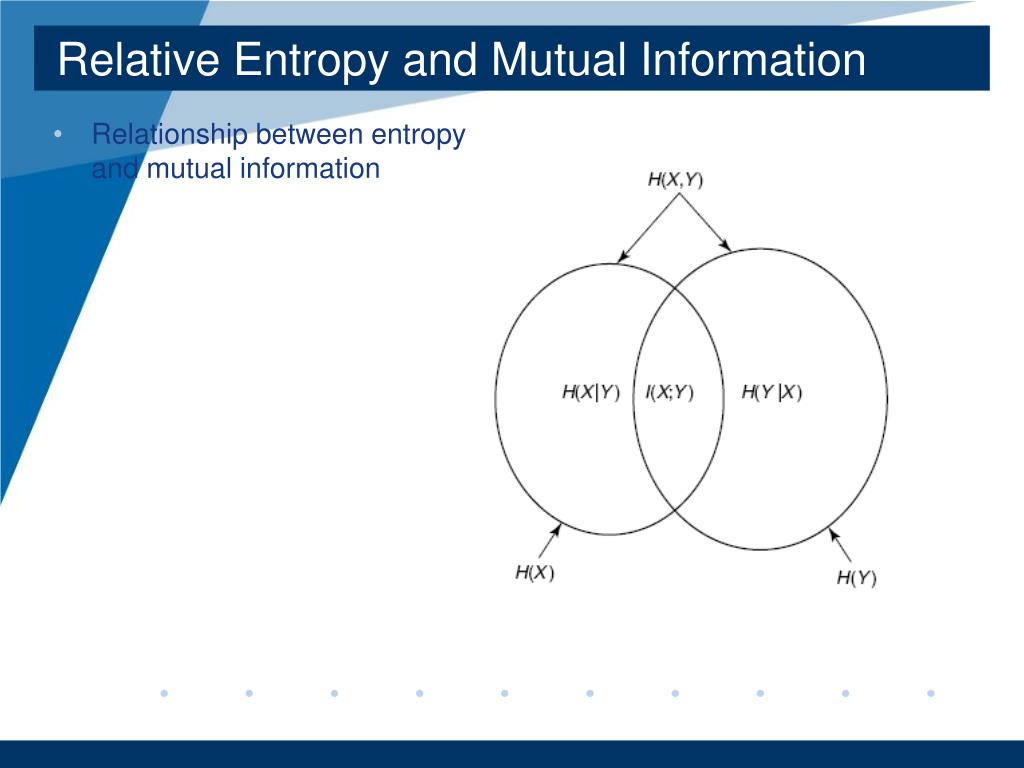
Let's return to the video to see how these concepts are connected and calculated.
Entropy & Mutual Information in Machine Learning
We'll continue with the same video, which now uses the Venn diagram to explain the interplay between different entropy measures and defines mutual information.
Please watch from 06:50 to 26:44. The key segments are: Joint Entropy: How to calculate uncertainty for two variables together using a 2D histogram (15:56 - 20:06). Visualizing the Relationships: How H(X), H(Y), H(X,Y), H(Y|X), and I(X;Y) all relate to each other (20:06 - 24:54). This is the most important part conceptually. Formulas for Mutual Information: The mathematical formulas that connect these quantities (24:54 - 26:44).
Mutual Information vs. Correlation
A critical advantage of mutual information over Pearson correlation is its ability to capture non-linear relationships. Correlation only measures the strength of a linear association. A U-shaped relationship would have a correlation near zero, but a high mutual information, as knowing the value of one variable significantly reduces the uncertainty about the other.
The video makes this exact comparison, which is essential for understanding why MI is a more general and powerful tool for assessing feature relevance.
Entropy & Mutual Information in Machine Learning
Let's watch a short segment comparing mutual information and correlation directly.
Watch the section from 33:51 to 35:35, which summarizes the key differences, highlighting MI's ability to measure non-linear dependence.
A Principled Framework for Feature Selection
Now we can use these tools to formalize the goals of feature selection.
- Relevance: We want features that share a lot of information with the target. This can be measured by a high .
- Redundancy: We don't want features that contain the same information. This can be measured by a high between two features.
- Complementarity (or Synergy): This is a more advanced concept. Two features and might be weakly informative on their own, but highly informative when combined. This means they provide synergistic, or complementary, information. This is captured by conditional mutual information.
The following paper provides a superb review of these concepts and unifies many famous feature selection algorithms under a single theoretical framework. Given your interest in a deep understanding, this is a central resource for this lesson.
[PDF] A review of feature selection methods based on mutual information
The paper 'A review of feature selection methods based on mutual information' by Vergara and Estévez formalizes the concepts we've discussed and shows how they are used in practice.
Please read the following sections: Section 2.2, 'Basic definitions' (page 176): This serves as a concise mathematical recap of Entropy, Joint Entropy, Conditional Entropy, and Mutual Information. Section 3, 'Relevance, redundancy, and complementarity' (pages 178-180): This is the core reading. It provides formal definitions for these three crucial concepts, explaining how information theory is used to quantify them. Pay close attention to how complementarity is defined in terms of multi-information.
The Ideal vs. The Practical
Ideally, in a greedy forward search for the best feature set , we would add the feature that maximizes the new information it brings, given what we already know. This is captured by the criterion:
This term measures the mutual information between the candidate feature and the target , conditioned on the set of already selected features .
However, estimating this high-dimensional conditional mutual information is computationally difficult and requires vast amounts of data. As a result, many popular feature selection algorithms are actually clever approximations of this ideal criterion.
A seminal paper by Brown et al. (2012), which we are providing as LINK and is the foundation for the review paper you just read, showed that can be expanded as:
This elegant formula shows that the ideal feature is one that is highly relevant, has low redundancy with existing features, and high synergy.
Different algorithms are born from how they approximate this equation:
- MIM (Mutual Information Maximization): Keeps only the relevance term, . Fast but selects redundant features.
- MRMR (Max-Relevance Min-Redundancy): Approximates the redundancy term as an average of pairwise redundancies and ignores the synergy term. A very popular and effective trade-off.
- JMI (Joint Mutual Information): Another approximation that tries to balance redundancy and synergy.
Understanding that these heuristics are principled approximations of an ideal objective function provides the deep insight you're looking for.
To see how these algorithms are used, let's look at the final part of our main video resource.
Entropy & Mutual Information in Machine Learning
This final segment of the video explains how the concepts of relevance and redundancy are used in feature selection algorithms like MRMR.
Please watch from 35:35 to the end. The video explains: The definitions of relevance (MI between feature and class) and redundancy (MI between two features) (35:35 - 38:03). How this leads to algorithms like MRMR, and it even mentions its use by Uber engineers, highlighting its real-world applicability (38:03 - 50:02).
Interview & Business Context Alert
Question: "You have a dataset with hundreds of features. How would you select a smaller, more effective subset of features for your model in a way that is model-agnostic?"
Your Analysis: "My primary approach would be to use a filter method based on mutual information. Unlike correlation, mutual information can capture complex, non-linear dependencies between features and the target. I would start by calculating the mutual information between each feature and the target to measure relevance.
To avoid selecting a set of highly correlated features, I would use an algorithm like MRMR (Maximum Relevance, Minimum Redundancy). This method iteratively builds a feature set by selecting features that are highly relevant to the target while being minimally redundant with the features already selected.
This is a principled approach because MRMR is a practical approximation of the ideal, but computationally expensive, goal of maximizing the conditional mutual information . It provides a robust, model-independent feature set that balances predictive power with compactness."
Conclusion
In this lesson, we ventured into information theory to build a model-agnostic framework for understanding feature value. We moved beyond simple correlations to a more fundamental measure of statistical dependence.
Key Takeaways:
- Entropy quantifies the uncertainty of a variable.
- Mutual Information measures the information shared between two variables—or the reduction in uncertainty about one, given the other. It is a powerful tool that captures both linear and non-linear relationships.
- We can formalize feature selection goals using MI:
- Relevance:
- Redundancy:
- Synergy: Captured by conditional mutual information.
- Many well-known feature selection algorithms like MRMR are practical approximations of an ideal information-theoretic objective, balancing the trade-off between maximizing relevance and minimizing redundancy.
What's Next?
We've now seen how to quantify statistical relationships using both linear models (multicollinearity) and information theory (mutual information). However, a strong statistical relationship does not imply a causal one. In our next lesson, we will confront this critical distinction head-on by exploring the difference between correlation and causation in the context of feature creation, a concept that is paramount for building interpretable and reliable models.