Recommended resources
The freely available resources this lesson will direct you to.
Hello. In the last lesson, you distinguished an explanation from an example and a practice exercise by noticing who does the reasoning. You also saw why understanding a worked example is different from making the decisions yourself.
This lesson is about finding out which part of that understanding you can use without help. You will learn a brief self-check that turns “I’m not sure I get it” into a specific gap. That gap will give you something useful to address when you revisit your learning question in the next lesson.
A feeling about understanding is a starting point
A quick confidence rating can help you pause and reflect. The Scale of Understanding pictured below asks learners not only to choose a rating, but also to explain it.
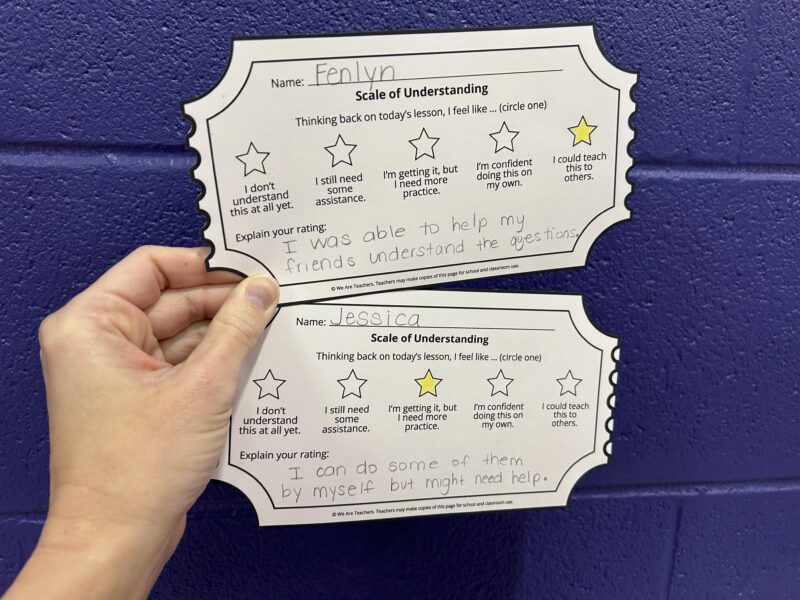
The written reasons are more informative than the stars. “I could teach this” suggests a way to check the rating; “I can do some by myself but might need help” points toward a boundary between independent work and work with support. Neither rating, however, tells us exactly which idea or decision causes difficulty.
One way to narrow that down is to name your muddiest point: the particular concept that still feels least clear. Watch this short segment from Edutopia’s How to Foster Metacognitive Skills for Independent Learning for that idea.
How to Foster Metacognitive Skills for Independent Learning
Edutopia introduces a brief pause for identifying the most confusing point in what you have studied.
Watch the muddiest point. Notice the shift from a general impression of confusion toward naming one unclear concept. The next section of this lesson adds a way to check that impression against something you actually try to do.
A muddiest point might be: “I am unclear about the difference between a worked example and a practice exercise.” That is more useful than “I don’t get the lesson.” But you can make it sharper still by attempting a small task and noticing where your reasoning holds or breaks down.
Make the self-check small enough to reveal something
A self-check does not need to be a full test. Choose one narrow thing you expect to be able to do, then try it before looking back at the explanation. If you consult the answer while trying, you learn less about what you can currently do on your own.
The Learning Scientists’ Learn how to Study Using... Retrieval Practice offers several ways to do this, from answering a question to writing down what you remember. Read the suggested methods and, importantly, what to do after an attempt.
Learn how to Study Using... Retrieval Practice
The Learning Scientists describe simple ways to bring an answer to mind without looking, then use your source material to see what you missed or misunderstood.
In the list of retrieval methods, begin with the bullet about practice tests and read through the bullet about concept maps: self-check options. Then find the subsection “What should you do after you practice retrieval?” and read the feedback step. Focus on why an attempt followed by comparison reveals more than either guessing or rereading alone.
For this course, the whole check can take two or three minutes:
- Pick a target. For instance, “Can I tell whether a passage is demonstrating a decision or asking me to make it?”
- Try without the lesson open. Explain your answer in a sentence, or classify a short passage and give your reason.
- Compare with the lesson. Look for what was accurate, missing, or mistaken.
- Record one gap. Describe the particular point where your answer needs work.
The last step matters. “I got it wrong” reports a result; “I treated a new article as an example even though the reader was asked to analyse it” identifies a gap you can address.
Watch a gap come into view
Suppose a learner recalls these definitions from the previous lesson: an explanation clarifies a principle; an example shows it in a case; a practice exercise leaves a task for the learner. So far, recall looks good.
Now consider a page with three parts. It first explains why evidence should be relevant to a claim. It then marks the claim and observations in a sample article, showing how someone evaluated them. Finally, it gives a different, unmarked article and asks the reader to identify its claim and supporting observations.
The learner labels the first part explanation and the second worked example, but labels the third example because it contains an article. Comparing that answer with the previous lesson reveals the missed distinction: the third part contains an article, but it also asks the reader to do the analysis. In that part, the article is material for a practice exercise.
Notice how much more precise the result is than “I need to review examples.” The learner can recall the definitions but has trouble applying them when a task contains a concrete case. Another reading of the definitions alone might not expose that difficulty; a short, unmarked case did.
Explaining an idea aloud or on paper can serve as a self-check too. In this segment of Thomas Frank’s How to Learn Faster with the Feynman Technique (Example Included), watch how trying to explain a concept exposes the places where an explanation stalls.
How to Learn Faster with the Feynman Technique (Example Included)
Thomas Frank demonstrates using a plain-language explanation to locate uncertain parts of your understanding, rather than taking fluency with a definition as the whole test.
Watch the explanation attempt, then spotting the gaps. Focus on the instruction to notice exactly where you stall and return to the relevant source material.
You need not produce an elegant explanation. A pause such as “I know this is a practice exercise, but I cannot say why” is useful information. It points to the missing reason, not to a failure of the entire lesson.
Describe the gap without overstating it
A brief self-check gives you evidence about one attempt, not a final verdict on your ability. Forgetting a term once may be a recall lapse. Answering one familiar case correctly does not establish that you can handle every new case. The useful question is: What did this attempt show, and what remains untested?
These descriptions point to different needs:
| What the check shows | A useful gap statement |
|---|---|
| You cannot bring the distinction to mind without looking. | “I need to recall what separates an example from an exercise.” |
| You recall the distinction but misclassify an unfamiliar passage. | “I need to notice who is making the judgment in a new case.” |
| You classify a passage but cannot justify your answer. | “I need to explain why the reader’s task changes the passage’s role.” |
The same method applies to the earlier learning question about evidence in an online article. You might remember that evidence should be relevant to a claim, yet find that you cannot explain how a reported observation bears on a particular claim. That is a more useful discovery than either “I understand evidence” or “I understand nothing.” It names the decision you could not yet make.
Keep your gap statement close to what you actually observed. If you only tried recalling a definition, you have not yet checked whether you can apply it. If you struggled with one application, you have found something worth investigating—not proof that you lack all understanding of the topic.
Key takeaways
A useful brief self-check combines an attempt without looking, a comparison with a reliable explanation or example, and a specific description of the difference. A confidence rating or “muddiest point” can start the process; trying to recall, explain, or apply an idea helps locate the gap more precisely.
In the next lesson, you will use what a self-check reveals to revise a learning question. Instead of asking for more information in general, you will be able to ask about the particular part you could not yet explain or do.