Recommended resources
The freely available resources this lesson will direct you to.
Hello! Welcome back to our module on advanced computational methods.
In our last lesson, we established that Matrix Product States (MPS) provide a compact and computationally efficient way to represent the low-entanglement ground states typical of 1D quantum systems. We now possess the language to describe these states. The crucial question that follows is: how do we find the specific MPS that represents the ground state of a given Hamiltonian, without ever having to deal with the exponentially large full state vector?
Today, we will answer that question by exploring the Density Matrix Renormalization Group (DMRG), arguably the most powerful numerical method for one-dimensional quantum many-body systems. Your learning outcome for this lesson is to describe the conceptual basis of the Density Matrix Renormalization Group (DMRG), including the role of the reduced density matrix in truncating the Hilbert space. We'll focus on the "why" and the "how" at a conceptual level, which will prepare us for implementing the algorithm in our next session.
1. The Variational Challenge: A "Chicken and Egg" Problem
At its heart, DMRG is a variational method. We are searching for the best MPS approximation to the true ground state. As we learned, an MPS is defined by a set of tensors, and its accuracy is controlled by the bond dimension, . The variational problem is to find the optimal set of tensors for a given that minimizes the energy .
This presents a significant challenge. To construct an optimal, truncated basis for a part of our system, we need to know which states are the most "important." The Singular Value Decomposition (SVD) from our last lesson provided the answer: the most important states correspond to the largest singular values in the Schmidt decomposition of the true ground state. But the true ground state is exactly what we are trying to find!
Matrix Product States and DMRG
Steve White, the inventor of DMRG, describes this as a classic 'chicken and egg' problem. In this clip, he explains this self-referential challenge and hints at the iterative solution that DMRG employs.
Watch from 34:06 to 37:25. Listen for the core problem statement and the analogy to evolution as a self-consistent, iterative process for solving it.
DMRG solves this problem by starting with a guess and iteratively improving it, simultaneously refining the wavefunction and the basis used to describe it. To understand how it does this, we first need to appreciate a major conceptual hurdle that DMRG was designed to overcome.
2. The Failure of a Naive Approach
The original idea for a numerical renormalization group (NRG) on lattice systems, predating DMRG, seemed simple enough:
- Start with a small block of sites.
- Add a new site to the block.
- Diagonalize the Hamiltonian for this new, larger block.
- Keep the lowest-energy eigenstates to form a new, truncated basis.
- Repeat.
This procedure failed dramatically for lattice models. The reason is that by diagonalizing the block in isolation, you impose artificial boundary conditions. The low-energy states of an isolated block are not necessarily good building blocks for the low-energy states of a much larger system. This leads to "kinks" in the constructed wavefunctions where blocks meet.
The Density Matrix Renormalization Group I - White
To build physical intuition, let's watch Steve White explain why this naive NRG fails, using the simple and intuitive example of a quantum particle in a box.
Watch from 25:42 to 42:24. The key takeaway is how imposing 'hard wall' boundary conditions on each block (by keeping eigenstates that are zero at the boundaries) makes it impossible to construct smooth, low-energy wavefunctions on a larger scale.
3. White's Insight: The Density Matrix
The conceptual breakthrough of DMRG was to realize that the importance of a state within a block should not be judged in isolation. Instead, it must be judged by its role within the context of the entire system.
Imagine the full system divided into two parts: the block we want to truncate (the "system," ) and everything else (the "environment," ). We are looking for the ground state of the combined "superblock," .
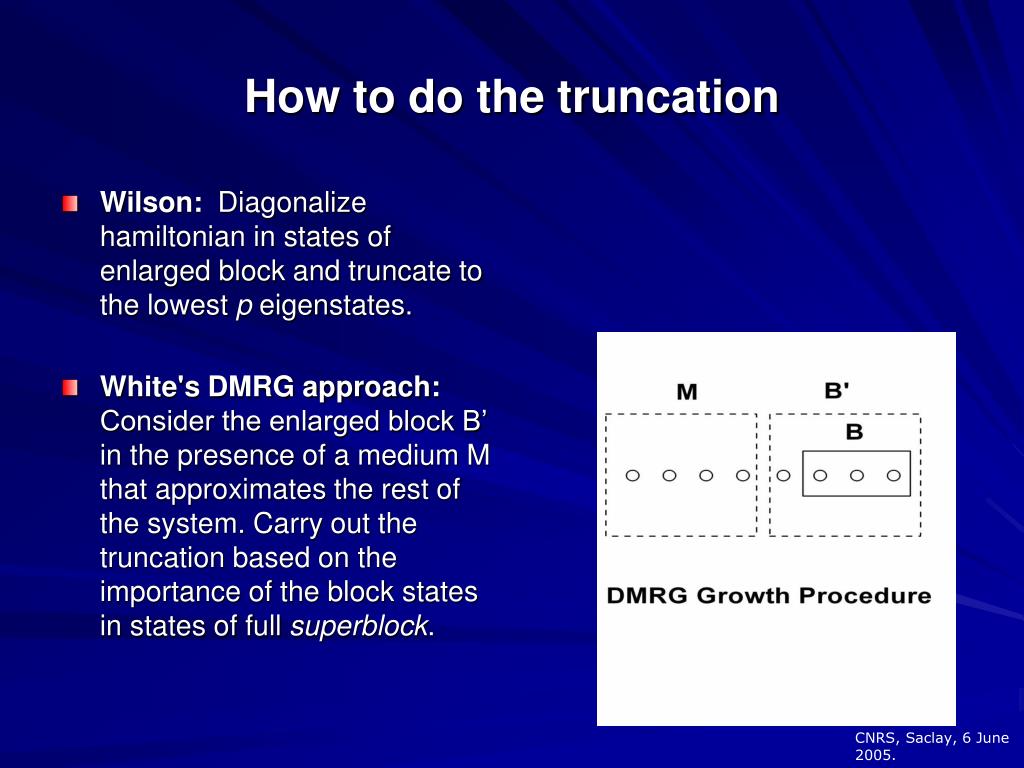
How do we find the best basis for the system block ? We use the reduced density matrix. If the ground state of the superblock is , we can write it as:
where is a basis for the system and is a basis for the environment.
The reduced density matrix of the system block is obtained by tracing out the environment's degrees of freedom:
The properties of make it the perfect tool for our task:
- Its eigenvectors, , form the optimal basis for describing the system block as it is embedded in the environment .
- Its eigenvalues, , represent the probability of finding the system block in the corresponding eigenstate when the full system is in the state .
This means the optimal truncation strategy is clear: to build the new basis for the system block, we should keep the eigenvectors of the reduced density matrix that have the largest eigenvalues. This procedure minimizes the amount of the wavefunction's "weight" that we discard.
Density Matrix Renormalization
The review article 'Density Matrix Renormalization' by Karen Hallberg provides a concise mathematical justification for this approach.
Read the sections 'Definitions and method' and 'Quantum information analysis' (pages 9.3 to 9.5). Pay close attention to equations (3) through (8). This derivation shows explicitly that minimizing the distance between the true state and the truncated state, ( |||\psi angle - |\hat{\psi} angle||^2 ), is equivalent to keeping the eigenstates of ( ho_S) with the largest eigenvalues.
This connection between the density matrix spectrum and entanglement is fundamental. If a system is weakly entangled (obeys an area law), the eigenvalues of the reduced density matrix decay very quickly. This means we only need to keep a small number of states () to capture almost all the weight of the wavefunction, justifying the truncation and ensuring the efficiency of DMRG.
Test your understanding!
In the previous lesson, we saw that the Schmidt decomposition provides the optimal basis for a bipartition. How do the eigenvalues and eigenvectors of the reduced density matrix relate to the Schmidt values and Schmidt vectors ?
Show answer
The eigenvectors of the reduced density matrix, , are precisely the Schmidt vectors for that subsystem, . The eigenvalues of the reduced density matrix, , are the squares of the Schmidt values, . This is why the eigenvalues are interpreted as probabilities, since .
4. The DMRG Algorithm in Practice
We now have the key ingredient: a criterion for optimally truncating the Hilbert space. The DMRG algorithm puts this into an iterative, self-consistent procedure. There are two main phases:
a) Infinite-System DMRG
This phase is used to "warm-up" and grow the system to the desired size. It builds the MPS tensors from scratch.
- Start: Begin with a small superblock, typically 4 sites: a left block , a single site, another single site, and a right block . Initially, and are just single sites themselves.
- Diagonalize: Find the ground state of the current superblock Hamiltonian using an iterative method like Lanczos.
- Truncate:
- Form a new, larger left block by combining and the adjacent site: .
- Calculate the reduced density matrix by tracing out the rest of the superblock.
- Find the eigenvectors of and use the most probable ones to create a transformation matrix . This matrix truncates the basis of from size down to .
- All operators for the new left block are transformed into this new truncated basis.
- Grow: Construct a new, larger superblock by adding sites and repeat the process. In the simplest version, the new right block is just a copy of the new left block.
This process grows the chain while keeping the Hilbert space dimension of the blocks manageable.
b) Finite-System DMRG (Sweeping)
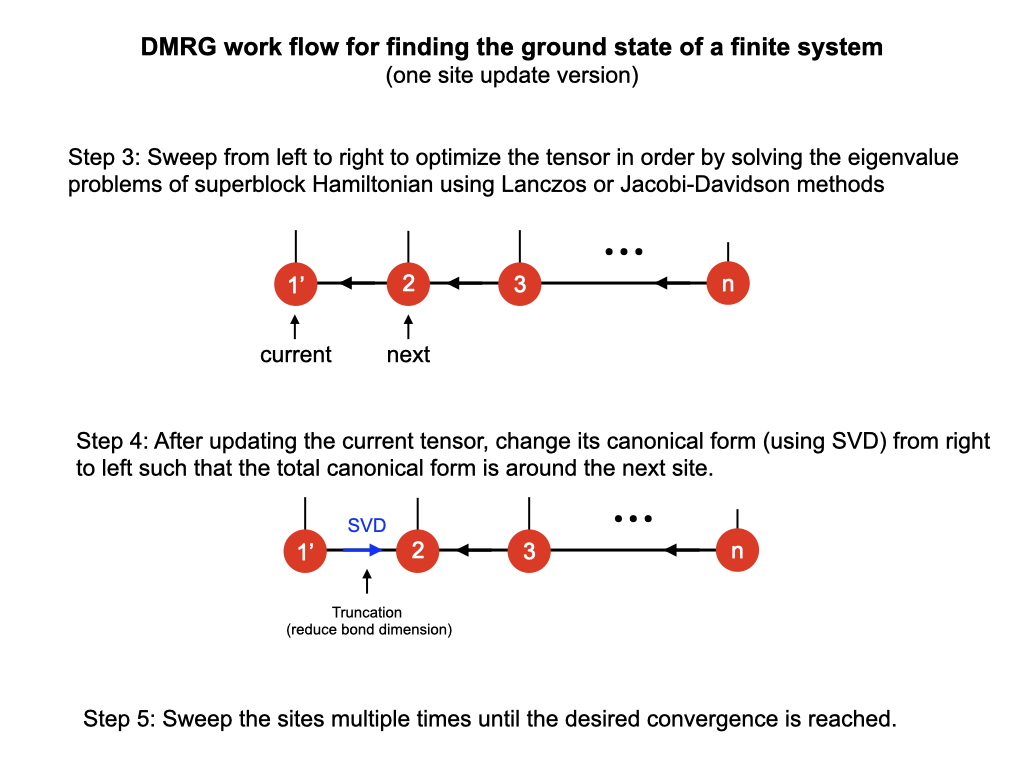
The infinite algorithm builds up good basis states, but the states for a block on the left end of the chain were created when the environment was small. They are not optimal for the final, full-sized environment. The finite algorithm corrects this by "sweeping" back and forth through the chain.
- Grow Left, Shrink Right: The left block grows by one site at a time, and the right block shrinks by one site. The shrinking right block's basis is retrieved from those stored during the initial growth phase. At each step, a superblock is formed (where and have varying sizes but ), and the ground state is found. The density matrix is then used to refine the basis for the new left block.
- Sweep Back: Once the left block has grown to its maximum size, the process reverses. The right block grows, and the left block shrinks, refining the basis for the right-side blocks.
- Repeat: These sweeps are repeated until the ground state energy and other observables converge to the desired accuracy. Each sweep variationally improves the MPS representation of the ground state.
DMRG101 tutorial Documentation
The 'DMRG101 tutorial' documentation provides a very clear, code-oriented description of how these steps are put together.
First, skim Section 2.1 'Infinite DMRG algorithm...'. Look at the infinite_dmrg_step function to see the core loop: calculate ground state, then grow_block_by_one_site. The grow_block_by_one_site function contains the key steps: build density matrix, diagonalize, and truncate. Next, read the introduction to Section 2.2 'Finite DMRG algorithm...'. It explains the concept of sweeping where one block grows and the other shrinks, using stored operators.
Conclusion
In this lesson, we have demystified the conceptual core of the Density Matrix Renormalization Group. We moved from understanding what an MPS is to understanding how an algorithm like DMRG can variationally find the optimal MPS for a given Hamiltonian.
Key Takeaways:
- DMRG is a variational algorithm that efficiently finds the ground state of 1D quantum systems within the class of Matrix Product States.
- It overcomes the failure of naive renormalization methods by considering a system block within the context of an environment, forming a superblock.
- The key insight is to use the reduced density matrix to perform the basis truncation.
- The optimal strategy is to keep the eigenvectors of with the largest eigenvalues, as this minimizes the discarded probability weight and optimally represents the entanglement between the system and its environment.
- The practical algorithm involves iterative sweeps across the system, which systematically refine the local MPS tensors to lower the total energy until convergence is reached.
Preview of the Next Lesson:
We have now covered the theoretical and conceptual foundation of DMRG. In the next lesson, "Implement the infinite-system DMRG algorithm to find the ground state of a one-dimensional quantum lattice model," we will translate these concepts into practice. You will write code to implement the "warm-up" phase of DMRG, putting the pieces—superblock diagonalization, density matrix calculation, and basis truncation—together to compute the ground state energy of a quantum spin chain.