Recommended resources
The freely available resources this lesson will direct you to.
- Thinking About Thinking: How to Challenge & Change Metacognitive Beliefs | Katy O'Brien | TEDxUGAwww.youtube.com
- The Testing Effect & Retrieval practice: the number 1 study hackwww.youtube.com
- Metacognitive Accuracy and the Self-Regulated Learner - Shyam Barrwww.shyambarr.com.au
- The Pretesting Effect: Why Testing Before Teaching Workswww.structural-learning.com
Hello! Welcome to the final lesson in our module, "Metacognition: Becoming a Self-Aware Learner."
In our last session, we focused on using self-questioning as a real-time tool to monitor your comprehension during a learning activity. This helps you catch confusion the moment it happens.
Today, we're adding the final, powerful layer to your metacognitive toolkit. We'll move beyond monitoring your present understanding to predicting your future performance and then reflecting on that prediction's accuracy. This directly addresses our learning outcome: Use prediction (e.g., 'What do I think the answer is?') and reflection to calibrate your judgment of learning.
Think of this as calibrating an instrument. In your design work, an uncalibrated monitor can display colors inaccurately, leading you to make poor design choices. Similarly, an uncalibrated "judgment of learning" leads you to make poor study choices—either stopping too soon because you're overconfident or wasting time restudying things you already know. Today's goal is to sharpen your self-awareness so your confidence aligns perfectly with your competence.
The Challenge of Metacognitive Accuracy
Before we learn how to calibrate our judgment, let's be clear on the problem we're solving. We all have a subjective sense of how well we know something. Psychologists call this a Judgment of Learning (JoL). The accuracy of these judgments is called metacognitive accuracy or calibration.
Unfortunately, we are often poor judges of our own knowledge. We mistake the temporary feeling of fluency from re-reading an article for genuine, durable understanding. This mismatch is a significant "bug" in the learning process.
Let's explore this concept in a short article by learning specialist Shyam Barr.
Metacognitive Accuracy and the Self-Regulated Learner - Shyam Barr
This article, 'Metacognitive Accuracy and the Self-Regulated Learner,' clearly defines the concept and explains why it's so critical for effective learning.
Please read from the beginning down to the end of the section discussing the three metacognitive profiles (it ends just before the heading 'Encourage overt retrieval of knowledge'). Pay close attention to the definition of metacognitive accuracy and the risks associated with the 'overconfident' profile.
As the article highlights, being overconfident is particularly risky. It leads to under-preparation, stress, and dissatisfaction. Our goal is to move from being unknowingly overconfident to being accurately calibrated. The tools for this are prediction and reflection.
Step 1: The Power of Prediction
The first step in calibrating your judgment is to make it explicit by forming a prediction. Instead of passively thinking, "I think I get this," you actively ask, "How well will I be able to recall or apply this information later?"
Making a prediction before you confirm the answer has a surprisingly powerful effect on memory, even when your prediction is wrong. This is known as the pretesting effect or errorful generation.
The Pretesting Effect: Why Testing Before Teaching Works
This article, 'The Pretesting Effect: Why Testing Before Teaching Works,' explains the science behind this counterintuitive idea.
Read the sections 'What Is the Pretesting Effect?' and 'The Science Behind Pretesting Effects.' Focus on understanding what the effect is and the different cognitive mechanisms (like the Attention Hypothesis and Error Correction Account) that explain why it works.
In essence, trying to answer a question before you know the answer does two things:
- It primes your brain, creating a "need to know" that focuses your attention.
- It makes the subsequent corrective feedback more memorable. The brain pays special attention when an expectation is violated.
This process of making a prediction forces a "covert retrieval attempt," as you'll see in the following demonstration.
Thinking About Thinking: How to Challenge & Change Metacognitive Beliefs | Katy O'Brien | TEDxUGA
In this TEDx talk, Dr. Katy O'Brien gives a live audience a memory task. We'll watch the first part where she asks them to make an initial prediction.
Watch from 01:39 to 03:09. Notice how she explicitly asks the audience to predict their future performance on a memory quiz. This is the act of making a Judgment of Learning.
Making a prediction is the first half of the process. But on its own, it doesn't lead to calibration. For that, you need reflection.
Step 2: Reflection and Calibration
Calibration happens when you complete the feedback loop: you compare your prediction to your actual performance. This act of reflection is what trains your metacognitive accuracy over time.
This is the core cycle of metacognitive regulation, which involves assessing your state, applying a strategy, and then reflecting on the outcome to inform future actions.
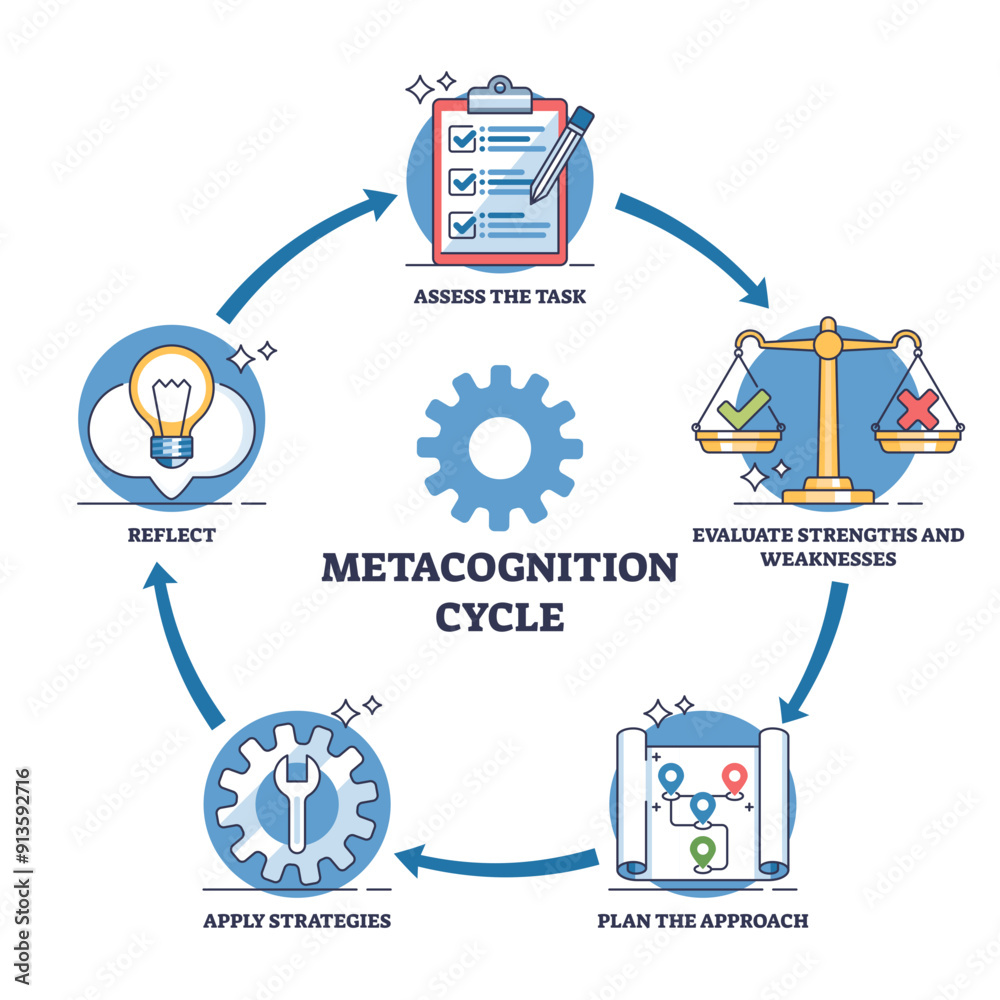
Let's return to the article by Shyam Barr, which provides an excellent, practical workflow for this process.
Metacognitive Accuracy and the Self-Regulated Learner - Shyam Barr
The same article lays out a clear, evidence-based method for using prediction and reflection to improve metacognitive accuracy.
Read the section titled 'Incorporate opportunities for judgments of learning.' Focus on the four numbered steps that create the predict-test-compare-reflect cycle. This is the key takeaway of today's lesson.
The process is:
- Predict: Make a judgment about your future performance.
- Test: Use an active retrieval method (like a quiz or free recall) to get objective data on your performance.
- Compare & Reflect: Compare your prediction to your actual results and ask yourself clarifying questions ("Was I overconfident? Why? What will I do differently?").
Now, let's see this cycle play out in the TEDx talk.
Thinking About Thinking: How to Challenge & Change Metacognitive Beliefs | Katy O'Brien | TEDxUGA
Dr. O'Brien now completes the experiment, asking the audience to reflect on their predictions and explaining the cognitive science behind it.
Watch from 10:13 to 13:39. Notice how she prompts for a second judgment, reveals the results, and then explains why making judgments after a delay (which forces a 'covert retrieval attempt') is more accurate.
Dr. O'Brien's explanation highlights a crucial point: judgments made when information feels fresh and fluent are unreliable. Judgments made after forcing yourself to try and retrieve the information are far more accurate. This is why self-testing (retrieval practice) is not just a study tool, but also your most reliable diagnostic tool for calibration.
The Testing Effect & Retrieval practice: the number 1 study hack
This video reinforces the idea that retrieval practice is essential for forming accurate judgments about your memory.
Watch from 02:30 to 04:07. The speaker explicitly states that a key benefit of retrieval practice is that it helps you make evidence-based judgments about your memory, correcting for over- or under-confidence.
Test your understanding!
Think about a specific concept you want to learn next, for example, a new data analysis function in Python or a specific UX methodology like Jobs-to-be-Done (JTBD).
Describe how you would apply the Predict -> Test -> Reflect cycle to learn it. What specific question would you ask yourself for each stage?
- Prediction Question: (What would you ask yourself before you start reading the article or watching the video?)
- Testing Method: (How would you get objective data on your understanding after learning?)
- Reflection Questions: (What two questions would you ask yourself when comparing your prediction to your test results?)
Show answer
Let's use the example of learning the Jobs-to-be-Done (JTBD) framework.
- Prediction Question: "After reading this 20-minute article on JTBD, on a scale of 1-5, how confident am I that I could explain the difference between a 'job' and a 'task' to a colleague without looking at my notes?" (Let's say I predict a 4/5).
- Testing Method: After reading, I would close the article and do 5 minutes of free recall, writing down everything I remember about JTBD, specifically focusing on defining 'job' vs. 'task'.
- Reflection Questions:
- "My free recall was much vaguer than I expected; I couldn't clearly articulate the difference. My prediction of 4/5 was too high. Why was I so overconfident?"
- "What cues did I rely on? (Probably the clarity of the writing and the simple diagrams). What should I do next time to get a more accurate prediction? (Perhaps try to generate an example before reading the full explanation)."
Conclusion
Today, we've completed your core metacognitive toolkit. You now have strategies to monitor your understanding in real-time (self-questioning) and to accurately calibrate your judgment of learning over time (predict-test-reflect). By consistently practicing this cycle, you are essentially "debugging" your internal sense of competence, making it a more reliable guide for your study decisions. You will learn to trust the evidence of retrieval, not the feeling of fluency.
Key Takeaways:
- Judgment of Learning (JoL) is your subjective assessment of what you know, and it's often inaccurate.
- Metacognitive accuracy is the skill of aligning your confidence with your actual competence.
- The Predict-Test-Reflect cycle is the primary method for improving this accuracy.
- Prediction (or pretesting) enhances learning by focusing attention and making corrective feedback more effective, even when you're wrong.
- Reflection involves comparing your prediction to objective evidence from a self-test and asking why there was a mismatch.
What's Next?
This lesson marks the end of our module on metacognition. You now have a powerful set of mental tools to understand your own learning, diagnose issues, and apply effective strategies.
However, even with the best tools, a major obstacle can stand in the way of using them: procrastination. In our next module, we will tackle this challenge head-on. We'll begin by exploring the surprising emotional and psychological drivers that cause us to procrastinate, even when we know what we should be doing.