Recommended resources
The freely available resources this lesson will direct you to.
Hello! Welcome to the first lesson in our module, "Metacognition: Becoming a Self-Aware Learner."
In our last session, you designed a deliberate practice plan. The very act of choosing a skill, breaking it down, designing a task, and planning for feedback is a powerful example of what we're covering today. You were thinking about how to learn—a process called metacognition.
Today's learning outcome is to distinguish between metacognitive knowledge (what you know about learning) and metacognitive regulation (what you do to manage learning). Understanding this distinction is like differentiating between a user persona (knowledge about the user) and a usability testing plan (a process for guiding the user). Both are essential, but they serve different functions. This foundation will help you diagnose and improve your own learning process with greater precision.
What is Metacognition?
At its core, metacognition is often simply described as "thinking about thinking" or "cognition about cognition." It's your ability to step outside of your immediate mental stream and observe, understand, and direct it.
To get a clear, structured introduction, let's start with a foundational reading.
Getting started with Metacognition
The article 'Getting started with Metacognition' from Cambridge Community offers a very clear and direct definition of metacognition and its two core components.
Please read the section titled 'What is metacognition?'. Focus on how it immediately splits the concept into 'metacognitive knowledge' and 'metacognitive regulation' and the simple examples given for each.
As the article lays out, metacognition isn't a single skill but a combination of two distinct dimensions: what you know and what you do. Let's explore each one.
Dimension 1: Metacognitive Knowledge (The "What")
Metacognitive knowledge is your personal database of information about how learning works. It’s the declarative knowledge and beliefs you hold about yourself as a learner, the tasks you face, and the strategies available to you.
Think of this as the research and discovery phase of a design project. You gather insights about your user (yourself), the context (the learning task), and the available tools (strategies).
The Cambridge article breaks this down into three categories:
-
Knowledge of Self (Person): This is your understanding of your own cognitive strengths and weaknesses.
- Example: "I have trouble remembering abstract syntax, but I'm good at seeing the big picture in a system."
- Your Context: "I find it easier to learn a new UI principle by trying to replicate a good design rather than just reading about it."
-
Knowledge of Tasks: This is your ability to assess a task's difficulty, demands, and scope.
- Example: "This chapter looks dense and complex; it will require more focus than the introduction."
- Your Context: "Learning the basics of data analysis with SQL will be a different kind of challenge than learning a new Figma feature. The former requires more abstract logical thinking."
-
Knowledge of Strategies: This is your awareness of different learning techniques and when to apply them.
- Example: "If I can't remember a list of items, creating a mnemonic might help."
- Your Context: "For learning project management frameworks like Scrum, creating flashcards for key terms (sprint, backlog) is useful, but for understanding why it works, explaining it to a colleague is better."
This is the foundation upon which you build your learning plan. Without accurate knowledge, your actions may be ineffective.
Dimension 2: Metacognitive Regulation (The "How")
Metacognitive regulation is the active, in-the-moment process of managing your learning. It's what you do with your metacognitive knowledge. If knowledge is the research, regulation is the agile design and development loop: plan, execute (monitor), and evaluate.
This process is often described as a cycle. To explore this, let's look at another resource that frames it as 'monitoring' and 'control'.
Thinking about thinking. The role of metacognition in UX design
The article 'Thinking about thinking' by Harry Morgan discusses an influential model of metacognition that clarifies this action-oriented side.
Read the section 'Understanding metacognitive processes'. Pay close attention to the piano recital example. It beautifully illustrates the two-step 'monitoring' and 'control' process, which is the essence of regulation.
As the article shows, regulation involves three key phases:
-
Planning: Before starting a task, you set goals and select appropriate strategies from your "database" of metacognitive knowledge.
- Questions: "What's my goal for this study session?" "Based on my past experience, what's the best way to approach this article?" "How much time should I allocate?"
-
Monitoring: While engaged in the task, you actively track your progress and comprehension. This is your internal "usability test."
- Questions: "Am I understanding this?" "Is this strategy working, or should I switch?" "Have I lost focus?"
-
Evaluating: After completing the task, you reflect on the outcome and the process. This feedback refines your metacognitive knowledge for next time.
- Questions: "How well did I do?" "What went well, and what didn't?" "What could I do differently next time I face a similar task?"
This active cycle of planning, monitoring, and evaluating is what allows you to be an agile and self-correcting learner.
Seeing the Two Together
Metacognitive knowledge and regulation are distinct but deeply intertwined. Your knowledge informs your planning, and the results of your evaluation update your knowledge.
This video offers a dynamic way to think about the relationship between being aware (knowledge) and taking control (regulation).
Metacognition 1: understanding and controlling your mind
In 'Metacognition 1: understanding and controlling your mind', the speaker explains the difference between being a passive observer of your mind and an active director.
Watch the segment from 14:04 to 17:00. Focus on the explicit distinction the speaker makes between 'monitoring' (awareness) and 'control' (steering). This is the core of the difference between knowledge and regulation.
Here are two diagrams that visualize this relationship.
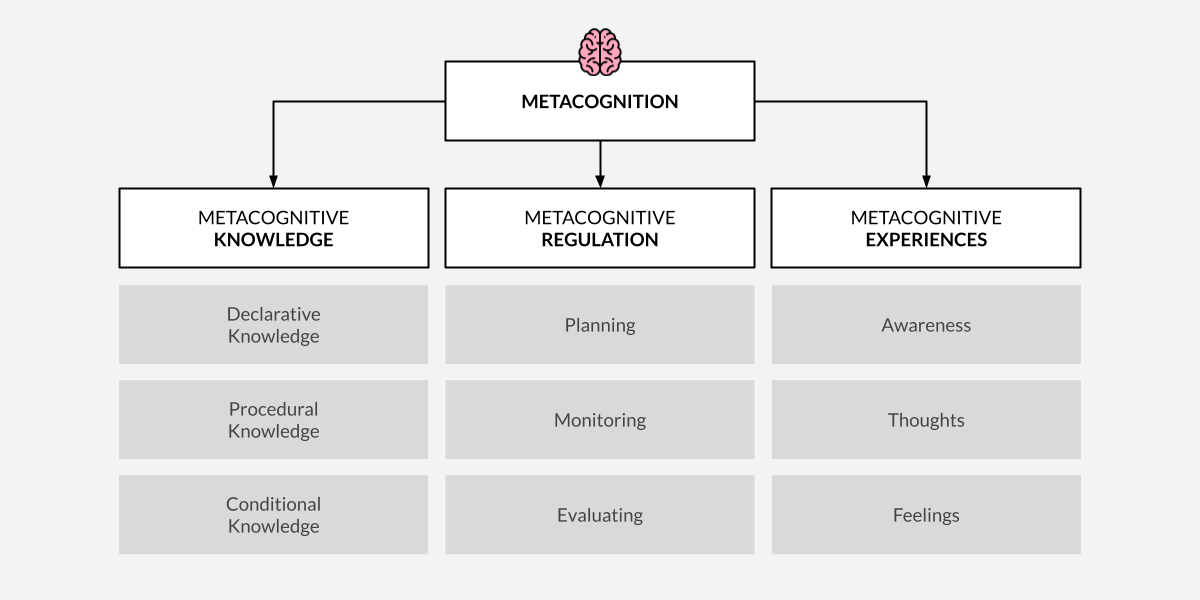
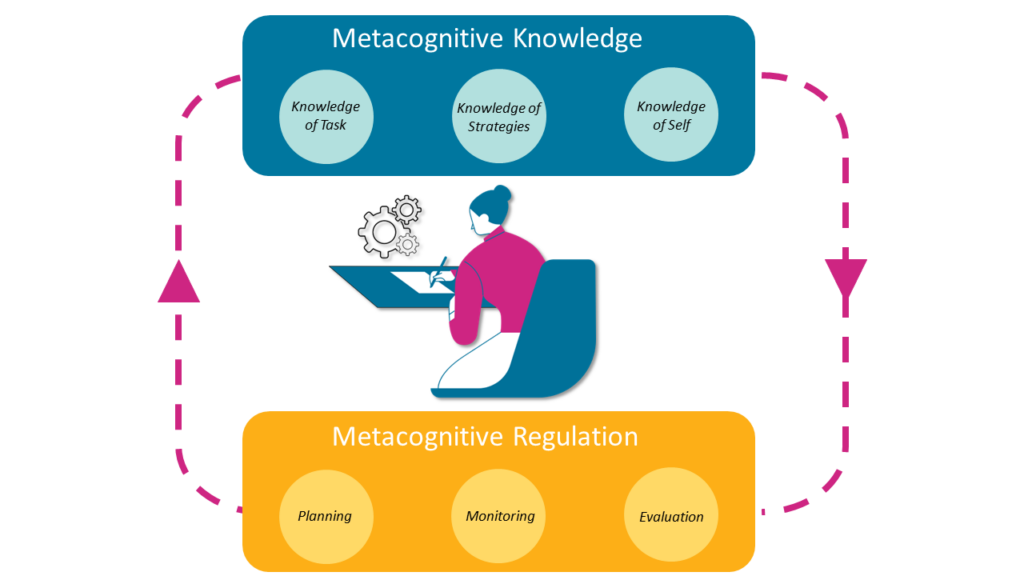
To summarize the distinction in a table:
| Aspect | Metacognitive Knowledge | Metacognitive Regulation |
|---|---|---|
| Nature | Declarative ("knowing that...") | Procedural ("doing this...") |
| Focus | Awareness of self, tasks, & strategies | Management of the learning process |
| State | The information in your mental "database" | The active process of using that database |
| Example | "I know that I get distracted by notifications." | "I am now putting my phone in another room." (Planning) |
| UX Analogy | User Persona & Research Insights (knowledge about the user and context) | The Design Sprint (a structured process of building, testing, and learning) |
Test your understanding!
For each scenario below, identify whether it primarily demonstrates Metacognitive Knowledge or an act of Metacognitive Regulation.
- Before starting a new online course on data visualization, you look at the syllabus to estimate how long each module will take.
- You believe that you are better at learning from hands-on projects than from lectures.
- While trying to debug a piece of CSS, you realize your current approach isn't working and decide to search for a different solution on Stack Overflow.
- You know that explaining a concept to someone else is a good way to test your own understanding.
- After finishing a chapter in a book, you close it and try to summarize the key arguments in your own words.
Show answer
- Metacognitive Regulation (Planning): You are actively planning your approach to a learning task.
- Metacognitive Knowledge (of Self): This is a belief you hold about your own learning preferences and abilities.
- Metacognitive Regulation (Monitoring & Control): You are monitoring your progress ("this isn't working") and controlling your strategy ("decide to search for a different solution").
- Metacognitive Knowledge (of Strategies): You are aware of a specific, effective learning strategy.
- Metacognitive Regulation (Monitoring/Evaluating): You are actively executing a strategy to check your comprehension.
Conclusion
Today, we've dissected metacognition into its two fundamental parts. You now have a clearer language to describe your own learning process.
Key Takeaways:
- Metacognition is your ability to think about and direct your own thinking.
- Metacognitive Knowledge is what you know about yourself as a learner, the nature of learning tasks, and the strategies available to you. It's your internal knowledge base.
- Metacognitive Regulation is what you do to manage your learning. It's the active, cyclical process of planning, monitoring, and evaluating your cognitive activities.
- Effective learning depends on having both accurate knowledge and skillful regulation.
What's Next?
Having a great process for regulation (planning, monitoring, evaluating) is only half the battle. What if your internal "monitor" gives you faulty information? In our next lesson, we'll explore a critical bug in human learning: the 'illusion of competence.' We'll examine how passive and comfortable learning strategies can trick you into thinking you understand something much better than you actually do, leading to major errors in metacognitive judgment.