Recommended resources
The freely available resources this lesson will direct you to.
- How to find the Protons Neutrons and Electrons of an element on the Periodic tablewww.youtube.com
- Elements and atomic number | Chemistry | Khan Academywww.youtube.com
- Protons, Neutrons, and Electrons (M2Q1) – UW-Madison Chemistry 103/104 Resource Bookwisc.pb.unizin.org
- 4.5: Elements- Defined by Their Number of Protons - Chemistry LibreTextschem.libretexts.org
Welcome to the course. We will begin by using the periodic table as a practical reference tool: each element has a unique name, symbol, and atomic number. In this lesson, you will learn how to read an element’s box and use one number to determine its identity and the numbers of protons and electrons in a neutral atom.
By the end, you should be able to look at a symbol such as , find its atomic number, identify it as copper, and state how many protons and electrons a neutral copper atom has.
The atomic number: an element’s identity number
An element is defined by its number of protons. This number is called its atomic number and is often represented by .
This is not merely a label or position in a list. It is what makes an atom a particular element:
- Every hydrogen atom has 1 proton.
- Every helium atom has 2 protons.
- Every carbon atom has 6 protons.
- Every atom with 29 protons is copper.
Changing the number of protons changes the element itself. An atom with 6 protons can never be oxygen; oxygen must have 8 protons.
The periodic table arranges elements in order of increasing atomic number. Each box usually includes:
- Atomic number — commonly at the top.
- Chemical symbol — one or two letters in large print.
- Element name — written out.
- Atomic mass — usually a decimal near the bottom.
Elements and atomic number | Chemistry | Khan Academy
Watch “Elements and atomic number” by Khan Academy for a compact visual explanation of why proton number defines an element and how the periodic-table box is read.
Watch from element identity to connect atomic number with protons and neutrality. Then continue through reading a cell, focusing on the order of information in a periodic-table square and the capitalization of symbols.
A chemical symbol is shorthand for an element. It follows a strict capitalization pattern:
- One-letter symbols are capitalized: , , .
- Two-letter symbols have a capital first letter and lowercase second letter: , , .
Capitalization matters. is the element cobalt, while will later mean a substance containing carbon and oxygen.
Why a neutral atom has the same number of electrons
From the previous idea about atomic particles:
- A proton has a positive charge.
- An electron has a negative charge.
- A neutral atom has no overall electric charge.
For the positive and negative charges to balance, a neutral atom must contain equal numbers of protons and electrons.
Since the atomic number already tells us the proton count, it also tells us the electron count when the atom is neutral:
For example, nitrogen has atomic number 7. Therefore a neutral nitrogen atom has:
| Particle | Number |
|---|---|
| Protons | 7 |
| Electrons | 7 |
The word neutral is essential. It tells you that the charges cancel. Atoms can gain or lose electrons and become charged particles, but that is a later topic. For this lesson, when a question says “neutral atom,” use the simple rule: electrons equal protons.
Protons, Neutrons, and Electrons (M2Q1) – UW-Madison Chemistry 103/104 Resource Book
Read this concise section from the UW–Madison Chemistry 103/104 Resource Book to reinforce the relationship among atomic number, elemental identity, and electrical neutrality.
In the discussion following Table 1, begin at “For example, any atom that contains six protons” and read the central explanation. Focus on the two linked claims: proton number fixes an element’s identity, and equal positive and negative charges make a neutral atom.
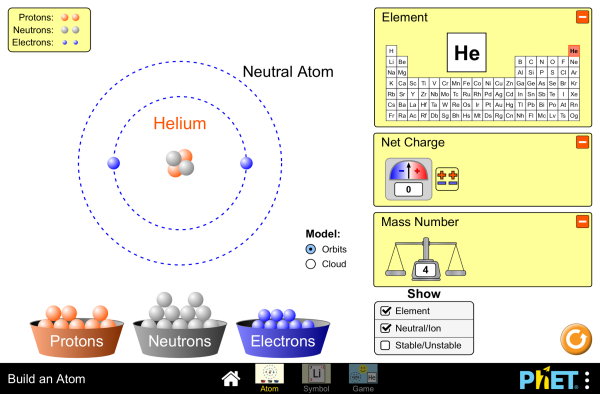
The helium model illustrates the rule clearly. The periodic table identifies helium as atomic number 2, so it has 2 protons. Because the display says it is neutral, it also has 2 electrons. The neutrons shown are not needed to identify helium or determine its electron count in this lesson.
A reliable method for any periodic-table question
When you are given an element’s name or symbol, use this sequence:
- Find the element’s box on the periodic table.
- Read the chemical symbol and element name to confirm you found the correct element.
- Read the atomic number .
- State that the number of protons equals .
- If the atom is neutral, state that the number of electrons also equals .
Consider nitrogen:
- Symbol:
- Atomic number: 7
- Element: nitrogen
- Protons: 7
- Electrons in a neutral atom: 7
Now consider copper:
- Symbol:
- Atomic number: 29
- Element: copper
- Protons: 29
- Electrons in a neutral atom: 29
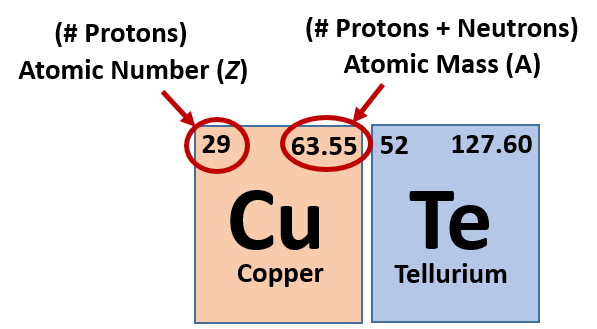
Using the tellurium entry in the image:
| Information | Result |
|---|---|
| Symbol | |
| Name | Tellurium |
| Atomic number | 52 |
| Protons | 52 |
| Electrons in a neutral atom | 52 |
Notice that the large symbol helps you identify the element, while the atomic number provides the particle counts.
Do not confuse atomic number with atomic mass
A periodic-table box often contains two numbers, and they have different jobs.
| Quantity | What it tells you | Typical form |
|---|---|---|
| Atomic number | Number of protons; also electrons in a neutral atom | Whole number |
| Atomic mass | Average mass of the element’s naturally occurring atoms | Usually a decimal |
For copper, 29 is the atomic number. It gives the definite answer: every copper atom has 29 protons.
The decimal 63.55 is copper’s atomic mass, not its number of protons. Similarly, tellurium’s 127.60 is an atomic mass, while 52 is its atomic number.
The copper-and-tellurium image correctly emphasizes the importance of the atomic number, but its wording about the decimal “atomic mass” needs one correction: a decimal atomic mass is not simply the number of protons plus neutrons in one atom. A particular atom’s proton-plus-neutron count is called its mass number, and it is always a whole number. Because elements can occur as atoms with different neutron counts, periodic tables normally list a weighted average, which is why atomic masses are often decimals.
For this lesson, keep the distinction simple:
- Use atomic number to find protons and neutral-atom electrons.
- Do not use the decimal atomic mass for those counts.
A compact reference to remember
For a neutral atom:
So if a periodic-table box tells you an element has , you immediately know:
- It is the element with 15 protons, phosphorus.
- A neutral atom has 15 protons.
- A neutral atom has 15 electrons.
A useful way to build speed is to make a three-column note whenever you encounter an element:
| Symbol | Atomic number | Neutral atom: protons and electrons |
|---|---|---|
| 1 | 1 proton, 1 electron | |
| 6 | 6 protons, 6 electrons | |
| 8 | 8 protons, 8 electrons | |
| 11 | 11 protons, 11 electrons | |
| 17 | 17 protons, 17 electrons |
Key takeaways
An element is identified by its atomic number, , which is the number of protons in its atoms. The periodic table gives each element a name, symbol, and atomic number in one place.
For every neutral atom:
Be careful to use the whole-number atomic number, not the usually decimal atomic mass, when determining proton and electron counts.
Next, the course moves outward from single atoms to particle diagrams: you will distinguish atoms, molecules, elements, compounds, and mixtures.