Recommended resources
The freely available resources this lesson will direct you to.
Hello! Welcome to the first lesson in our course on "Rank vs. wealth, liberty, institutions."
Introduction
In this lesson, we will situate Walter Bagehot's seminal work, The English Constitution, within the turbulent political and social climate of Victorian England. Our focus will be the passage of the Second Reform Act in 1867, the very year Bagehot's book was published as a collection of essays.
Understanding this context is the essential first step for our course. The 1867 Act represented a seismic shift in the British political landscape, dramatically expanding the right to vote to working-class men. This event triggered profound anxiety within the ruling elite about the future of their institutions and the potential rise of an unstable democracy. Bagehot's analysis was a direct and influential response to this perceived crisis. By grasping the specific problems he was trying to solve, we lay the groundwork for exploring the course's central themes: the tension between inherited rank, monetary wealth, and political power, and the nature of liberty in a changing society.
Let's begin by looking at the cover of a modern edition of Bagehot's book.

1. The Unstable Equilibrium: Britain Before 1867
To understand the shock of 1867, we first need to appreciate the system it disrupted. The prevailing constitutional ideal was one of a "balanced constitution," a delicate equilibrium between the Monarchy, the House of Lords (the aristocracy), and the House of Commons.
The first major jolt to this system in the 19th century was the Great Reform Act of 1832. While often portrayed as a democratic milestone, many historians now view it as a strategic, conservative measure. It was designed not to usher in democracy, but to preserve the existing order by incorporating the growing industrial and commercial middle classes into the political establishment, thereby creating a bulwark against more radical demands from the working classes.
The following reading provides an excellent analysis of this pre-reform context, arguing that the reforms of the 19th century were fundamentally anti-democratic in their motivation. Given your background in economics and strategic analysis, you may find the framing of these reforms as a calculated move by the ruling class to stabilize their authority particularly interesting.
Unintended Democracy: Parliamentary Reform in the UK
Please read sections of the paper 'Unintended Democracy: Parliamentary Reform in the UK' by Jo Eric Khushal Murkens. This will provide a critical perspective on the purpose of 19th-century electoral reform, setting the stage for the 1867 crisis.
Please read sections 1 and 2 of the chapter. In section '1. The Ideal of the Balanced Constitution', read balanced constitution. Then in section '2. Great Reform Act 1832', read Reform Act 1832. Focus on how the 1832 Act is presented as a measure to resist democracy by co-opting the middle classes, rather than a step towards it. Note the argument that it was a 'technique' to make aristocratic government more acceptable.
As Murkens argues, the 1832 Act was seen by its architects as a "final settlement," not the first step on a democratic path. It rationalized the system but kept power firmly in the hands of the propertied classes. This established a new, but inherently unstable, equilibrium. The forces of industrialization and population growth, and the political consciousness of the excluded working class, did not simply vanish. By the 1860s, the pressure for further reform was once again becoming irresistible.
2. The "Leap in the Dark": The Second Reform Act of 1867
The 1860s saw a confluence of factors that brought the issue of parliamentary reform to a head:
- Political Rivalry: A fierce competition between the Liberal party, led by William Gladstone, and the Conservative party, led by Benjamin Disraeli.
- Public Agitation: A revitalized reform movement, marked by mass demonstrations and the infamous Hyde Park riots of 1866, which stoked elite fears of revolution.
- External Events: The victory of the Union in the American Civil War was seen by many as a validation of a more democratic system.
- Economic Conditions: A financial crisis and a cholera epidemic heightened social tensions and fears of working-class unrest.
The political maneuvering that led to the Act's passage was a masterclass in strategy and opportunism, culminating in what was, for many, an entirely unexpected outcome. The Conservative leader, Disraeli, having defeated Gladstone's more modest reform bill in 1866, ended up passing a far more radical version himself in 1867.
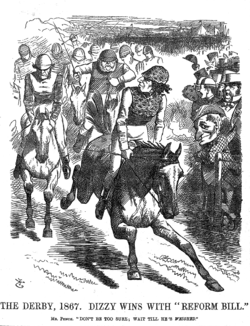
The following, more detailed reading will walk you through the complex narrative of the Act's passage and its specific provisions. It explains how a bill intended to be a limited, controllable reform was transformed on the floor of the House of Commons into what Lord Derby, the Prime Minister, famously called a "leap in the dark."
Janice Carlisle, “On the Second Reform Act, 1867”
We will now turn to Janice Carlisle's article, 'On the Second Reform Act, 1867', for a detailed account of the political and social dynamics that produced the Act.
This is a comprehensive article. Please focus on the following sections: Read the section titled 'The Second Reform Act (1867) raised in its own time...' (starts after the introduction), which covers the initial reception. Pay close attention to the contemporary reactions of figures like Carlyle and Bagehot. Read the next section, 'Traditional accounts of the 1867 act...', which outlines the multiple causes of the reform. Read the section 'To provide a number of different perspectives...' to understand why the borough franchise was the central point of contention. Skip the section on Gladstone's 1866 bill and read the section starting 'The most effective attacks on the Liberal bill came not from the Conservative Disraeli...'. Focus on Robert Lowe's arguments against democracy, which crystallized the fears of the elite. Read the sections 'With the formation of a minority Conservative government...' and 'Between 18 March 1867, when Disraeli introduced this bill...'. These explore the riots and amendments, explaining the role of the Hyde Park riots and, crucially, how Disraeli's bill was amended to become far more radical than anyone, including Disraeli himself, had intended.
The key takeaway from this political drama is the accidental nature of the outcome. Through a series of amendments, most notably the abolition of "compounding" (whereby landlords paid local taxes, or 'rates', on behalf of their tenants), the Act enfranchised almost all male heads of household in the boroughs. This went far beyond the initial proposals and created an electorate nearly double the size of the one before it, with a large, unpredictable working-class majority in many urban constituencies.
3. Bagehot's Citadel: Context and Motivation
The passage of the 1867 Act was not seen as a triumphant step towards a better future by most contemporary observers. For the established political and intellectual class, it was a moment of profound crisis.
- The historian Thomas Carlyle predicted a "Niagara leap of democracy."
- The politician Robert Lowe prophesied that England was about to "pluck down on our own heads the venerable temple of our liberty and our glory."
- And Walter Bagehot, the editor of The Economist, lamented that "The Conservative party relinquished the citadel without a fight."
This is the crucial context for The English Constitution. Bagehot wrote his book to make sense of this new political reality. The formal, theoretical checks and balances of the "balanced constitution" had seemingly failed. A wave of "numbers" was about to crash against the "citadel" of the old order.
Bagehot’s project was to look behind the formal theory and describe how the English constitution actually worked. He believed its resilience lay not in its formal rules, but in its unwritten conventions and the subtle interplay of its component parts. He was, in essence, trying to provide a new user manual for a system that had just received a massive, unexpected shock. His analysis was an attempt to diagnose how the system might absorb the impact of democracy and preserve stability, order, and what he considered true liberty.
This brings us to the heart of our course. The 1867 Act was a direct challenge to the power of traditional "rank" (the aristocracy and gentry) by the force of popular democracy. Bagehot's subsequent analysis, which we will begin in the next lesson, is a foundational attempt to theorize how a non-elected, non-monetary source of authority and prestige could survive and function in this new world.
Conclusion
In this lesson, we have established the essential historical backdrop for Walter Bagehot's The English Constitution.
Key Takeaways:
- The Second Reform Act of 1867 was a pivotal, yet complex and almost accidental, event that dramatically expanded the British electorate to include many working-class men.
- It was the result of a confluence of factors, including intense party rivalry, public pressure, and elite miscalculation, rather than a principled or planned move towards democracy.
- The Act generated immense anxiety among the traditional ruling class, who feared it would lead to the collapse of the existing political and social order.
- Walter Bagehot's book was a direct response to this crisis. It was an attempt to explain the real, functional workings of the constitution and to understand how it might survive the shock of this democratic surge.
Preview of the Next Lesson:
Now that we understand the question Bagehot was trying to answer, we can begin to study his answer. In the next lesson, we will deconstruct his famous and highly influential distinction between the 'dignified' and 'efficient' parts of the constitution. This framework is his core tool for analyzing how a system can combine popular government with traditional authority.