Recommended resources
The freely available resources this lesson will direct you to.
- Doctrine of Basic Structure under Indian Constitution: Madras High Court Bar Association at Madurai.www.youtube.com
- The 1974 Law That Shook the Constitution? Minerva Mills Explained! | StudyIQ IAS Englishwww.youtube.com
- The Basic Structure Judgment - Kesavananda Bharati Judgment - Homejudgments.ecourts.gov.in
- MANU_SC_0075_1980www.manupatracademy.com
Welcome back. Last lesson asked whether a statute had commenced and what survived its repeal. This lesson asks a different question: even if Parliament follows the prescribed procedure to amend the Constitution, can the resulting amendment still be invalid? For the Maharashtra Higher Judicial Service examination, the answer requires more than naming Kesavananda Bharati. You need to identify the amendment’s legal effect, connect it to the Constitution’s governing principles, and explain precisely what limit Parliament has crossed.
We will use two recurring settings: an amendment that gives Directive Principles priority over Fundamental Rights, and one that changes how superior-court judges are appointed. Allow about 40 minutes, including the selected video passages and reading.
Begin with the power and the procedure
Article 368 gives Parliament constituent power to amend the Constitution. Its procedure ordinarily requires passage in each House by a majority of that House’s total membership and at least two-thirds of members present and voting. For amendments affecting matters specified in the proviso—including specified provisions concerning the Union and State judiciaries, legislative powers, and Article 368 itself—ratification by at least half the States is additionally required before the Bill is presented for the President’s assent.
Keep two inquiries separate. Procedural validity asks whether these requirements were met. Substantive validity asks whether the amendment damages a basic feature of the Constitution. State ratification, where required, satisfies a procedural condition; it does not immunise the amendment from the second inquiry.
Doctrine of Basic Structure under Indian Constitution: Madras High Court Bar Association at Madurai.
In “Doctrine of Basic Structure under Indian Constitution,” on the Justice Nariman Official Channel, Justice R. F. Nariman starts with Article 368 rather than a memorised list of basic features. Watch these short passages to establish the two distinct limits on amendment.
Watch the starting question: why must the Constitution remain recognisably a constitution after it is amended? Then watch the ratification proviso for the subjects in which States have a constitutional stake. For an exam answer, use the precise subjects specified in Article 368’s proviso rather than treating every provision about courts or States as automatically requiring ratification.
There is a further distinction from ordinary legislation. Article 13 tests ordinary laws against Fundamental Rights. A constitutional amendment is not invalid simply because one of its provisions changes a Fundamental Right as it stands today; Article 368 expressly permits amendment of constitutional provisions, including Part III. The governing substantive question is whether the amendment, judged by its effect, damages or destroys the Constitution’s basic structure.
What does “basic structure” protect?
In Kesavananda Bharati v. State of Kerala (1973), a thirteen-judge bench held, by a 7:6 majority on the central question, that Parliament may amend any part of the Constitution but cannot alter its basic structure. This rejects two tempting but incorrect extremes: that Fundamental Rights are wholly unamendable, and that compliance with Article 368 permits Parliament to remake the Constitution without substantive limit.
The doctrine is not a closed checklist of untouchable Articles. The Preamble helps identify the character the Constitution must retain: a sovereign, socialist, secular, democratic republic committed to justice, liberty, equality, fraternity, individual dignity, and national unity and integrity. Its language is an interpretive guide, not a substitute for explaining the operative constitutional provisions affected by an amendment. The Preamble itself can be amended; what matters is whether the change destroys a basic feature.
Consider three connected constitutional arrangements:
- Democracy and the rule of law: public power remains subject to legal standards rather than becoming an exemption for particular office-holders.
- Separation of powers and judicial review: institutions have distinct constitutional responsibilities; courts must retain meaningful authority to decide whether constitutional limits have been observed.
- Judicial independence: judges must be able to decide cases without improper pressure, including pressure that could arise from control over their selection or tenure.
These are principles derived from the Constitution’s design, not a claim that its institutions must be sealed off from one another. In particular, separation of powers does not mean that every executive role touching the judiciary is forbidden. Ask what power has been transferred, who can exercise it, and whether an effective constitutional safeguard remains.
Doctrine of Basic Structure under Indian Constitution: Madras High Court Bar Association at Madurai.
Return to Justice Nariman’s lecture for his account of how constitutional features can be traced to the Preamble and Article 368’s proviso. Use it to develop an argument from the constitutional text, rather than treating every observation in a lecture as a separate binding holding.
Watch Preamble foundations for sovereignty, democracy, and republican government. Continue with liberty and institutions, focusing on the discussion from individual liberty and dignity to separation of powers, judicial independence, and federalism. When applying these ideas, identify the particular feature endangered by the proposed amendment.
A useful threshold question: Does the amendment merely change how a constitutional commitment is pursued, or does it make that commitment ineffective? An altered institutional mechanism is not necessarily destructive. A clause declaring that no court may ever examine whether an amendment complied with Article 368 presents a much sharper problem: it disables enforcement of the very limit Article 368 is subject to.
Fundamental Rights and Directive Principles: means and ends
Suppose Parliament wants laws that advance welfare, distribute resources, or protect workers. Part IV’s Directive Principles of State Policy give these objectives constitutional weight. Article 37 says that the principles are not enforceable by courts, but are fundamental in the governance of the country and are to be applied by the State in making laws. Part III’s Fundamental Rights, by contrast, are judicially enforceable. The distinction does not make Part IV unimportant, or Part III expendable.
Minerva Mills v. Union of India (1980) makes the relationship concrete. Section 4 of the Forty-second Amendment expanded Article 31C: instead of the narrower protection associated with laws giving effect to Article 39(b) or (c), it sought protection for laws giving effect to any Directive Principle against challenges under Articles 14 and 19. Section 55 also inserted clauses (4) and (5) into Article 368, purporting to bar challenges to constitutional amendments and declare Parliament’s amending power unlimited.
The Court invalidated both changes. The majority held that giving sweeping priority to Part IV over Articles 14 and 19 damaged the constitutional harmony between Parts III and IV. The proposed end could be important without justifying the removal of essential rights protections across such a broad class of laws. Separately, Parliament could not convert its limited amending power into an unlimited one, or prevent courts from examining whether that limit had been breached.
Read this Manupatra Academy account of Minerva Mills for the challenged text and the Court’s reasoning. It is a case analysis, so keep the distinction between the Forty-second Amendment’s attempted expansion of Article 31C and the narrower position that survived the judgment.
Under “Issues” and “Law,” read the challenged provisions. Under “Validity of Section 55 of Constitution (42nd Amendment) Act, 1976,” read the power analysis. Under “Supremacy of Directive Principles over Fundamental Rights,” read the balance analysis. Finally, under “Conclusion,” read the disposition.
Doctrine of Basic Structure under Indian Constitution: Madras High Court Bar Association at Madurai.
Justice Nariman’s account of Minerva Mills puts the two invalidated changes side by side: one widened immunity from rights challenges; the other tried to remove limits on amendment and judicial review.
Watch the Minerva analysis. Notice that the objection is not to pursuing Directive Principles. It is to giving them such extensive priority that essential Fundamental Rights safeguards, and the balance between the two Parts, lose their force.
Do not turn this holding into the claim that every law pursuing a Directive Principle must survive Articles 14 and 19, or that no constitutional accommodation between rights and Directive Principles is possible. In an answer, specify the immunity the amendment creates, how widely it operates, and what remains open to judicial examination.
Judicial appointments: independence in an institutional setting
The appointments cases provide a second, less abstract application. Under the constitutional scheme, appointments to the Supreme Court and High Courts involve Articles 124 and 217. Over a sequence of decisions, the Supreme Court developed the collegium system and the principle of judicial primacy in recommendations. The 1998 reference clarified, among other matters, that recommendations for Supreme Court appointments involve consultation with the four senior-most Supreme Court judges alongside the Chief Justice of India.
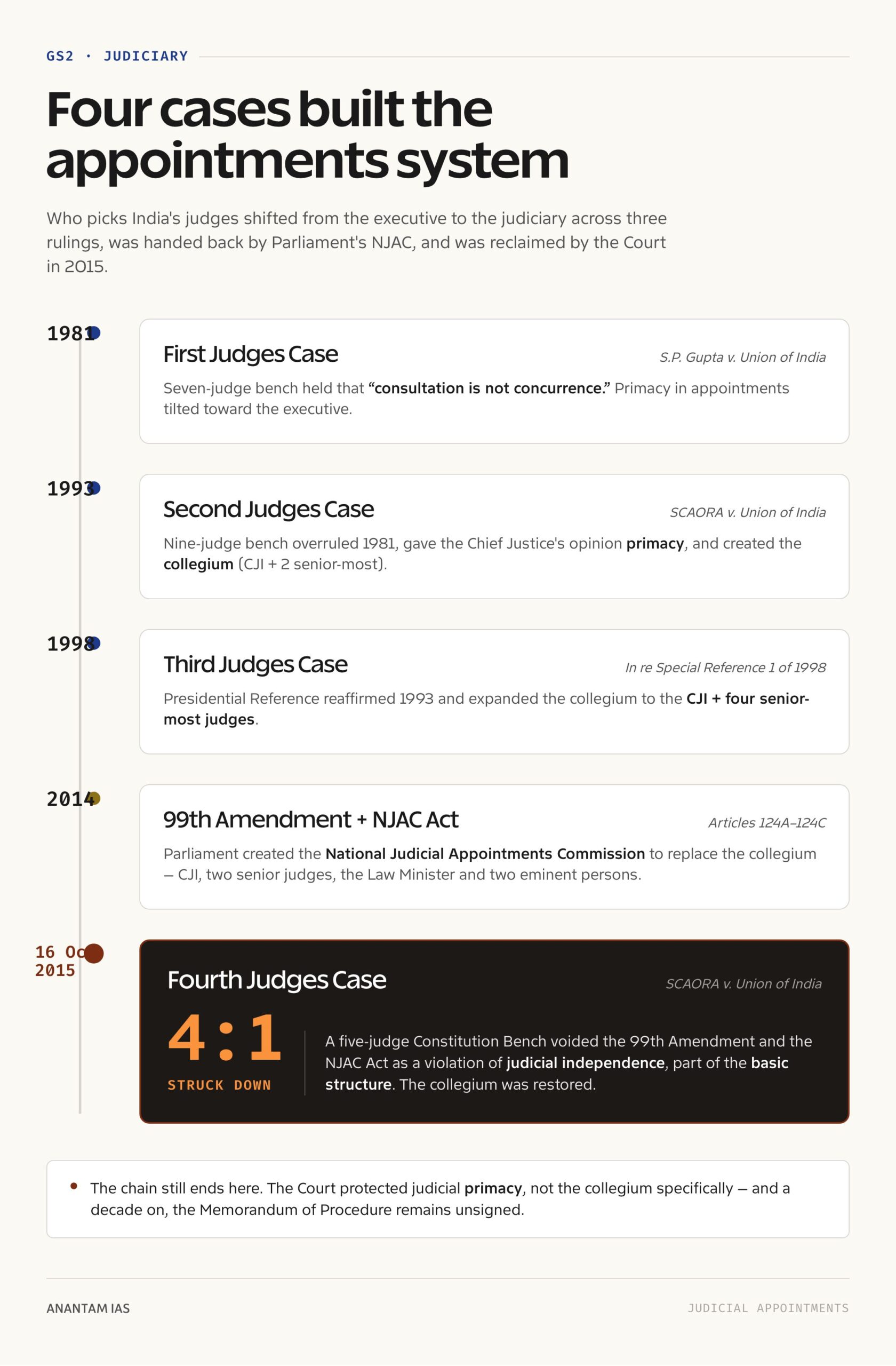
The Ninety-ninth Amendment and the National Judicial Appointments Commission Act sought to replace the collegium with a commission comprising the Chief Justice of India, two senior-most Supreme Court judges, the Union Law Minister, and two eminent persons. In the Fourth Judges Case, Supreme Court Advocates-on-Record Association v. Union of India (2015), a 4:1 majority held the amendment and implementing Act unconstitutional. The controlling concern was judicial independence as part of the basic structure, particularly the loss of judicial primacy in the proposed appointments arrangement.
The sound exam formulation is not “only the collegium can ever exist.” It is that an amendment to the appointments process must preserve judicial independence in substance. Evaluate the commission’s composition, decision rules, and ability of non-judicial members to block a recommendation. Executive participation alone is not the whole analysis; nor do criticism of the collegium’s opacity and a desire for accountability, however serious, automatically validate any proposed replacement. Those considerations matter when assessing a design that protects independence while improving the process.
There is a helpful link back to Part IV. Article 50 directs the State to separate the judiciary from the executive in the public services of the State. It is not itself a complete appointments code for Supreme Court and High Court judges. It does, however, reinforce why the Constitution treats institutional independence as a substantive concern rather than a question answered merely by counting votes in Parliament.
Writing the answer to an amendment problem
Imagine a proposed amendment with three clauses. One shields every law said to advance any Directive Principle from Articles 14 and 19 challenges. Another places superior-court appointments in a commission on which government nominees can control the final recommendation. A third says no constitutional amendment may be questioned in any court. The Bill has secured the requisite parliamentary majorities, but the facts do not say whether States ratified it.
A rank-focused answer would proceed in a disciplined order:
- Identify the power and procedural issue. Article 368 supplies the amending power. Check whether each change engages a matter in its ratification proviso; do not assume silence in the facts proves ratification. State expressly that procedural compliance cannot cure substantive damage.
- Name each implicated feature and its constitutional basis. For the first clause, connect Articles 14 and 19, Article 37 and Part IV, and the Preamble’s commitments to justice, liberty, and equality. For appointments, connect the relevant court provisions to separation of powers and judicial independence. For the review bar, identify judicial review and the limited nature of the amending power.
- Apply the relevant decision to the clause’s effect. The broad Part IV shield closely resembles the change rejected in Minerva Mills. The appointments clause calls for the design-sensitive inquiry illustrated by the Fourth Judges Case: demonstrate how government control affects judicial independence. The blanket review bar closely resembles the Article 368 change rejected in Minerva Mills.
- Give a clause-specific conclusion. Explain which feature each clause damages and why. Avoid saying merely that an amendment “violates Article 14”: for a challenge to a constitutional amendment, the essential question is its effect on the basic structure.
That method also prevents a common mains error: citing every constitutional value in one paragraph without showing what the disputed amendment actually does to any of them.
Conclusion
Article 368 allows substantial constitutional change, but not destruction of the Constitution’s basic features. The Preamble helps identify those features; Fundamental Rights and Directive Principles must be understood in constitutional balance; and separation of powers, judicial independence, and judicial review must be tested against the amendment’s practical institutional effect. In an exam answer, decide procedure first, then make a distinct, reasoned basic-structure finding for each challenged clause.
The next lesson narrows the lens from amendments to rights disputes under Articles 14–19: there, the detailed tests for equality, freedoms, restrictions, and proportionality will matter in their own right.