Recommended resources
The freely available resources this lesson will direct you to.
Introduction
Bonjour ! In our last lesson, we focused on how the passé composé and l'imparfait work together to build a narrative. You learned to distinguish between the background scene (imparfait) and the specific, plot-driving events (passé composé).
So far, we have been telling stories on a single "past" timeline. But what if you need to refer to an event that happened before the main past story you're telling? For example, "I arrived at the station (passé composé), but the train had already left."
This lesson introduces the final piece of our past tense toolkit: the plus-que-parfait. Our goal is to recognize the plus-que-parfait and its function in expressing events prior to other past events. This tense, often called the "past of the past," adds depth and clarity to your narrations.
The "Past of the Past"
The function of the plus-que-parfait (in English, the pluperfect or past perfect) is simple: it describes a past action that was completed before another past action took place.
Think of it as creating a second, deeper layer of the past.
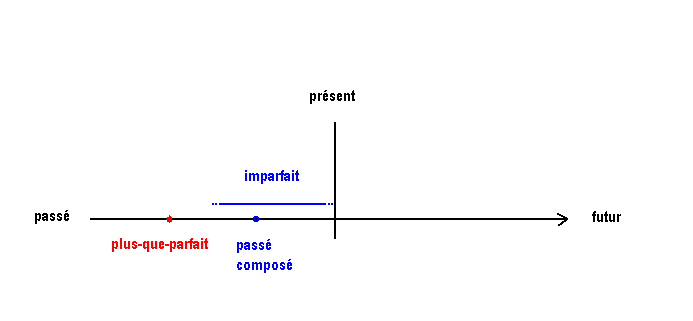
Let's look at a concrete example:

Here, both actions are in the past, but making the batter (que j'avais faite la veille) is in the plus-que-parfait because it happened before making the pancakes (J'ai fait des crêpes).
How to Recognize the Plus-que-parfait
The good news is that if you understand the passé composé and the imparfait, the structure of the plus-que-parfait will look very familiar.
It is a compound tense, just like the passé composé. The formula is:
Auxiliary verb (avoir or être) in the imparfait + Past Participle
Compare this to the passé composé:
- Passé Composé:
J'ai mangé(I ate / I have eaten) -> Auxiliaryavoiris in the present tense. - Plus-que-parfait:
J'avais mangé(I had eaten) -> Auxiliaryavoiris in the imparfait tense.
To see the structure clearly, please take a moment to review the formation rules and the conjugation of the auxiliary verbs.
How to Form and Use the French Pluperfect - FluentU
The article 'How to Form and Use the French Pluperfect' provides a clear, concise guide to the structure of this tense.
Please read the section titled 'How is the Pluperfect Formed?'. Pay special attention to the table showing the imparfait conjugations for 'avoir' and 'être', as they are the building blocks of this tense.
The choice between using avoir or être as the auxiliary verb follows the exact same rules as the passé composé.
Seeing the Plus-que-parfait in Context
The best way to internalize this tense is to see it used in natural examples. The following video gives several clear scenarios where the plus-que-parfait is necessary to show the sequence of past events.
Le plus-que-parfait (conjugaison française)
In this video from Français Authentique, Johan explains the concept and use of the plus-que-parfait with simple, practical examples.
Please watch from 01:24 to 07:19. Focus on the examples he provides: The story about his daughter Emma and the raspberries she had picked (qu'elle avait cueillies). Notice how the picking happened before the eating. His explanation of the formation, comparing it directly to the passé composé (04:32). The second example: Il m'a dit qu'il ne l'avait jamais vu. Notice how 'not seeing' happened before 'telling'.
As you saw in the video, the plus-que-parfait works with both the imparfait and passé composé as the main past reference point.
Emma **mangeait** (imparfait) des framboises qu'elle **avait cueillies** (plus-que-parfait).Il m'**a dit** (passé composé) qu'il ne l'**avait jamais vu** (plus-que-parfait).
The Past Tense Trio
You now have three powerful tools for narrating the past. Let's summarize their roles in storytelling:
- L'Imparfait: The background. It sets the scene and describes ongoing states or habits.
Il pleuvait.(It was raining.)
- Le Passé Composé: The foreground. It describes the main, completed actions that move the plot forward.
...donc je suis resté à la maison.(...so I stayed home.)
- Le Plus-que-parfait: The backstory. It provides context by explaining what happened before the main story.
...parce que j'avais perdu mon parapluie.(...because I had lost my umbrella.)
Putting it all together creates a rich, complete narrative:
Il **pleuvait** (imparfait), donc je **suis resté** (passé composé) à la maison parce que j'**avais perdu** (plus-que-parfait) mon parapluie.
It was raining, so I stayed home because I had lost my umbrella.
Conclusion
In this lesson, you've added the plus-que-parfait to your grammatical toolkit. By recognizing its form and function, you can now understand narratives with multiple layers of past events, a crucial skill for reading French novels and watching films.
Key Takeaways:
- The plus-que-parfait is used to talk about a past action that happened before another past action. It is the "past of the past."
- It is formed with the auxiliary verb
avoirorêtrein theimparfait, followed by the past participle. - This tense works in conjunction with the
passé composéandimparfaitto create a complete and detailed timeline of past events.
In our next and final lesson of this module, you will get a chance to apply everything you've learned about these three past tenses. We will analyze a short story together, focusing on how the interplay between the passé composé, imparfait, and plus-que-parfait creates a compelling narrative.