Recommended resources
The freely available resources this lesson will direct you to.
- How to use and form the imparfait imperfect past French tense animated videowww.youtube.com
- How to build the IMPARFAIT in French // French conjugation course // Lesson 27www.youtube.com
- French Imperfect Conjugations - Lawless French Verbswww.lawlessfrench.com
- L'imparfait: When and how to use the French imperfect tenselingoculture.com
Bonjour! Welcome to our next module.
Introduction
In the previous module, we focused entirely on the passé composé. You learned how to form it and how to interpret it in a narrative as a sequence of completed actions—the events that move a story forward. It answers the question, "What happened?"
However, stories are more than just a list of events. They need context, description, and atmosphere. To paint this picture of the past, French uses a different tense: the imparfait (imperfect).
Today, we will focus on the first step: forming the imparfait for regular and common irregular verbs from example patterns. We will break down its formation into a single, highly consistent pattern. In the next lesson, we will explore when to use it.
1. The Core Pattern of the Imparfait
The great news about the imparfait is that its formation is remarkably consistent, even for verbs that are irregular in the present tense. There is one simple, three-step pattern to learn.
To see this pattern in action, let's start with a video explanation.
How to build the IMPARFAIT in French // French conjugation course // Lesson 27
The video 'How to build the IMPARFAIT in French' by The perfect French with Dylane provides a very clear, step-by-step guide. We'll start with the general rule.
Watch from the beginning until 02:08. The host, Dylane, will explain the fundamental rule for forming the imparfait and demonstrate it with the verb 'donner' (to give).
As you just saw, the pattern is as follows:
- Take the
nous(we) form of the verb in the present tense.- Example:
nous parlons(we speak)
- Example:
- Drop the
-onsending to find the stem.- Example:
parl-
- Example:
- Add the specific
imparfaitendings:
| Subject Pronoun | Imparfait Ending | Example: parler | Pronunciation |
|---|---|---|---|
je / j' |
-ais |
je parlais |
par-leh |
tu |
-ais |
tu parlais |
par-leh |
il / elle / on |
-ait |
il parlait |
par-leh |
nous |
-ions |
nous parlions |
par-lee-on |
vous |
-iez |
vous parliez |
par-lee-ay |
ils / elles |
-aient |
ils parlaient |
par-leh |
Notice the pronunciation pattern: the endings for je, tu, il, and ils all sound the same, even though they are spelled differently.
2. Applying the Pattern to All Regular Verbs
This single rule works for all three groups of regular verbs (-er, -ir, and -re). The key is to always start from the nous form of the present tense. For some verbs, like those ending in -ir, this is crucial.
Let's see this applied to -ir and -re verbs.
How to build the IMPARFAIT in French // French conjugation course // Lesson 27
Let's continue with the same video, where Dylane demonstrates how the rule applies just as well to the other verb groups.
Watch from 02:08 to 03:28. Pay close attention to the verb 'finir' (to finish). Its present tense 'nous' form is 'nous finissons', which gives us the stem 'finiss-'. This is a perfect example of why the 'nous' rule is so important.
To reinforce this pattern, take a look at the conjugation tables in the following article. You don't need to read the whole article, just observe the pattern in the tables.
L'imparfait: When and how to use the French imperfect tense
The article 'L'imparfait: When and how to use the French imperfect tense' from LingoCulture provides clear examples.
Quickly review the conjugation tables for 'parler' (-er), 'rendre' (-re), and 'choisir' (-ir). They are located under the main heading 'French imparfait conjugation'. Notice how the stem for 'choisir' is 'choisiss-', derived directly from 'nous choisissons'.
3. "Irregular" Verbs and the One True Exception
Here is more good news: most verbs that are considered irregular in the present tense become regular in the imparfait, because they still follow the nous-form rule.
Let's look at a few of the most common ones.
- Faire (to do/make): Present tense
nousform isnous **fais**ons.- Stem:
fais- - Imparfait:
je faisais,tu faisais,il faisait...
- Stem:
- Aller (to go): Present tense
nousform isnous **all**ons.- Stem:
all- - Imparfait:
j'allais,tu allais,il allait...
- Stem:
- Avoir (to have): Present tense
nousform isnous **av**ons.- Stem:
av- - Imparfait:
j'avais,tu avais,il avait...
- Stem:
There is only one verb in the entire French language that is irregular in the imparfait: être (to be). Its stem is ét-.
Let's see how to form the imparfait for être and get a helpful tip to remember it.
How to build the IMPARFAIT in French // French conjugation course // Lesson 27
We'll return to Dylane's video one last time to look at the only exception.
Watch from 06:15 to 07:40. This segment covers the conjugation of 'être' and provides a simple mnemonic technique based on its past participle, 'été'.
The image below provides a great summary of the imparfait for these three essential verbs.
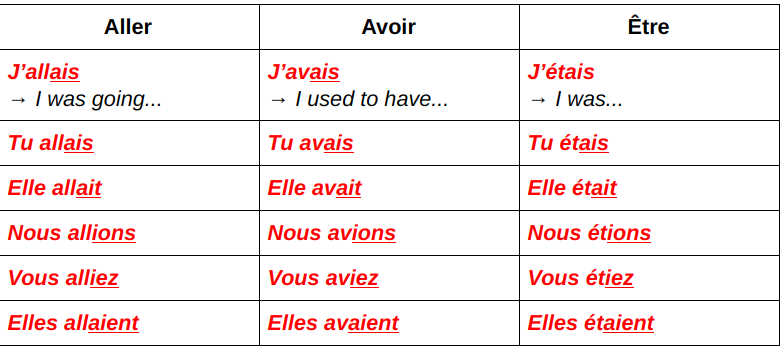
4. A Note on Spelling Adjustments
Some verbs require minor, logical spelling tweaks to maintain their pronunciation. This isn't a new rule, but rather an application of sound rules you may already know.
- Verbs ending in -ger (e.g.,
manger- to eat): Thenousform isnous man**ge**ons. An extraeis kept before theimparfaitendings-ais,-ait, and-aientto preserve the soft 'g' sound.je mang**e**ais,tu mang**e**ais,il mang**e**ait,ils mang**e**aient- (but
nous mangions,vous mangiez, since 'i' already creates a soft 'g' sound).
- Verbs ending in -cer (e.g.,
commencer- to begin): Thenousform isnous commen**ç**ons. Thecbecomes aç(cédille) before endings that start with 'a' to preserve the soft 's' sound.je commen**ç**ais,tu commen**ç**ais,il commen**ç**ait,ils commen**ç**aient
You can see a quick visual explanation of this in the following video.
How to use and form the imparfait imperfect past French tense animated video
The video 'How to use and form the imparfait' by Lingo Learner has a very concise explanation of these spelling changes.
Watch from 05:11 to 05:55. The video explains why verbs like 'manger' and 'commencer' need these small adjustments.
Conclusion
You've now learned the foundational pattern for forming the imparfait, one of the most consistent tenses in French.
Key Takeaways:
- To form the
imparfait, take thenousform of the present tense, drop the-ons, and add the endings:-ais, -ais, -ait, -ions, -iez, -aient. - This rule applies to regular verbs and almost all irregular verbs.
- The only verb that is truly irregular in the
imparfaitisêtre, which uses the stemét-.
Now that you know how to form the imparfait, you're ready for the next logical step. In our next lesson, we will explore when to use it—for descriptions, habitual past actions, and setting the background scene in a story. This will prepare you to see how it works together with the passé composé to create rich and detailed narratives.