Recommended resources
The freely available resources this lesson will direct you to.
Hei! This module is about using Norwegian in shops, with food, purchases, and checkout conversations. We’ll start with the words you need before you reach the cashier: what an item is, how much of it you want, what container it comes in, and what the shelf label says. By the end of this lesson, you should be able to make a short grocery list in Bokmål, recognize common quantities and packages, and interpret an ordinary price tag.
Finding the food words
Imagine walking into a matbutikk (grocery store) with a small list. You do not need the Norwegian name for every product in the building. A useful first vocabulary is built around the sections you visit regularly: fruit and vegetables, dairy and eggs, bread and pantry goods, and drinks.
The illustration gives you a visual starting point. Notice eple (apple), gulrot (carrot), brød (bread), egg (egg or eggs), and kaffe (coffee). These are product names in their basic form; a shopping list may need a plural or a quantity as well.
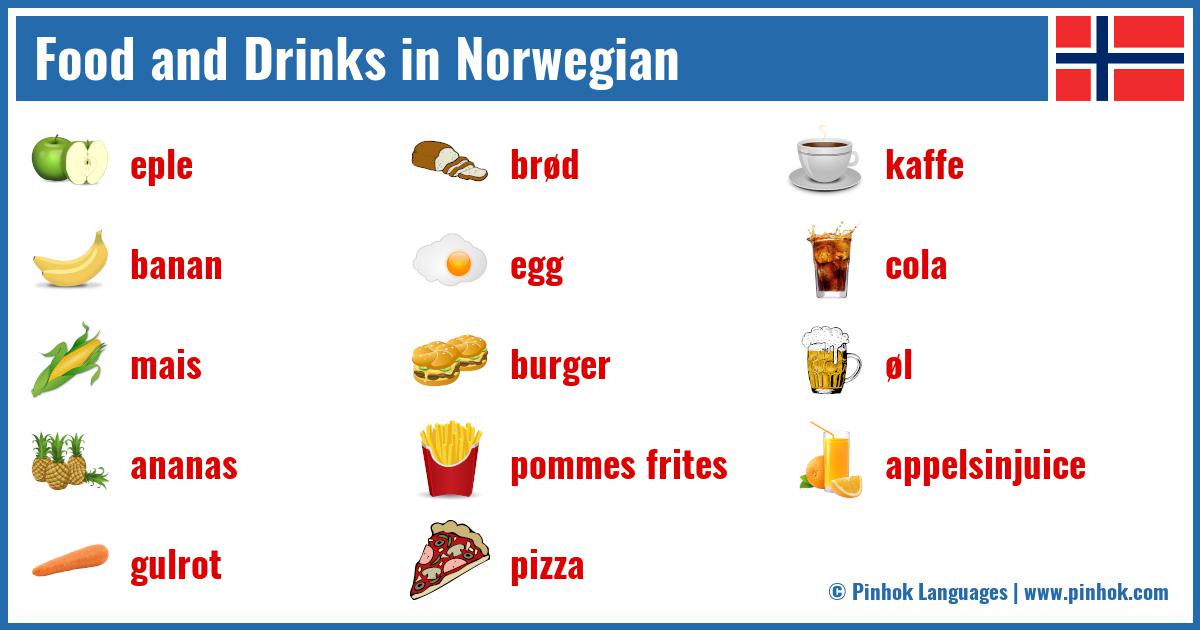
The reading below supplies a broader but still practical set of grocery words. Treat its lists as a recognition guide, not as a demand to memorize every entry today.
Grocery shopping in Norwegian – essential words and phrases
Read Preply’s “Grocery shopping in Norwegian – essential words and phrases” to connect product names with the store signs and price words you will encounter on a shopping trip.
In “Store basics” and “Price and quantity words,” read the store terms. Then, under “Grocery items in Norwegian,” read from “Fruit and vegetables” through “Drinks, snacks, and treats”: the food categories. Prioritize words for foods you actually buy; skim the others so you can recognize them on a sign or package.
Here is a compact list to retain from that reading:
| In the shop | Useful words |
|---|---|
| Fruit and vegetables | eple apple, banan banana, potet potato, gulrot carrot, løk onion, tomat tomato |
| Chilled foods | melk milk, ost cheese, smør butter, egg egg/eggs, kylling chicken |
| Bread and pantry | brød bread, ris rice, pasta pasta, mel flour |
| Drinks | vann water, kaffe coffee, te tea, brus soft drink |
Two signs help you orient yourself: frukt og grønt marks fruit and vegetables, while meieri marks dairy. Tilbud means an offer or sale; it tells you to inspect the price, not automatically that the product is the best value.
A bare product word works on a private list—melk, brød, tomater—but a quantity makes it useful when speaking or checking that you picked up the right thing. That is our next step.
Saying how much: counts, measures, and packages
Norwegian grocery quantities follow a pattern: number or amount + unit or package + product. For example, to epler means “two apples,” while en liter melk means “a litre of milk.” Unlike English, Norwegian does not insert “of” in these phrases.
The distinction between individual items and measured goods matters. You can count apples, but you usually buy milk by the litre and potatoes by weight or by the bag. A few highly reusable forms are:
- et eple → to epler — one apple, two apples
- en potet → to poteter — one potato, two potatoes
- en gulrot → to gulrøtter — one carrot, two carrots
- et egg → seks egg — one egg, six eggs
- et brød → to brød — one loaf of bread, two loaves
You do not need a complete theory of noun plurals to use these. Notice especially that egg and brød do not change form after a number, whereas eple becomes epler.
For goods sold by measure, learn the unit together with a realistic product:
| Quantity | Meaning |
|---|---|
| et kilo poteter | a kilo of potatoes |
| et halvt kilo epler | half a kilo of apples |
| hundre gram ost | a hundred grams of cheese |
| en liter melk | a litre of milk |
| en halv liter juice | half a litre of juice |
Why et halvt kilo, but en halv liter? The words for “half” agree with the unit: et kilo takes halvt, and en liter takes halv. Remembering the complete phrases is more useful at this stage than working through every adjective form.
A package can be the quantity you buy. En pakke is a pack, en pose a bag, en flaske a bottle, en boks a can or container, and en kartong a carton. Thus en pakke pasta, en pose poteter, en flaske vann, en boks tomater, and en kartong melk describe recognizable things to pick off a shelf. At checkout, pose can also mean the shopping bag you carry your purchases in; the context tells you which bag is meant.
These building blocks let you say Jeg trenger en liter melk og to brød (“I need a litre of milk and two loaves of bread”). If you are still browsing, Jeg skal ha en pakke pasta is a natural way to say that you are getting a pack of pasta. Focus on assembling the quantity and item clearly; fuller shop conversations come later in the module.
Reading the number on the shelf
Norwegian prices use kroner, abbreviated kr. One krone is divided into 100 øre. On a label, 19,90 kr means 19 kroner and 90 øre: the comma marks the decimal part. You will also see a space or dot separating thousands, as in 1 500 kr or 1.500 kr. Neither means one and a half kroner.
To make spoken prices less opaque, first hear the number words from 11 to 100. The video is short; repeat the tens aloud, because they appear constantly in prices.
Learn Norwegian - Norwegian in Three Minutes - Numbers 11-100
Watch “Learn Norwegian - Norwegian in Three Minutes - Numbers 11-100” from Learn Norwegian with NorwegianClass101.com for the number sounds you need to recognize prices.
In eleven to twenty, repeat the numbers after the speaker. Continue with the tens, listening especially for tretti, førti, and femti. In combined numbers, notice how a tens word joins a smaller number to make a price such as 56 or 98.
For reference, 20 is tjue, 30 tretti, 40 førti, 50 femti, and 90 nitti. A number such as 39 is trettini: thirty followed by nine. You can now read an everyday price, 39,90 kr, as trettini nitti. That shortened form means “39 kroner and 90 øre”; in full, it is trettini kroner og nitti øre.
The following reading explains both that spoken shortcut and the weight notation you will see beside produce.
Phone Numbers, Prices and Measurements | Norwegian Grammar | Elon.io
Read the price and shopping-measurement parts of Elon.io’s “Phone Numbers, Prices and Measurements” to connect written shelf labels with what someone may say aloud.
Skip the phone-number discussion at the top. In “Prices: kroner and øre,” read the price explanation, including the 19,90 example and the paragraph on the informal spoken form. In “Metric measurements read aloud,” read the metric examples; focus on 3,5 kg and the shopping phrase beginning “Kan jeg få et halvt kilo kjøttdeig?” You can skim the intervening transport examples.
A shelf label can state either the price of the package or a price per unit of measure. The little word per means “per”:
- 29,90 kr/stk: 29 kroner and 90 øre per item (stk abbreviates stykk).
- 39,90 kr/kg: 39 kroner and 90 øre per kilo.
- 24,90 kr/l: 24 kroner and 90 øre per litre.
These are different kinds of information. If apples cost 39,90 kr/kg, a half-kilo costs 19,95 kr, not 39,90 kr. On the other hand, a carton marked 24,90 kr has that price for the carton. Check the unit before comparing two offers.
When you want to ask rather than calculate, Hva koster det? means “What does it cost?” and Hva koster en liter melk? asks for the price of a litre of milk. Det koster 24,90 kr is “It costs 24 kroner and 90 øre.” For now, the main skill is to recognize the answer and connect it to the correct quantity.
Putting the words together
Consider this short shopping list:
Et brød, en kartong melk, seks egg, en pose poteter og to epler.
One loaf of bread, one carton of milk, six eggs, one bag of potatoes, and two apples.
It contains three different ways of specifying an amount: an individual item (et brød), a package (en kartong melk), and a counted number (seks egg). If a shelf label for loose apples says 39,90 kr/kg, you know you still need their weight to work out their cost. If the milk label says 24,90 kr/l, you know what quantity the price refers to. Product word, quantity, and price unit work together; missing any one of them can change what you think you are buying.
Your key takeaways are the core food names, reusable quantity phrases such as et halvt kilo and en liter, common packages such as pakke, pose, and kartong, and the distinction between kr per item, per kilo, and per litre. Prices use a decimal comma, and 19,90 is commonly said nitten nitti. Next, we will use this vocabulary to understand the routine questions you may hear at a Norwegian checkout.