Recommended resources
The freely available resources this lesson will direct you to.
Hei! Last lesson, you explained a problem with something you had bought and made a clear request using Kan jeg få …? Now you can use that same phrase before the purchase: at a café or restaurant. This lesson will help you order a dish and a drink, say how you would prefer them, and explain a dietary restriction clearly enough for staff to check it.
Build an order around one short phrase
At the counter, you do not need a long introduction. Start with the item you want:
Kan jeg få en kaffe, takk?
Can I have a coffee, please?Jeg tar fiskesuppen, takk.
I’ll have the fish soup, please.
Kan jeg få …? is a request; Jeg tar … states your choice. Both are natural. For a slightly softer way to state what you want, use Jeg vil gjerne ha … (“I’d like …”).
Listen to these phrases in a restaurant setting. The useful point is not to memorize the whole visit, but to hear how a customer moves from ordering a drink to naming a dish.
What to say in a restaurant in Norway
Watch “What to say in a restaurant in Norway” from Preben’s Norwegian community for spoken examples of ordering drinks and a meal.
Watch ordering a drink, where the customer uses a polite request, then choosing a meal. Listen for the short ordering phrase before the name of the item; you can replace that item with one you actually want.
For a compact written reference, read the ordering examples in Preply’s How to order food in Norwegian. Notice that the phrase stays nearly the same whether you order coffee, salad, or a particular dish on the menu.
How to order food in Norwegian – phrases and examples
Read Preply’s examples to see how a few reusable phrases cover both food and drinks.
In “3. Place the order,” begin with the paragraph introducing the two sentence frames. Read the frames and examples, ending with the example about bread for the table. Focus on the difference between asking for an item and simply stating your choice.
A menu often names a dish in its definite form: fiskesuppen (“the fish soup”), laksen (“the salmon”). You can use that name directly: Jeg tar laksen. For a drink, a quantity makes the request more precise: et glass vann (a glass of water), en kopp kaffe (a cup of coffee). If you have not decided yet, Hva er dagens rett? asks “What is today’s dish?”
Add a preference without rebuilding the sentence
A preference can usually be attached to the order you already know. Med means “with,” and uten means “without”:
Kan jeg få en kaffe med havremelk?
Can I have a coffee with oat milk?Jeg tar salaten uten løk, takk.
I’ll have the salad without onion, please.
If you want to express a preference while leaving room for another option, helst means “preferably”:
Jeg vil helst ha vann.
I’d prefer water.Jeg vil gjerne ha suppen, men helst uten fløte.
I’d like the soup, but preferably without cream.
That last sentence is a request, not confirmation that the soup can be made without cream. When an ingredient matters for your health, ask what is in the dish before settling on it. For an ordinary preference, uten løk, takk may be enough; for a dietary restriction, the kitchen may need more information.
A short café order might therefore be:
Kan jeg få en kaffe med havremelk og en salat uten løk, takk?
Can I have a coffee with oat milk and a salad without onion, please?
You have ordered a drink, ordered food, and stated two preferences in one sentence.
State the restriction, then ask about the dish
A dietary restriction deserves more than uten … on its own. Tell the server what the restriction is, then ask a question that can be checked. Preply’s section on dietary needs supplies several useful ways to do this.
How to order food in Norwegian – phrases and examples
Return to Preply’s guide for phrases about allergies, vegetarian options, ingredients, and changing part of an order.
In “Restaurant phrases for dietary needs and changes,” read the subsections “Mention an allergy” and “Ask for vegetarian or gluten-free options.” Start with the allergy and option phrases, ending with the question about dairy in sauce. Then, under “Change part of the order,” read the opening example about asking for a dish without onion. Notice the difference between asking what a dish contains and requesting a change to it.
Choose the statement that describes your actual need:
- Jeg er allergisk mot nøtter. — I’m allergic to nuts.
- Jeg er laktoseintolerant. — I’m lactose intolerant.
- Jeg er vegetarianer. Jeg spiser ikke kjøtt. — I’m vegetarian. I don’t eat meat.
- Jeg spiser ikke gluten. — I don’t eat gluten.
These statements are not interchangeable. In particular, laktoseintoleranse and melkeallergi (milk allergy) are different conditions. If you have a milk allergy, say Jeg er allergisk mot melk, rather than calling it lactose intolerance. State your own restriction accurately instead of relying on a broad label such as “no dairy.”
The translation card below shows why this information is worth preparing before a meal. Its front lists foods to ask about, while the Norwegian card behind it states that the holder is lactose intolerant. The list is a prompt for a conversation, not a guarantee that every listed food contains lactose or that an unlisted dish is safe.
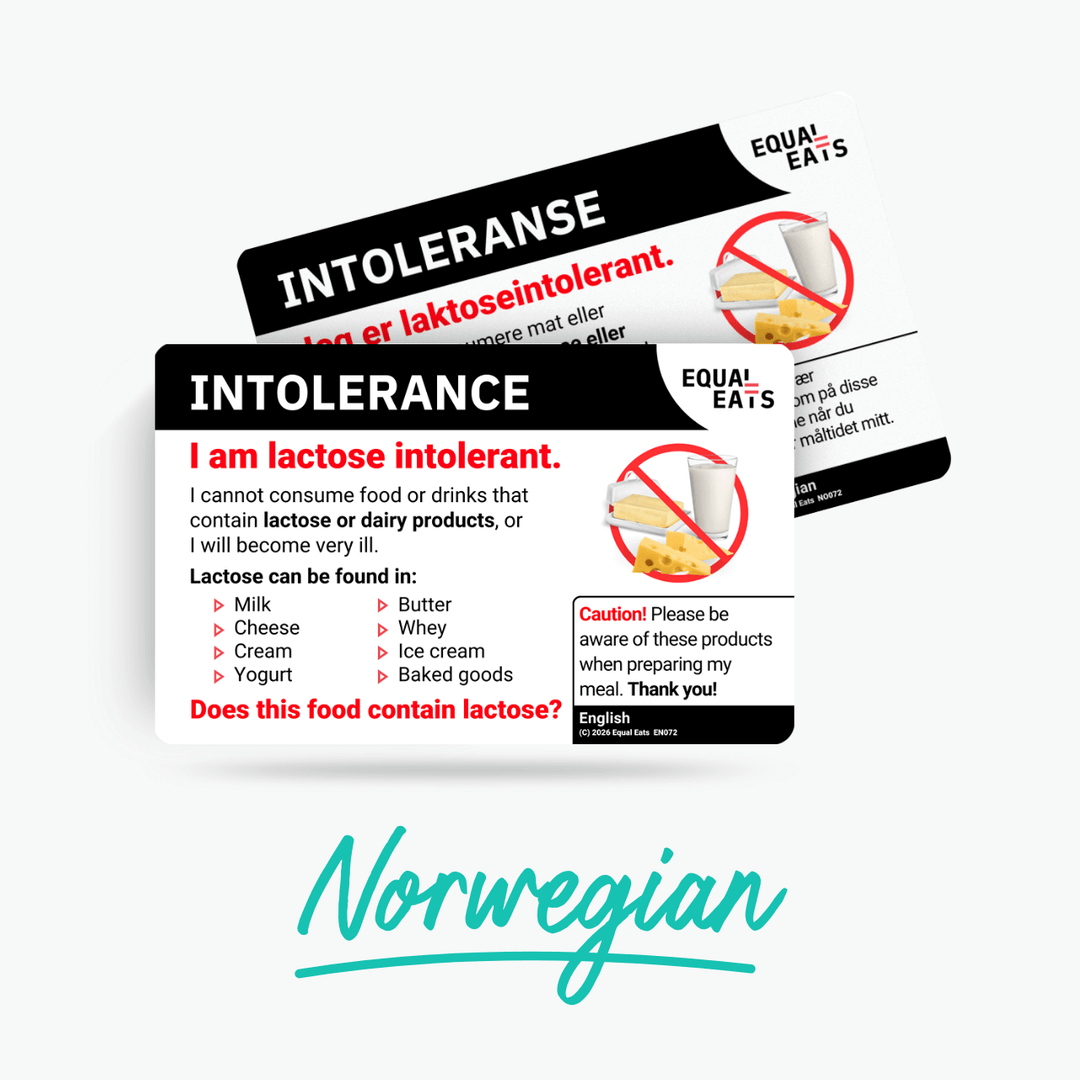
Once you have stated the restriction, make your question specific:
Inneholder fiskesuppen melk eller fløte?
Does the fish soup contain milk or cream?Er det nøtter i denne retten?
Are there nuts in this dish?Er denne retten vegetarisk?
Is this dish vegetarian?Har dere laktosefrie alternativer?
Do you have lactose-free options?
Inneholder …? asks whether something “contains” an ingredient. Er det … i denne retten? asks whether there is an ingredient “in this dish.” Either lets you check before ordering. If the server is unsure, Kan du sjekke med kjøkkenet? means “Can you check with the kitchen?” For a serious allergy, explain it clearly and wait for a reliable answer; merely removing a visible ingredient may not address how a dish was prepared.
Put the parts together at the table
Imagine you are considering fish soup but cannot have lactose. You can identify the concern before you commit to the dish:
Du: Hei. Jeg er laktoseintolerant. Inneholder fiskesuppen melk eller fløte?
Servitør: Det må jeg sjekke med kjøkkenet.
Du: Takk. Har dere noe laktosefritt? Og kan jeg få et glass vann?
The server says, “I need to check with the kitchen.” You have not ordered the soup yet. Meanwhile, you have asked about an alternative and ordered a drink. Once the ingredients are confirmed, you can choose: Da tar jeg den (“Then I’ll have that one”) if the suggested option works for you.
For a preference rather than a medical restriction, the exchange can be shorter:
Servitør: Hva vil du ha?
Du: Jeg tar salaten uten løk, takk. Og kan jeg få en kaffe med havremelk?
Servitør: Ja, selvfølgelig.
Hva vil du ha? means “What would you like?” The customer answers with a food choice, a requested change, and a drink. If a change is not possible, you can keep the conversation moving with Da tar jeg heller … (“Then I’ll have … instead”).
The most reliable order is not necessarily the longest one. Say what you want; add med, uten, or helst for a preference; and, when something is a dietary restriction, state it explicitly and ask the staff to check the relevant ingredients.
Takeaways
Keep Kan jeg få …?, Jeg tar …, and Jeg vil gjerne ha … ready for food and drinks. Use med and uten to request changes, but do not treat a requested change as proof that a dish meets a dietary need. For a restriction, say what it is, ask about the particular dish, and use Kan du sjekke med kjøkkenet? when the answer is uncertain.
Next lesson, the focus shifts to understanding the server’s questions about choices, additions, payment, and receipts—so you can respond as readily as you can now place the order.