Recommended resources
The freely available resources this lesson will direct you to.
Hei! In the last lesson, you listened for a server’s questions about choices, payment, and receipts. You also saw a phrase for asking someone to say something again. This lesson puts that phrase to work when a transaction goes off track: perhaps you missed a price, did not understand an ingredient, or received something other than what you ordered.
The aim is not to understand every word immediately. It is to keep the conversation in Norwegian long enough to identify the problem, check the important detail, and put it right. Allow about 35–40 minutes, including a second viewing of the short video and time to say the dialogues aloud.
Ask for the kind of help you need
A quick Unnskyld? (“Pardon?”) can signal that you missed something. If the second attempt is still unclear, a more specific request gives the other person a better way to help:
- Kan du gjenta det? — Can you repeat that?
- Kan du snakke litt saktere? — Can you speak a little more slowly?
- Kan du si det på en annen måte? — Can you say it another way?
- Hva betyr «kullsyre»? — What does “kullsyre” mean?
These requests solve different problems. Repetition helps when you did not hear the words. Slower speech helps when you cannot separate them quickly enough. An explanation or rephrasing helps when you heard a word but do not know what it means. Repeating the same unfamiliar word more slowly may still leave you stuck.
The phrases in the image are useful starting points. Jeg forstår ikke (“I don’t understand”) signals a problem; adding a request such as Kan du gjenta det? tells the speaker what to do next.
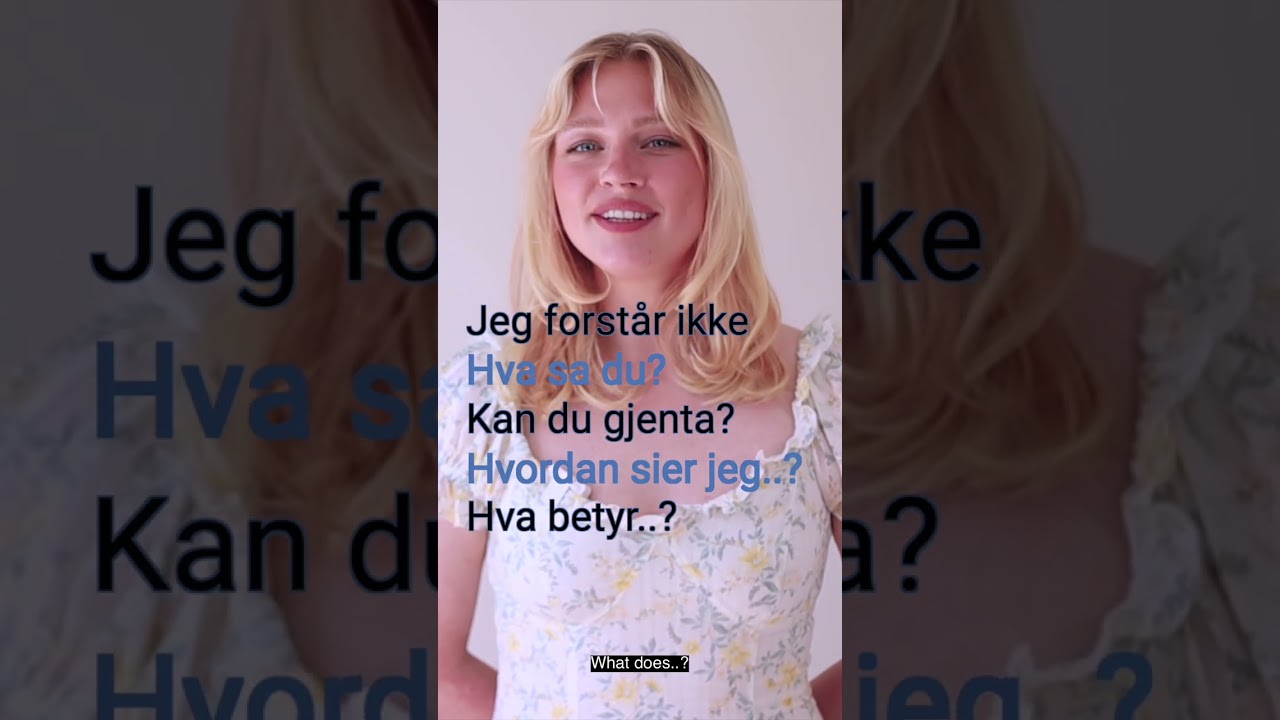
Watch the short selections from Simple Norwegian #3 – Fundamental Words & Phrases, by Simple Norwegian. Listen to the phrases as complete utterances rather than trying to pronounce each word separately.
Simple Norwegian #3 - Fundamental Words & Phrases
Watch “Simple Norwegian #3 – Fundamental Words & Phrases” to hear useful repair phrases spoken aloud.
Start with pardon and sorry; this segment begins with two other adjectives before reaching unnskyld and beklager. Then watch not understanding and slower speech. On a second viewing, pause after Jeg forstår ikke and Kan du snakke saktere? and say each aloud.
For a few more options, read the opening and first part of the phrase list in Slow Down and Repeat from the Norwegian Language Blog. Focus on phrases you could say to a cashier or server; you do not need to memorize the whole list.
Slow Down and Repeat | Norwegian Language Blog
The Norwegian Language Blog’s “Slow Down and Repeat” gives you short ways to signal and repair a misunderstanding.
In the main body, begin with the opening paragraph that starts “Jeg lærer norsk.” Then read the first phrases, from Unnskyld? through Kan du gjenta det? Compare asking what a word means with asking someone to repeat it. The examples involving other vocabulary illustrate the same pattern; your transaction might involve a price, an ingredient, or a product name instead.
You can keep the request brief. Unnskyld, kan du gjenta det? is enough in a busy shop. If you caught part of the sentence, name the part you need: Kan du gjenta prisen? (“Can you repeat the price?”) or Kan du si det siste en gang til? (“Can you say the last part once more?”).
Confirm what you think you heard
Sometimes you understand almost everything. In that case, asking for the entire sentence again can be less effective than saying what you think it means. You give the other person something specific to confirm or correct.
Imagine a server asks a quick question about water. You hear med … kullsyre, but miss whether it was med (“with”) or uten (“without”). Before choosing, say:
Mente du med eller uten kullsyre?
Did you mean with or without carbonation?
Or, if you think you understood the choice:
Så det er vann uten kullsyre, stemmer det?
So it’s still water, is that right?
Mente du …? checks what the speaker meant. Stemmer det? asks “Is that correct?” after your own summary. Both are particularly valuable when the difference is small in sound but important in practice: to versus tre items, med versus uten an ingredient, or one price versus another.
A confirmation should contain the detail that matters. Ja, ja may sound as though you understood when you did not. Ja, uten melk confirms a specific requirement. If an allergy or intolerance is involved, do not treat a vague answer as confirmation that a dish is safe. You can say Jeg tåler ikke melk. Kan du sjekke med kjøkkenet om suppen inneholder melk? (“I can’t tolerate milk. Can you check with the kitchen whether the soup contains milk?”) Wait for a clear answer before deciding.
If speech remains difficult, you can ask to see the relevant information instead: Kan du vise meg prisen? (“Can you show me the price?”). This is not giving up on Norwegian; it is choosing a more reliable way to settle the transaction.
Correct the transaction, not just the conversation
A misunderstanding may become visible only after someone has acted on it. Perhaps the cashier enters the wrong quantity, or the server brings the wrong drink. At that point, another request to repeat the original question will not fix the result. State what happened and what you need instead.
At a shop counter, the correction can be very short:
Kasserer: Tre epler?
Du: Nei, to epler, takk.
Kasserer: Å ja, to. Beklager.
Du: Det går bra.
Nei, to epler, takk makes the contrast clear without turning it into a confrontation. If you were the one who spoke unclearly or changed your mind, Beklager, jeg mente to epler, ikke tre (“Sorry, I meant two apples, not three”) takes responsibility for the correction. The important information is to … ikke tre.
In a restaurant, the error may be in what arrives:
Du: Unnskyld, jeg bestilte vann uten kullsyre, men dette er med kullsyre. Kan jeg få vann uten kullsyre?
Servitør: Beklager. Jeg kommer med et nytt glass.
Du: Takk.
This works because it identifies the order, identifies the mismatch, and makes a clear request. Jeg tror det har skjedd en misforståelse (“I think there has been a misunderstanding”) is a useful gentle opening when you are unsure where the error occurred. Follow it with the concrete detail: Jeg bestilte uten kullsyre.
The same approach works at payment. If the amount seems wrong, pause before paying and check the item rather than guessing at the cause:
Du: Unnskyld, det står tre epler her, men jeg har bare to. Kan du sjekke det?
Kasserer: Ja, selvfølgelig. Jeg retter det.
Du: Takk.
Det står … her (“It says … here”) points to what you can see on the screen or bill. Kan du sjekke det? asks the cashier to check without assuming how the mistake happened. After a correction, make sure the quantity or amount now matches what you intended.
Keep the repair moving
You do not need a long explanation while people are waiting. In most transactions, one short phrase opens the repair, one sentence identifies the uncertain or incorrect detail, and a final response confirms the resolution.
Compare these two situations:
You missed the question:
Unnskyld, kan du gjenta prisen?
Pardon, can you repeat the price?You heard the number but doubt it:
Sa du hundre og tjue kroner?
Did you say 120 kroner?
The second response is more precise if you caught a likely amount. It lets the other person answer Ja or supply the correct number. Likewise, Hva betyr «kullsyre»? is more useful than Kan du gjenta det? when the unfamiliar word itself is the obstacle.
Spend a few minutes saying the shop and restaurant dialogues aloud, first reading both parts and then just your own lines. Keep a small pause after Unnskyld so the other person has a chance to turn toward you. When you correct to, ikke tre or uten, ikke med, make those contrasting words especially clear. Your goal is not a perfect performance; it is a phrase you can retrieve while a real transaction is underway.
Takeaways
When something is unclear, match your phrase to the problem: ask for repetition if you missed the words, slower speech if you could not keep up, or rephrasing or a definition if you heard the words but did not understand them. When you partly understand, confirm the critical detail aloud. If an order or charge is already wrong, state the mismatch and ask for a specific correction.
This completes the module on shopping, food, and routine transactions. Next, you will begin learning the vocabulary needed to navigate public transport, tickets, and disruptions.