Recommended resources
The freely available resources this lesson will direct you to.
- Enterprise Architecture 101: How to Improve Decision-Makingwww.youtube.com
- What is Enterprise Architecture (EA) and why is it important? EA concepts explained in a simple way.www.youtube.com
- The All-in-One TOGAF Guide - Visual Paradigm Guidesguides.visual-paradigm.com
- Embedding Enterprise Architecture in Strategic Decision-Makingwww.businessarchitecture.info
Hello! Last lesson established two ideas: an enterprise is defined by the goals and boundary under consideration, and its architecture describes significant components, relationships, and guidance for their evolution. This lesson asks what that description is for. How can it help an organization turn a strategic goal into coordinated change—and make better decisions before committing resources?
We will keep using the library system from the previous lesson. It gives us a way to see why a decision about software can also be a decision about services, responsibilities, information, and investment.
From a strategic goal to a change decision
Suppose the library system adopts a goal: readers should be able to find and borrow materials across branches more reliably. That statement gives direction, but it does not specify what to change. Leaders might consider replacing the shared catalog, improving how branches update it, changing lending rules, or some combination of these.
Enterprise architecture helps by making the consequences of those choices visible. The current arrangement—often called the baseline—shows how branches, lending activities, records, and systems work today. A target describes the arrangement needed to support the goal. Comparing the two exposes gaps: perhaps branches apply different rules, records are updated at different times, and no team has clear responsibility for resolving discrepancies.
A gap is not automatically a request to buy technology. In this example, new catalog software alone might leave inconsistent lending rules untouched. Conversely, changing rules without improving the flow of records might leave readers seeing incorrect availability information. The architectural view connects the parts so that decision-makers can ask what combination of changes would actually achieve the goal.
Watch this short segment from AssistKD’s Enterprise Architecture 101: How to Improve Decision-Making. It introduces baseline and target descriptions and explains how architects use differences between them to guide change initiatives.
Enterprise Architecture 101: How to Improve Decision-Making
AssistKD’s explanation provides a compact picture of how architecture supports planned change rather than merely documenting the present.
Watch planning change. Focus on the distinction between describing the baseline and target, planning how to bridge their differences, and carrying out the resulting change projects. The video also introduces intermediate descriptions; for now, it is enough to understand them as possible checkpoints on the way to a target.
The key separation is between informing change and executing change. Architecture can identify dependencies, establish direction, and provide guidance against which proposals are assessed. The people responsible for funding, managing, and delivering initiatives still make their respective decisions and do the implementation.
Where architecture enters organizational decisions
Architecture is most useful while options are still open. If a platform has already been purchased and several projects depend on it, discovering that it cannot support the target service is much less useful than discovering the constraint before the purchase.
Daniel Lambert’s Embedding Enterprise Architecture in Strategic Decision-Making argues for bringing architectural information into decisions early. Read the selected passages as an account of how EA can contribute, not as a rule that architects make every strategic or funding decision.
Embedding Enterprise Architecture in Strategic Decision-Making
Read Daniel Lambert’s article for concrete examples of the decisions enterprise architecture can inform: strategic direction, investment priorities, and coordinated delivery.
In the opening of “Embedding Enterprise Architecture in Strategic Decision-Making,” read the early-decision argument, from the discussion of architects arriving after decisions through the paragraph beginning “A more effective model.” Then go to “1. Executive Committee: Connecting Strategy to Enterprise Change” and read architecture's role. In “3. Product and IT Portfolio Decisions: Prioritizing the Right Initiatives,” read portfolio decisions. Finally, in “7. Transformation Execution: Connecting Decisions to Delivery,” read coordinated delivery. As you read, notice who makes a decision, what information architecture adds, and who carries out the work.
The diagram below places enterprise architecture among four related activities. It is an illustration of relationships, not a required TOGAF organization chart or a claim that the architecture team controls all four.
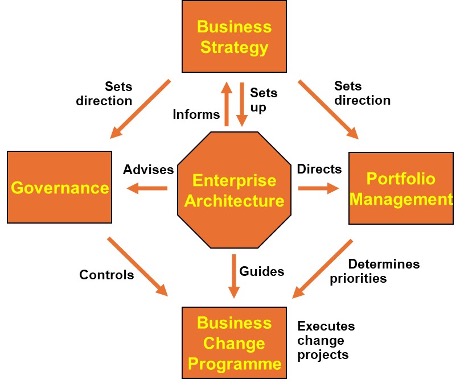
The distinctions matter:
- Business strategy sets goals and priorities. Architecture can inform strategy by showing whether existing capabilities and systems can support a proposed direction, but it does not choose the organization’s goals on its own.
- Portfolio management weighs proposed investments against limited resources. Architecture adds information about overlap, dependencies, risk, and fit with the intended future state.
- Governance provides decision-making and oversight arrangements. Architecture can supply guidance for assessing whether a proposed change remains consistent with agreed direction.
- Change programmes and projects perform the work. Architectural guidance helps separate projects contribute to the same outcome rather than produce incompatible results.
These are connected activities, not substitutes for one another. An architecture that never reaches investment or delivery decisions has little effect; a project that ignores the wider architecture may succeed locally while making the enterprise’s goal harder to achieve.
Making a better choice in the library system
Return to the goal of reliable cross-branch borrowing. Imagine two proposals competing for funding:
Proposal A replaces the reader-facing catalog. Proposal B establishes shared rules for recording availability and updates the connection between branch lending records and the catalog. A polished new catalog might improve how readers search, but if it displays stale availability information, it will not solve the central reliability problem.
Architecture gives leaders a way to test each proposal against the goal. They can ask: Which parts of the current arrangement cause incorrect availability? Which branches and services depend on those parts? Would one proposal duplicate work another team is already funding? What risk remains if only one proposal proceeds? The answers may support Proposal B first, or reveal that a coordinated combination is needed. The architecture does not determine the answer without evidence; it makes the reasoning more complete.
This is also a question of sequence. If a new catalog depends on consistent branch records, improving those records may need to happen first. Making that dependency visible helps decision-makers fund and schedule change sensibly. We will study formal approaches to gaps, work packages, and roadmaps later in the course; here, the essential point is that an intended future state helps connect individual projects to an overall direction.
Enterprise architecture therefore supports strategic change in three complementary ways. It translates intent into implications for the enterprise, compares options using their enterprise-wide effects, and guides coordinated implementation as decisions become projects. It can reveal risks and trade-offs, but it does not guarantee that a chosen strategy will succeed.
Key takeaways
Enterprise architecture is not valuable merely because it describes an enterprise accurately. Its practical value lies in helping people decide what should change, why, and with what consequences. A baseline and target make the direction of change discussable; relationships and dependencies make investment choices better informed; and architectural guidance helps separate initiatives work toward a coherent result.
Next, we will distinguish the Business, Data, Application, and Technology Architecture domains. Those domains give us a more precise vocabulary for identifying which parts of the library example—and of any enterprise—need attention.