Recommended resources
The freely available resources this lesson will direct you to.
Hello! Welcome to your next lesson.
In our previous session, we delved into the world of Surrealism, analyzing how filmmakers like Luis Buñuel and Maya Deren dismantled conventional narrative to explore the subconscious. We saw how Buñuel used shock and anti-narrative tactics, while Deren crafted poetic, psychological "psychodramas."
Today, we'll build directly on that foundation. If Surrealism showed us how to break the rules of storytelling, this lesson will give you a map of the new territories that opens up. Our goal is to distinguish between narrative, poetic, and essayistic structures in experimental cinema.
Understanding these three fundamental modes will provide you with a "structural toolkit." As a director with an artistic and interdisciplinary vision, you can use these structures—or blend them—to shape your ideas and emotions into compelling films that don't rely on a traditional plot.
Part 1: Deconstructing "Narrative"
First, let's clarify what we mean by narrative structure. A story is not the same as its structure. A great way to visualize this is by looking at the basic components of any narrative.
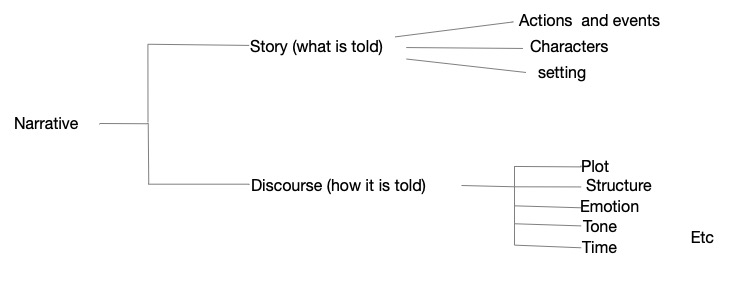
Conventional films typically use a linear discourse: events are presented chronologically and linked by clear cause and effect. Experimental cinema fundamentally plays with the discourse.
In our last lesson, we discussed Maya Deren. In her own writings, she made a crucial distinction that perfectly frames our discussion today. She contrasted the "horizontal attack" of conventional narrative (moving from point A to point B to tell a story) with the "vertical investigation" of poetic film. A vertical approach doesn't move forward in time; instead, it dives deep into the texture, symbolism, and emotional resonance of a single moment or idea.
This gives us our first major distinction:
- Narrative Structure: Organizes events in a causal sequence to tell a story. There is a sense of progression, even if it's unconventional. The primary question it answers is, "What happens next?"
- Poetic Structure: Abandons plot and causality in favor of rhythm, mood, and the association of images and sounds. It's structured more like a poem or a piece of music. The primary question it asks is, "What does this feel like?" or "What does this suggest?"
To solidify the concept of the poetic mode, let's watch a brief explanation.
The Modes of Documentary Explained
The video 'The Modes of Documentary Explained' introduces a framework by film theorist Bill Nichols. While it focuses on documentary, the categories are essential for understanding all non-fiction and experimental forms. We'll start with the 'poetic mode.'
Please watch the segment from 01:23 to 02:12. Pay close attention to how it describes films organized by 'rhythm or tone' rather than a linear structure.
Deren's Meshes of the Afternoon is a perfect example of this poetic, "vertical" structure. It doesn't tell a story in a linear sense; it explores a state of mind through recurring motifs and a cyclical, dreamlike rhythm.
Part 2: The Essay Film - Thinking Through Cinema
Now we introduce a third, powerful structure: the essayistic mode. If narrative film tells a story and poetic film evokes a feeling, the essay film investigates an idea. It is a work of cinematic thinking, a form that makes an argument, explores a topic, or reflects on a question.
Let's return to the same video to get an initial definition. The "expository" mode described here is a direct precursor to the essay film.
The Modes of Documentary Explained
Now, let's watch the section on the 'expository' mode from the same video. Notice the explicit link it makes to 'essay films.'
Please watch from 02:12 to 03:48. Focus on the description of films that are created to 'get a clear point across' and 'argue a point to their audience.'
The essay film takes this idea of making an argument and elevates it into a highly creative and often personal form. To understand its key characteristics, we'll watch a detailed analysis of the form through the work of director Adam McKay (The Big Short, Vice).
Vice: The Essay Film and the Creativity of Adam McKay
The video 'The Essay Film and the Creativity of Adam McKay' by The Take is an excellent deep dive into this structure. It clearly breaks down what makes the essay film a unique and innovative form.
Please watch from 01:58 to 06:16. This section provides a clear, bulleted-style definition of the essay film. Focus on its key traits: editing-driven arguments, the blend of fiction and documentary, a personal voice, self-reflexivity, and the use of citation.
As the video brilliantly explains, the essay film is defined by a cluster of techniques:
- Argument-driven: The structure is built to support an idea or thesis, not a plot.
- Editing as Voice: The argument is made primarily through the juxtaposition of images and sounds.
- Blurs Boundaries: It freely mixes documentary footage, fictional scenes, animation, and text.
- Personal & Conversational: Often uses a narrator who speaks directly to the viewer, creating a dialogue.
- Self-Reflexive: It is aware of its own construction and often draws attention to the fact that you are watching a film. This aligns with the "Reflexive Mode" also mentioned in the first video you watched.
- Citation: It "quotes" other films, images, books, and ideas, much like a written essay cites its sources.
Your interest in creating interdisciplinary work connects powerfully with the essay film's ability to absorb and re-contextualize different media into a cohesive argument.
Part 3: Comparing the Structures
Let's put it all together. These modes are not mutually exclusive—many films blend them—but understanding their pure forms is crucial for a director.
| Feature | Narrative Structure | Poetic Structure | Essayistic Structure |
|---|---|---|---|
| Primary Goal | To tell a story | To evoke a mood, feeling, or sensation | To explore an idea or make an argument |
| Organizing Principle | Cause-and-effect (Plot) | Association, rhythm, motif (Pattern) | Logic, reflection, thesis (Argument) |
| Viewer's Role | Immersion in the story world | Contemplation of sensory experience | Engagement in a dialogue or thought process |
| Key Question | "What happens next?" | "What does this feel like?" | "What does this mean?" or "Do I agree?" |
| Classic Example | Citizen Kane (even its complex structure serves story) | Meshes of the Afternoon (Maya Deren) | Sans Soleil (Chris Marker) |
The essay film is a particularly fluid and intellectually rich form. To deepen your understanding, let's read a short text that describes its unique character.
The essay film | Sight and Sound - BFI
The article 'The essay film' from Sight and Sound magazine is a cornerstone text on this topic. We will read a small but essential part that defines the form's elasticity and its relationship with documentary and fiction.
Please read from the beginning of the article down to the end of the paragraph that concludes with: '...impure in both form and, perhaps, intention.' This section captures how the essay film is an 'invented tradition' that purposefully cuts across boundaries.
As the article notes, the essay film is "remarkably elastic" and "moves blithely between the realms of fiction and non-fiction." This is its power. It is not bound by the rules of documentary truth or fictional consistency. Its only loyalty is to the path of its own thought process. For a director like you, inspired by artists who defy categorization, this is perhaps the most liberating structure of all.
Conclusion
Today we've defined a crucial toolkit for you as an experimental filmmaker. By moving beyond traditional narrative, you can structure your films in radically different ways:
- Narrative: You can still tell stories, but you can manipulate the discourse to make them fragmented, subjective, or dreamlike.
- Poetic: You can abandon story altogether and build a film from rhythm, visual association, and mood, creating a "vertical investigation" into a moment or feeling.
- Essayistic: You can use the language of cinema to think, argue, and reflect, blending different forms of media to explore an idea and engage your viewer in an intellectual dialogue.
These are not rigid boxes but points on a map. The most exciting films often live in the spaces between them. A film can have a narrative core but be told in a poetic style, or an essay film can use narrative vignettes to make its argument.
What's Next?
Now that you have this framework of narrative, poetic, and essayistic structures, it's time to start thinking about your own work. In our next lesson, you will apply these concepts directly by tackling the task: Write a concept statement articulating the core vision for an experimental short film. You'll be able to consider which of these structures—or which blend of them—will best serve the story you want to tell, the emotion you want to evoke, or the idea you want to explore.