Recommended resources
The freely available resources this lesson will direct you to.
Hi! Last time, you practiced using a short phrase when you needed a moment to think. This time, someone else is talking. You may understand every word, but if you say nothing, they might wonder whether you’re still with them.
In casual American conversation, a brief “uh-huh,” “right,” or “I see” can show that you’re listening without taking over the conversation. Today you’ll learn what each response suggests, when to say it, and when a small listening sound isn’t enough.
Let the speaker keep going
Imagine a friend telling you about a frustrating trip to a restaurant:
Friend: “We got there at seven, and the place was packed.”
You: “Uh-huh.”
Friend: “Then we found out our reservation wasn’t in their system.”
You: “Oh no.”
Friend: “Luckily, they found us a table a few minutes later.”
You: “I see.”
Your responses are short, but they aren’t interchangeable. “Uh-huh” says you’re following along. “Oh no” reacts to the bad turn in the story. “I see” acknowledges what happened next. None of them requires your friend to stop telling the story.
These small listener responses are called backchannels. You don’t need the term in everyday conversation, but the distinction is useful: a backchannel is feedback from the listener, not a request to become the speaker.
Read the definition and the phrase guide in Turn-Taking & Backchanneling from Varsity Tutors. Treat the guide as a set of possible responses, not a schedule for how often you must speak.
Turn-Taking & Backchanneling — I can participate in...
Read the definition to see how a listener can respond without taking a full turn. Then use the phrase guide to compare attention, understanding, surprise, agreement, and empathy.
In SECTION 2, “Core Principles & Definitions,” find item 2, “Backchanneling.” Read its definition and examples. Then find “Backchannel Expressions by Function,” just after “Signals That Show You Are Finished Talking.” Read the expression guide, focusing on the difference between simply following a story and reacting to its meaning.
The guide groups expressions by function, but real conversations move quickly between those functions. The practical question is: What has the speaker just given you—a continuing story, an explanation, a surprise, or a feeling?
Hear the difference between three common responses
Start with “uh-huh” (also often written “mm-hmm”). It’s a light signal that says, “I’m following; go on.” It fits naturally after a small pause in someone’s story:
Friend: “So I called the restaurant…”
You: “Uh-huh.”
Friend: “…and they said they couldn’t find the reservation.”
“Right” often sounds more like “I’m with you on that point.” If a coworker is explaining why a plan changed, you might say:
Coworker: “We need the final numbers before we can decide.”
You: “Right.”
Coworker: “So we’re waiting until tomorrow.”
A quiet “right” can show that you follow the reasoning. Said strongly, though, it may sound like agreement. If you’re only listening and haven’t decided what you think, “uh-huh” or “I see” may be safer.
“I see” acknowledges new information or an explanation. It doesn’t automatically mean “I agree”:
Friend: “I left early because I wasn’t feeling well.”
You: “I see.”
Friend: “I’m doing better today.”
Tone matters. A warm “Oh, I see” may sound more engaged than a flat, clipped “I see,” especially when someone is sharing something personal. If the news is upsetting, acknowledge that as well: “Oh no” or “That sounds frustrating” responds to the feeling, not just the information.
Watch how brief sounds and words can encourage someone to continue in Active Listening Skills for Better Conversations from Extra English Practice.
Active Listening Skills for Better Conversations
Watch for the difference between a small sound that says “keep going” and a short reaction to something the speaker has said.
In listening sounds, notice the “uh-huh” and “mm-hmm” used while the other person has the floor. Then watch brief reactions for examples such as “Oh, really?” that respond to the content without beginning a long new turn.
Notice one important contrast with the previous lesson. When you say “Hmm, let me think…”, you are preparing your own answer. When you say “Uh-huh” during someone else’s story, you are inviting them to continue. The sounds are small, but your role in the conversation is different.
Match the moment, not just the word
The same response can feel attentive or inattentive depending on what came before it. Look at this illustrated exchange:
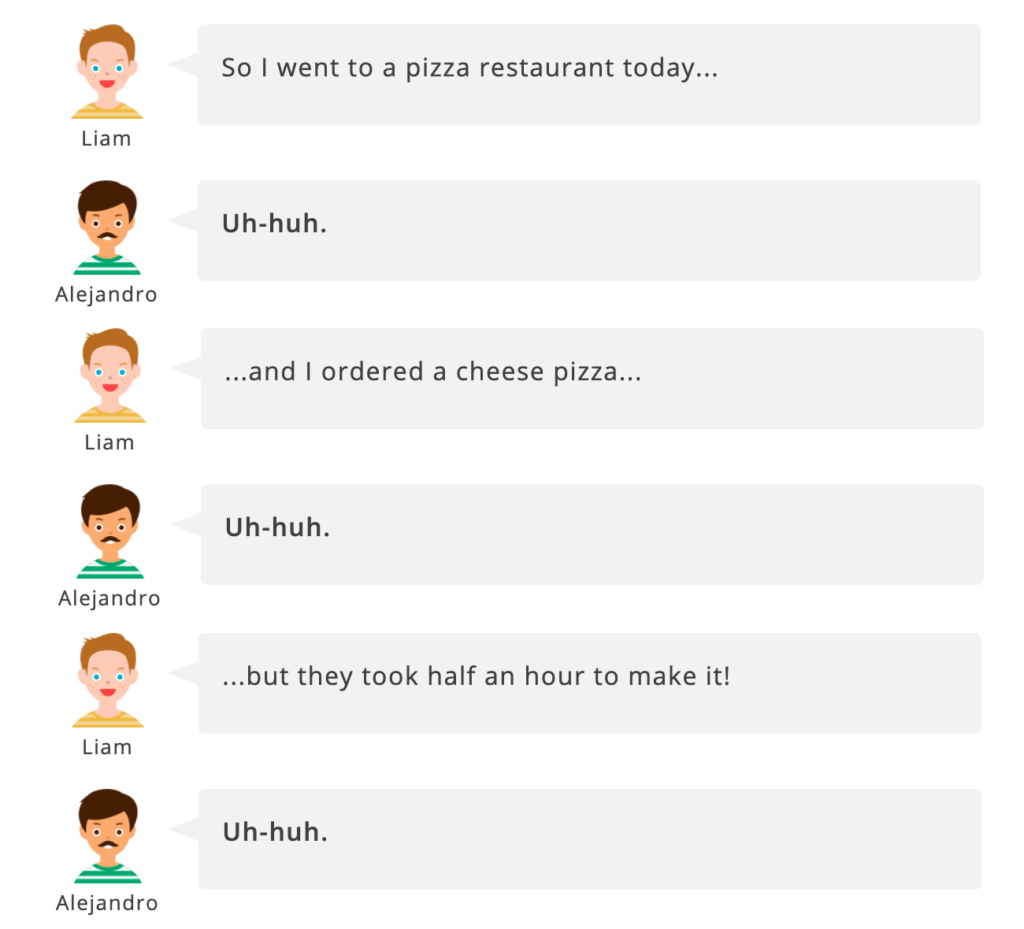
The first “uh-huh” works: the story has just begun. But after “they took half an hour to make it,” another identical “uh-huh” misses the frustration. “Oh, that’s a long wait” would show that the listener caught the point.
You don’t need a new reaction to every sentence. A nod, an interested expression, or a brief silence can also show attention. The goal is not to produce a sound at regular intervals; it’s to respond when there is a natural little pause and your response fits what you’ve heard. Repeated “right, right, right” or an enthusiastic “wow!” after ordinary information can sound as though you aren’t really following.
Now watch a longer exchange from the same video. The listener uses small acknowledgments, but also changes her reaction when the story becomes surprising or disappointing.
Active Listening Skills for Better Conversations
Listen to a complete story and notice how the listener’s responses change with it.
Watch the conversation. Listen for short acknowledgments during the setup, then for the reaction when the gift has not arrived in time. Notice, too, that a full question briefly redirects the story, while a small “yeah?” lets it continue.
There is no single perfect response for that story. What makes the listener sound engaged is that her reactions follow its changing meaning.
Know when a backchannel is not enough
A short listening response works while the other person is still developing a thought. It is less useful when they clearly hand you the turn:
Friend: “Do you want to come with us?”
You: “Uh-huh.”
Here, “uh-huh” might be understood as yes, but it’s easy to miss and gives your friend little to work with. “Yeah, I’d like to” is a clearer answer. Likewise, if someone has finished describing a difficult day and waits for your response, another automatic “right” may feel distant. You can say something more specific, such as “That sounds exhausting.”
A helpful listening habit is to notice the speaker’s next move. Are they pausing briefly inside a story? A small “uh-huh” may be enough. Have they explained a point? “Oh, I see” may fit. Have they reached an important or emotional moment? Let your response show that you heard that part.
Takeaway
“Uh-huh” and “mm-hmm” usually signal “I’m following; keep going.” “Right” can acknowledge someone’s point, though a strong “right” may suggest agreement. “I see” shows that you’ve taken in new information. In each case, your tone and timing matter as much as your choice of words: respond at a natural pause, and let the speaker continue unless they’ve asked you to take the turn.
In the next lesson, you’ll switch back to your own message and practice revising it smoothly when the first version doesn’t quite say what you mean.