Recommended resources
The freely available resources this lesson will direct you to.
Hi! Last time, you practiced asking someone to speak louder or more slowly when the sound was the problem. Sometimes, though, you hear enough to make a good guess. Instead of asking for the whole message again, you can check that guess: “Did you say Tuesday?” or “So you mean I should come on Tuesday?”
Today you’ll practice choosing between those two moves. One checks the words you heard; the other checks what you think the person means. Both help you keep a conversation moving without pretending you’re certain.
Check a word: “Did you say…?”
Imagine someone says, “We need fifteen chairs,” but the number is hard to catch. You have a likely answer, so you can ask:
“Did you say fifteen?”
If you heard two possibilities, name them:
“Did you say fifteen or fifty?”
This is more useful than “Could you say that again?” when only the number is uncertain. It tells the other person exactly what to confirm.
Other person: “We need fifteen chairs.”
You: “Did you say fifteen or fifty?”
Other person: “Fifteen.”
You: “Fifteen. Got it.”
Use this check for words that matter: a time, a day, a price, a name, or a quantity. Say the uncertain word clearly, with a friendly questioning tone. You don’t need a long apology.
There’s one important limit: “Did you say…?” is for checking what was said, not for guessing the person’s larger intention. If you didn’t hear enough to make a reasonable guess, the repetition request from the first lesson is still the better choice.
Check the meaning: “So you mean…?”
Now suppose you heard every word: “The draft can wait until Monday.” You’re not sure what that means for your next action. You might ask:
“So you mean I don’t need to send it today?”
You’re offering your interpretation for the other person to confirm or correct. In a casual conversation, “You mean…?” works too:
Friend: “I’ll leave the keys at the front desk.”
You: “You mean I should pick them up there?”
Friend: “Yeah, exactly.”
Notice that the listener doesn’t simply repeat front desk. They check the practical meaning of the plan. The other person can now say “Exactly,” or explain what they intended.
Watch this short excerpt from 50+ Advanced Phrases For English Conversations by mmmEnglish. Listen for the presenter’s examples of restating a point before responding. Some phrases in the clip are more elaborate than you need in everyday talk; for now, keep “So you mean…?” as your short default.
50+ Advanced Phrases For English Conversations
Watch 50+ Advanced Phrases For English Conversations by mmmEnglish for ways to check an interpretation rather than guess silently.
Watch the confirmation phrases. Pay particular attention when the presenter introduces “So what you’re asking is…” and “Do you mean…?”; near the end, notice how a more formal confirmation sounds different from a quick conversational check.
You can also summarize the point you think you heard with “So you’re saying…?”
Other person: “We can hold the item until the end of the day.”
You: “So you’re saying I can pick it up this afternoon?”
Other person: “That’s right.”
Keep your summary close to what the person actually said. With a neutral, curious tone, “So you’re saying…?” sounds like a check. With a challenging tone, it can sound as though you’re questioning their decision.
Pick the check that fits
The difference becomes clearer when you compare two questions about the same conversation:
Other person: “The appointment is on Thursday, so there’s no need to come in tomorrow.”
If you’re unsure which day you heard, ask “Did you say Thursday?” If you heard Thursday but aren’t sure what to do, ask “So you mean I shouldn’t come in tomorrow?”
That is the choice to make in the moment: Am I checking a word, or checking my understanding?
The Checking Understanding guide gives several short confirmation phrases in context. Read the focused passage below rather than trying to memorize its whole list.
Checking Understanding — I can check understanding by...
Read Checking Understanding from Varsity Tutors to compare a quick summary (“So…?”) with a check of one detail (“You mean…?”), and to see where “Did you say…?” fits.
In “How Confirmation Phrases Work — Structures and Intonation,” start with the sentence “Confirmation phrases in English follow simple patterns.” Read the phrase guide through “Pattern 1: ‘So…?’ — Summarizing What You Heard,” “Pattern 2: ‘You mean…?’ — Clarifying Specific Details,” the “Additional Confirmation Structures” table, and the first paragraph of “Detailed Breakdown — When and Where to Use Each Strategy.” Focus on the kind of uncertainty each phrase addresses, not on memorizing every example.
The image below offers more expressions under “Seeking confirmation.” Treat them as alternatives you may recognize, not as a list you must use all at once.
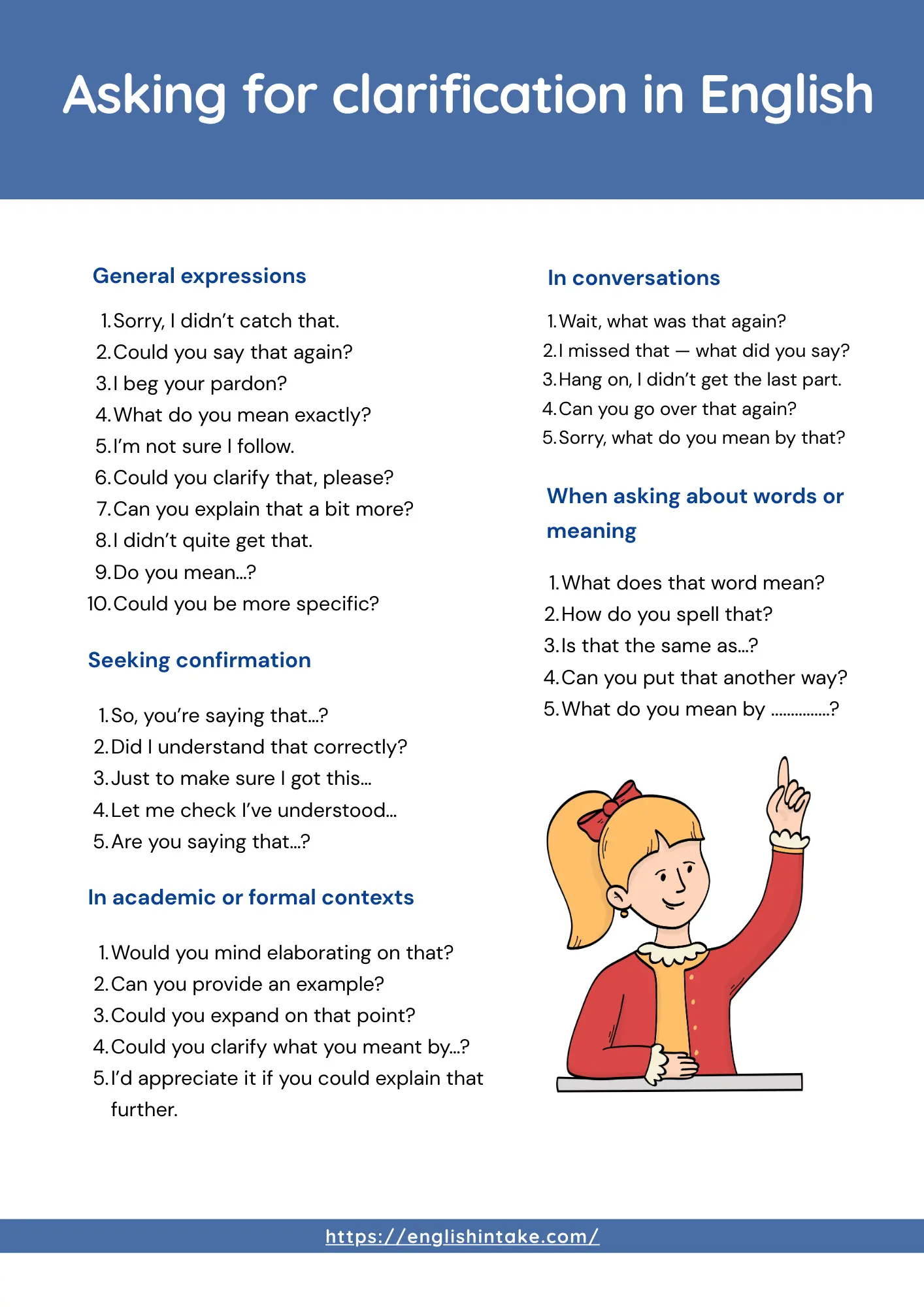
For most everyday conversations, two ready-to-use checks are enough: “Did you say…?” for an uncertain word and “So you mean…?” for an uncertain meaning. When the detail is especially important, you can introduce your check with “Just to make sure…”
“Just to make sure—did you say Thursday?”
“Just to make sure, you mean I should come in next week?”
It sounds careful without becoming stiff.
Let the answer settle the question
A confirmation check gives the other person an easy way to correct you. If they do, accept the correction and continue:
You: “Did you say the pickup is at six?”
Other person: “No, at seven.”
You: “Oh, seven. Thanks.”
Or, if you checked the meaning:
You: “So you mean I should bring the form today?”
Other person: “Actually, you can bring it tomorrow.”
You: “Tomorrow—got it.”
Briefly repeating a corrected detail can be helpful when it matters. You don’t need to explain why you misunderstood or keep asking once the answer is clear.
For a little spoken rehearsal, say the two default openings aloud—“Did you say…?” and “So you mean…?”—then try them with Thursday and I should come in on Thursday. Hear how the first checks a word while the second checks a plan. Aim for a curious, easy-to-answer question rather than a perfect performance.
Takeaway
When you have a plausible guess, check it instead of asking the person to start over. Use “Did you say…?” to verify a word or detail, and “So you mean…?” to verify your interpretation. Listen to the answer, acknowledge any correction, and carry on.
Next, you’ll work on a related situation: when you understand part of a message and want to point to the specific part that still isn’t clear.