Recommended resources
The freely available resources this lesson will direct you to.
Hello. Last time, you mapped how a product company creates value for buyers, users, employees, partners, and investors—and how it captures enough value to keep operating. Today, you’ll look at who is accountable for making that system work. The distinction matters if you want to lead innovation: a compelling idea is only one part of an executive’s job; the role also determines which outcomes you must deliver and which trade-offs you have authority to make.
This lesson compares five mandates: functional executive, product executive, innovation executive, business-unit head, and CEO. Allow about 35–40 minutes, including a short video and reading. The titles vary across companies, so focus on accountabilities rather than memorizing an organizational chart.
Start with the scope of the promise
An executive’s accountability is the outcome they are expected to answer for—not simply the tasks they perform or the meetings they attend. Several executives might help launch the same product, yet be accountable for different results. One must ensure the technology is dependable; another must ensure customers want the product; another must ensure the business earns a viable return.
Three questions help distinguish their mandates:
- What is the scope? A specialized capability, a product portfolio, future opportunities, an operating business, or the whole enterprise?
- What must improve? For example, reliability, customer outcomes, evidence for new growth, business profitability, or enterprise-wide performance.
- What trade-offs can they decide? They may propose a direction without having authority to commit every team or approve every investment.
A Chief Product Officer (CPO) provides a useful starting point because product leadership sits close to customers, technology, and commercial decisions. Watch this practitioner account for both the common responsibilities and the warning that the title changes meaning across organizations.
What Does A Chief Product Officer Do?
Watch “What Does A Chief Product Officer Do?” from Inside The Product to see how a product executive’s scope differs from hands-on product delivery.
Begin with role variability: note why company size and context matter. In CPO responsibilities, focus on portfolio vision, cross-functional teams, metrics, and the qualified discussion of financial accountability. Then watch executive perspective for the challenge of handling competing stakeholders without retreating into familiar product details.
The important shift is from making or managing a product to setting direction for a collection of products and enabling other teams to deliver it. That does not mean losing touch with the work. It means judging when a detail reveals a strategic problem and when it belongs with the team empowered to solve it.
Product leadership and innovation leadership overlap—but differ
A product executive is primarily accountable for the direction and performance of the company’s products. They decide, within their mandate, which customer problems the product portfolio will address, which outcomes matter, and how product investment should be prioritized. They build the product organization and work with engineering, design, sales, and other leaders to turn strategy into useful offerings. Success requires both customer value and a credible contribution to the business.
The image below gathers responsibilities commonly associated with a CPO. Read it as a picture of the role’s possible breadth, not a universal job description.
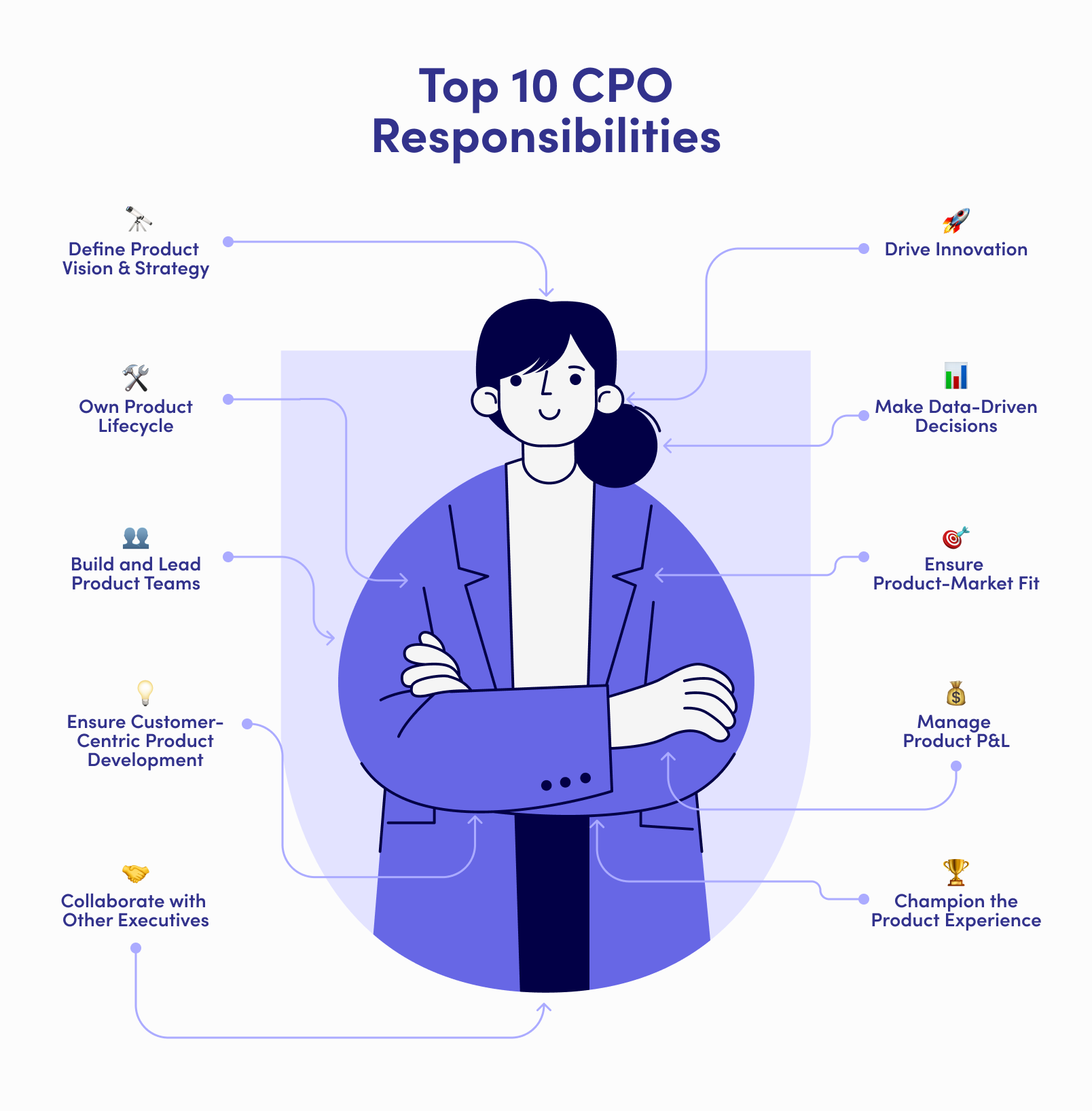
A P&L, or profit-and-loss responsibility, concerns revenue, costs, and the resulting financial performance within a defined scope. A product executive may be accountable for a product’s economics, but that does not automatically mean they control its sales team, set its final price, or own a standalone P&L. The video makes this qualification: commercial responsibility is sometimes shared. An executive has to establish what the company expects them to influence, what they can decide, and what they will be held to account for.
An innovation executive has a different primary promise: develop credible options for the company’s future. They identify opportunities beyond the current plan, organize a portfolio of experiments or ventures, and use evidence to recommend which concepts to stop, change, continue testing, or prepare to scale. Their work might concern new products, technologies, business models, or ways of operating. Success is not a high count of ideas or pilots. It is a stronger set of future growth options, built without committing large resources to unsupported assumptions.
The distinction is one of primary accountability, not exclusive territory. Product leaders innovate within their portfolios. Innovation leaders may sponsor a new product. A productive handoff occurs when an emerging concept has enough customer, technical, and commercial evidence for a product team or business unit to take responsibility for delivering and sustaining it. If the innovation team keeps every successful pilot indefinitely, the company may accumulate demonstrations without an operating business behind them.
For a creation-led career, this boundary is significant. Leading innovation at executive level requires more than selecting promising concepts. It requires deciding what evidence would justify further investment—and arranging for another part of the company to adopt a concept when it proves worthwhile.
Functions, businesses, and the enterprise
A functional executive is accountable for a capability the company needs across its work. A technology executive might set architecture, security, and reliability standards and develop engineering capability. A design executive might develop research and design talent, standards, and ways of working that improve experiences across products. The exact remit varies, but the common question is: Can this function supply the capability the business needs, responsibly and at an appropriate cost?
Functional executives influence product choices, sometimes decisively. For example, a technology executive may identify a security risk that prevents a proposed release. Yet being accountable for technology capability is not the same as being accountable for the entire product portfolio or the commercial performance of every business using that technology.
A business-unit head runs a defined operating business: perhaps a customer segment, geography, or collection of products with its own commercial goals. Their scope usually brings together customer demand, sales or distribution, delivery, people, investment, and business-unit P&L. They must resolve trade-offs across functions to deliver the unit’s results. A product executive might argue that a major redesign is essential for long-term retention; the business-unit head must also weigh its cost, effect on current customers, and impact on the unit’s financial commitments. Product and business-unit responsibilities can overlap, particularly in smaller companies, but their central questions differ: Is our product portfolio solving the right problems? versus Is this whole operating business performing sustainably?
The CEO is accountable for the enterprise as a whole. That includes setting overall direction, allocating scarce resources among competing priorities, shaping the senior leadership team, and ensuring that separate functions and businesses work toward enterprise outcomes rather than optimizing only their own results. A CEO does not personally make every product or technical decision. They do have to settle consequential trade-offs that no one function or unit can resolve on its own.
This distinction becomes clearer when a change touches the whole company. Read the following passages about AI as an example of cross-enterprise change, not as a requirement to study AI strategy today.
AI leadership for CEOs: A strategic imperative | McKinsey
Read these short passages from McKinsey for a concrete account of what functional leaders can own and what remains a CEO-level decision.
In the introduction, immediately before “Raise strategic ambitions—even when there’s no precedent,” read the scope problem. Then find the paragraph beginning “The rest of the senior team remains vital in this process,” immediately before “Build a culture that strengthens and preserves competitive moats.” Read the division of responsibility. Focus on why capable functional leaders are essential but cannot, separately, set and enforce a shared enterprise mandate.
The example illustrates a general rule: interdependence changes the level at which a decision must be made. A technology leader can establish the technical foundation; a finance leader can help reshape investment; an operating leader can sequence delivery. If the company must choose which businesses to favor, how to redeploy resources across them, and what shared outcome matters most, the CEO must make or sponsor that enterprise choice.
See all five mandates in one decision
Return to the fleet-maintenance software company from the previous lesson. Suppose it is considering an assistant that helps maintenance planners act on vehicle alerts. Early tests suggest that planners find the concept useful. Scaling it would require substantial product work, access to reliable data, changes to support processes, and funding that could otherwise improve the existing service.
Each executive can support the same initiative while answering a different question:
| Role | Primary question in this decision | Outcome they must protect |
|---|---|---|
| Functional executive | Can our teams and systems deliver it reliably, safely, and with the capabilities we have or can build? | Strength and responsible use of their function’s capability |
| Product executive | Does it solve a meaningful planner problem, and where should it rank against other product needs? | Customer and business performance of the product portfolio |
| Innovation executive | Which crucial assumptions remain unproven, and what evidence warrants the next investment? | Quality and future value of the opportunity portfolio |
| Business-unit head | Can this offering be sold, delivered, supported, and funded without damaging the operating business? | Integrated commercial and operating results of the unit |
| CEO | If scaling this changes enterprise priorities, is it a better use of company resources than competing opportunities? | Sustainable performance and direction of the whole enterprise |
None of these perspectives is sufficient alone. Strong early user feedback cannot establish technical reliability or financial viability. A favorable business-unit forecast cannot justify ignoring a shared capability needed elsewhere. And a CEO’s enthusiasm does not remove the product team’s obligation to discover whether planners will use the assistant in real work.
Decision rights must therefore be explicit. An innovation leader might approve a small test from an agreed experiment budget, while the business-unit head approves an operating pilot and the CEO decides on a major company-wide investment. Another company may set different thresholds. Before assuming someone “owns” an initiative, find out who can fund each stage, who must agree to take it into ongoing operations, and who resolves a disagreement that crosses organizational boundaries.
Conclusion
Executive roles differ most clearly by the outcome each is accountable for and the scope of trade-offs each can settle. Functional executives steward essential capabilities; product executives guide product portfolios; innovation executives build evidence-backed future options; business-unit heads run integrated operating businesses; and CEOs align and direct the enterprise. The roles collaborate, overlap, and sometimes share a title—but their primary promises should not be confused.
In the next lesson, you’ll use these perspectives to analyse an initiative’s customer, financial, strategic, and organisational outcomes. That will make it easier to judge not only whether an idea is attractive, but what an executive would need to know before backing it.