Recommended resources
The freely available resources this lesson will direct you to.
Welcome back. In our previous lesson, we worked through a standard econometric exercise: deriving the conditional distribution of a stock's return given a specific market index return , assuming a bivariate normal model. We arrived at the result using the elementary formula , while acknowledging the conceptual difficulty this formula presents when .
Today, we will begin to construct the rigorous, measure-theoretic bridge that justifies this seemingly paradoxical calculation. Our goal is to translate the components of our bivariate normal model—the joint and marginal densities—into the formal language of measures. We will then identify the precise condition, absolute continuity, that must be satisfied to allow the Radon-Nikodym theorem to do its work. This lesson lays the final piece of theoretical groundwork before we demonstrate in the next lesson how it all comes together to yield the exact result we derived previously.
From Densities to Measures
In modern probability, a probability density function (PDF) is not a fundamental object. It is a derivative. Specifically, it is the Radon-Nikodym derivative of a probability measure with respect to a background measure, which for continuous variables on is typically the Lebesgue measure.
Let's make this concrete for our bivariate normal model of asset returns .
-
The Joint Measure (): The joint PDF, , that we used in the last lesson is the density of the joint probability measure on the space . This measure assigns a probability to any well-behaved (Borel) set . The relationship is given by the integral:
The fact that we can write this relationship means that the joint measure is absolutely continuous with respect to the two-dimensional Lebesgue measure . The joint PDF is precisely the Radon-Nikodym derivative: .
-
The Marginal Measure (): Similarly, the marginal PDF, , is the density of the marginal probability measure on . This measure assigns a probability to any Borel set . Its relationship to the density is:
This implies that is absolutely continuous with respect to the one-dimensional Lebesgue measure , and .
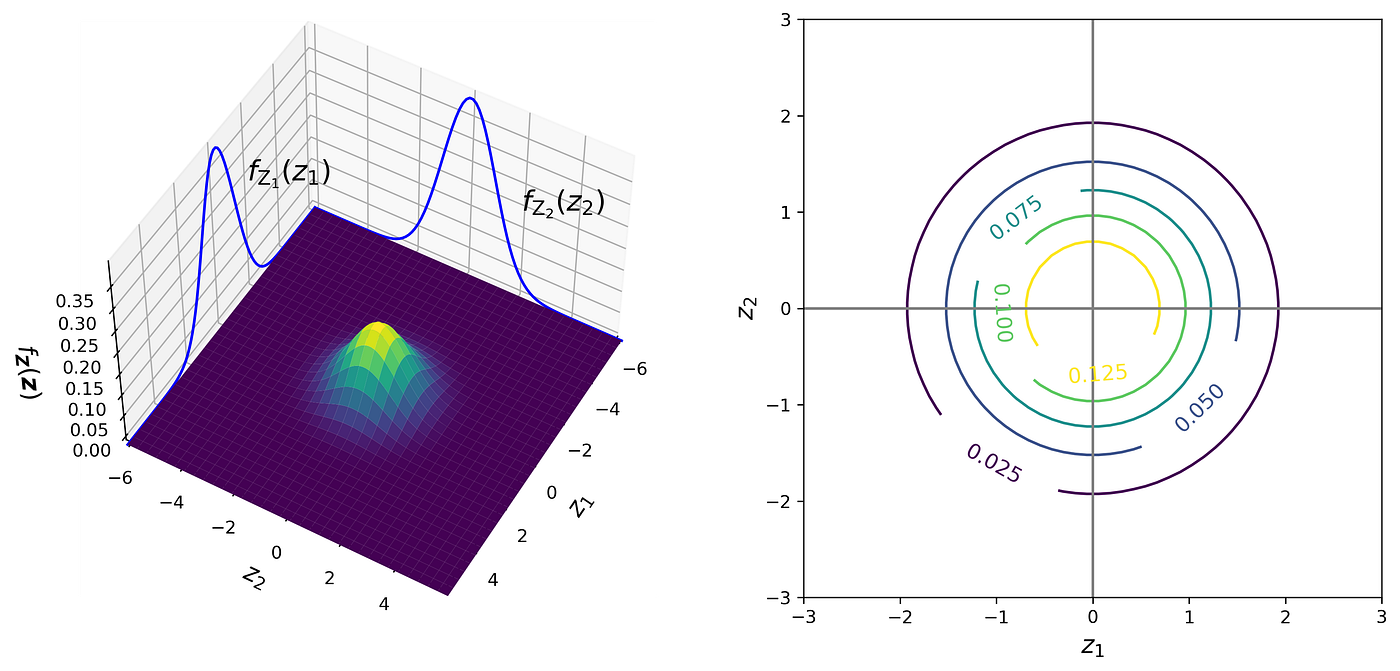
The image below provides a helpful visualization. The volume under the 3D surface over any region in the plane represents the joint measure of that region. The area under one of the projected curves (e.g., ) over an interval represents the marginal measure of that interval.
Framing the Problem for Radon-Nikodym
Our objective is to rigorously construct the conditional probability for some set . The Radon-Nikodym theorem is the tool, and to use it, we must define two measures on the same measurable space, one of which is absolutely continuous with respect to the other.
The space we will work on is the space of the conditioning variable, . Let's define our two measures, and , on this space.
Let be a fixed, arbitrary Borel set in the space of (e.g., if we're interested in the conditional CDF).
-
Let's define our first measure, , for any Borel set , as the probability that falls in and falls in :
By Fubini's theorem, we can write this as an iterated integral:
-
Our second measure, , will simply be the marginal measure of , which we've already called :
We now have two measures, and , defined on the same space . Our goal is to find the derivative . The Radon-Nikodym theorem tells us this derivative exists if is absolutely continuous with respect to .
Verifying Absolute Continuity
Let's formally state the condition we need to check. A measure is absolutely continuous with respect to a measure (written ) if for every measurable set , implies . In essence, cannot assign positive mass to a set that considers to have zero mass.
You can review this formal definition in the following excerpt.
[PDF] CHAPTER 3. A REVIEW OF PROBABILITY THEORY
This excerpt from Daniel McFadden's "Statistical Tools" provides a crisp definition of absolute continuity and its connection to the Radon-Nikodym theorem.
Please read the first paragraph of section 3.3.7, focusing on the definition of absolute continuity. The key idea is that the measure P "respects" the null sets of the measure μ.
Now, let's apply this definition to our two measures, and . We need to show that .
-
Consider : Our measure is the marginal distribution of . For a bivariate normal model, itself is normally distributed. Its PDF, , is a Gaussian function, which is strictly positive for all . The integral can therefore only be zero if the set has a Lebesgue measure of zero.
-
Consider : We defined , where . This is an integral of the function over the set . A fundamental property of Lebesgue integration is that if a set has Lebesgue measure zero, the integral of any function over that set is also zero.
-
Conclusion: Since implies that the Lebesgue measure of is zero, and the Lebesgue measure of being zero implies that , we have successfully shown that .
Therefore, the measure is absolutely continuous with respect to the measure . This is the crucial verification. It guarantees that a Radon-Nikodym derivative exists. This derivative will be our rigorously defined conditional probability.
The following reading confirms that when a joint density exists, this procedure justifies writing the conditional density as a ratio of the joint to the marginal—exactly the formula we used in the previous lesson.
Lecture 10 Conditional Expectation
This result from Gordan Zitkovic's lecture notes on probability theory brings everything together. It shows how the existence of a joint density allows one to explicitly write down the conditional density.
Please read Proposition 10.19. This proposition considers a general random vector X = (X_o, X_u) (observed, unobserved) that admits a joint density. It shows that the conditional density of X_u given the sigma-algebra generated by X_o can be written as this formula. Notice that this formula is precisely the ratio of the joint density to the marginal density, evaluated at the observed value X_o(\omega). This provides the rigorous justification for the "elementary" formula from your undergraduate statistics courses.
Conclusion
In this lesson, we have moved our bivariate normal model from the world of elementary formulas into the framework of measure theory. We have successfully mapped the concepts of joint and marginal PDFs to their underlying measures and, most importantly, have performed the critical check required to use our most powerful tool.
Key Takeaways:
- The joint PDF and marginal PDF are Radon-Nikodym derivatives of the joint measure and marginal measure with respect to Lebesgue measure.
- To construct a conditional probability , we define two measures on the space of : and the marginal measure .
- For the bivariate normal distribution, we verified that is absolutely continuous with respect to . This is because the marginal density is strictly positive, meaning any set with zero marginal probability must also have zero Lebesgue measure, which in turn forces of that set to be zero.
- This verification of absolute continuity guarantees the existence of the Radon-Nikodym derivative , which provides the rigorous definition of conditional probability.
We have now established that a conditional density exists and can be represented as a ratio. In our next lesson, we will complete the argument by explicitly computing this Radon-Nikodym derivative for our bivariate normal case and showing that it produces the exact conditional mean and variance we found in the previous lesson. This will close the loop, demonstrating how the abstract machinery of measure theory provides the solid foundation for a calculation you have long performed.