Recommended resources
The freely available resources this lesson will direct you to.
Hello! Welcome back to our course on architecting security products.
In our previous lesson, we designed the heart of our vulnerability scanner: a centralized knowledge base that ingests, structures, and stores comprehensive data from the NVD. This gives us a single source of truth for all known vulnerabilities.
However, a central database is only useful if its knowledge can be accessed by our distributed fleet of scanners, which might be deployed across the globe in various customer environments. This brings us to a critical system design challenge.
This lesson focuses on solving that challenge, directly addressing the learning outcome: Design a system for versioning and distributing vulnerability signature updates to distributed scanners. We will architect the secure and efficient delivery pipeline that ensures every scanner has the latest vulnerability data, is protected from malicious updates, and can operate reliably even under adverse network conditions.
1. The Core Problem: Distribution at Scale
Before we dive into the design, let's look at a real-world example to appreciate the scale of the problem.
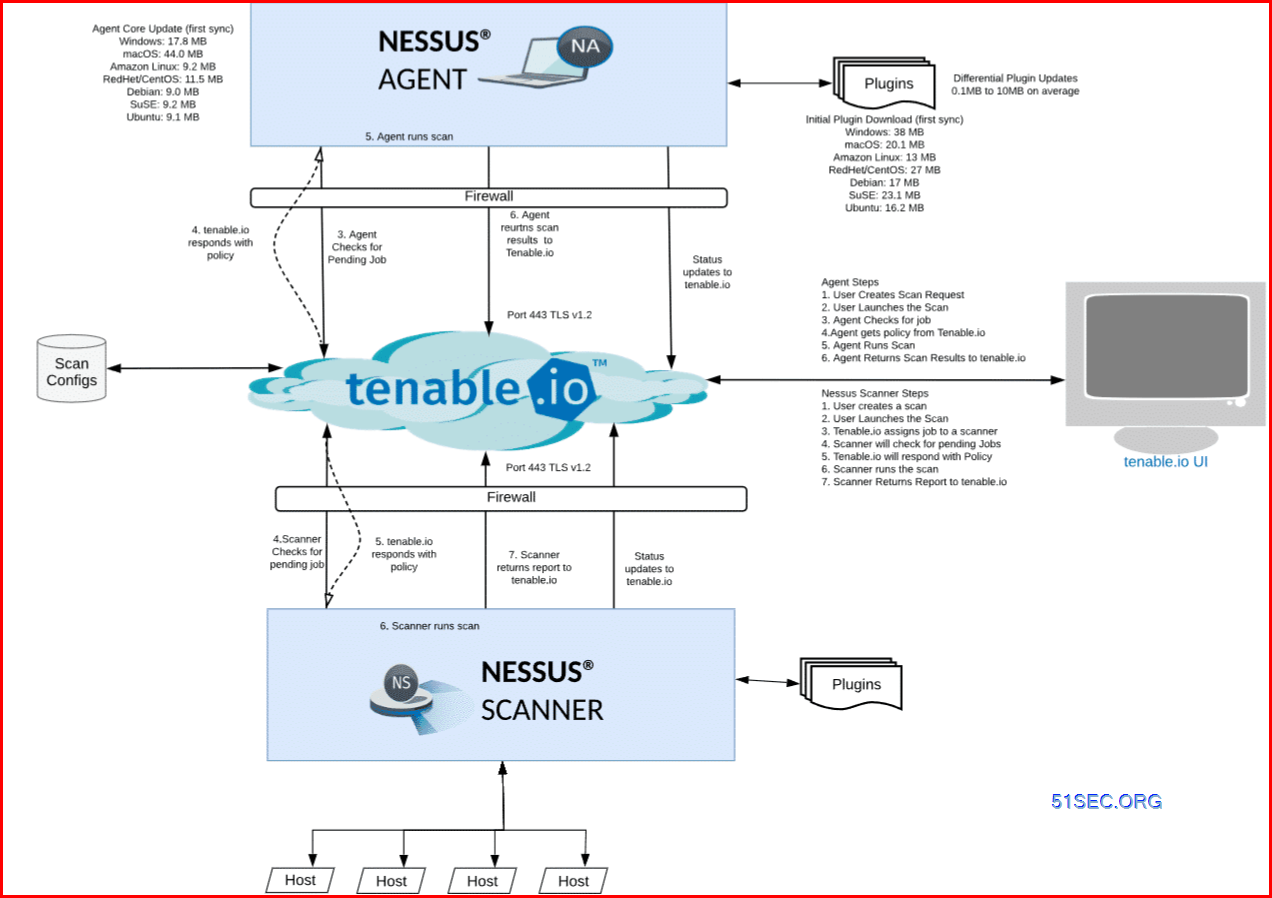
The diagram reveals several key challenges:
- Scale: A successful product could have tens or hundreds of thousands of active scanners.
- Payload Size: The initial data set is large, and while daily updates are smaller, they must be delivered reliably.
- Security: This is the most critical aspect. If an attacker could poison this update stream, they could control the scanners, effectively blinding them to real vulnerabilities or causing them to report false ones. The distribution mechanism itself is a prime target.
- Reliability: Scanners may operate on unreliable networks. The update process must be resilient to intermittent connectivity.
2. Architectural Choice: Push vs. Pull
Our first major design decision is how scanners will receive updates. As with many distributed systems, the choice is between a "push" and a "pull" model.

- Push Model: The central server would maintain persistent connections to all scanners and push updates as they become available. This offers low latency but is architecturally complex and brittle. It struggles with scale, firewalls, and scanners that are temporarily offline.
- Pull Model: Each scanner periodically polls a central distribution point to check for new updates. This is far more scalable and robust. The server side is simpler (it just needs to host files), and clients can manage their own update schedule, gracefully handling network failures.
For a large-scale, distributed system like a fleet of vulnerability scanners, a Pull-based architecture is the superior choice. We will design our system around this model.
3. The Cornerstone of Secure Updates: Trust
In a pull model, a scanner fetches a file from a URL. But how can it trust that file? Simply using TLS/HTTPS is not enough. While TLS protects data in transit, it doesn't protect against a compromised server. If an attacker gains control of the update server, they can serve a perfectly valid TLS-encrypted malicious file.
We must design for a scenario where the distribution infrastructure (e.g., a CDN or a cloud storage bucket) is untrusted. The trust must be established through cryptography, not by the location of the file.
This problem is not unique to us. It's a classic challenge in secure software updates, especially for firmware over-the-air (OTA) systems. Let's briefly look at the core principles from that domain.
Firmware over-the-air (OTA) updates: design patterns, pitfalls, and a ...
The article 'Firmware over-the-air (OTA) updates' provides an excellent overview of the security principles required for any robust update system. Its concepts are directly applicable to our vulnerability signature distribution design.
Please read the section titled 'Secure OTA frameworks'. Focus on the four key elements it describes: public-key signatures, manifests, key rotation, and version monotonicity. These are the foundational requirements we need to build.
The article lays out the blueprint: we need a system that uses cryptographic signatures, version control to prevent downgrades, and a clear process for key management. To address this with the rigor your "first principles" mindset appreciates, we will base our design on The Update Framework (TUF).
TUF is a CNCF-graduated project that provides a comprehensive specification for securing software update systems. It is designed specifically to protect against a compromised repository and is the gold standard for this problem.
4. Architecting a TUF-based Distribution System
TUF's core concept is separation of concerns through different signing roles. Instead of a single key signing everything, TUF uses a hierarchy of keys with different responsibilities and levels of security. This drastically minimizes the impact of a key compromise.
To understand this architecture, let's explore the TUF specification.
The Update Framework Specification
The TUF specification is our primary architectural guide. These sections introduce the problem space, the specific attacks TUF protects against, and its core architectural model based on roles.
Please read the following sections: Section 1: Introduction: Focus on 'Goals to protect against specific attacks' (1.5.2) to understand the threat model. Section 2: System overview: Focus on 'Roles and PKI' (2.1) to learn about the four fundamental roles. \nThis will give you the foundational knowledge of TUF's design.
As you read, TUF's design is all about establishing a chain of trust. Let's translate the roles into the context of our vulnerability signature system:
- Root Role: This is the foundation of all trust. It is responsible for signing the public keys of the other top-level roles. The Root role's private keys are kept offline and heavily secured. A compromise here is catastrophic, but TUF makes it extremely difficult.
- Targets Role: This role is responsible for signing the actual content—our vulnerability signature files. Its metadata file (
targets.json) is essentially a manifest, listing all available signature files along with their cryptographic hashes and sizes. The Targets keys are also typically kept offline. - Snapshot Role: This role provides integrity and consistency. It signs a
snapshot.jsonfile that contains the versions of all thetargetsmetadata files. This prevents "mix-and-match" attacks, where an attacker tries to trick a client into using a newtargetsfile with an old signature bundle. The Snapshot key is usually online, but in a secured environment. - Timestamp Role: This role provides freshness. Its key is the only one that is fully automated and expected to be online. It signs a
timestamp.jsonfile very frequently (e.g., every hour). This file contains the hash of the latestsnapshot.jsonfile. Its purpose is to prevent "freeze" attacks, where an attacker indefinitely replays old, but still valid, metadata to a client, preventing it from seeing new updates.
The Scanner's Update Workflow
A scanner (the TUF client) performs a disciplined, step-by-step verification process to ensure it's getting the right files. This workflow is detailed in Section 5 of the TUF spec, but here is the high-level summary:
- Start with a trusted root.json file. This is shipped with the scanner's initial installation.
- Fetch
timestamp.json. This is the entry point. It's small and tells the client the hash of the latest snapshot. The client verifies the timestamp signature using the keys from its trustedroot.json. - Fetch
snapshot.json. The client verifies this file against the hash fromtimestamp.json. It then verifies the snapshot signature. This file tells the client the version of thetargets.jsonfile it needs. - Fetch
targets.json. The client verifies this against the version fromsnapshot.jsonand verifies its signature. This file contains the hashes of the actual vulnerability signature files (the "targets"). - Fetch the signature file(s). Finally, the client downloads the actual signature bundle and verifies its hash against the hash listed in the trusted
targets.json.
If any signature or hash verification fails at any step, the entire process is aborted. This creates an unbreakable cryptographic chain from the offline root keys to the data file on the scanner, even if the CDN hosting the files is malicious.
5. Design Details and Trade-offs
With the core security architecture defined by TUF, let's address some practical implementation details.
Distribution Infrastructure
The beauty of the TUF model is its simplicity from an infrastructure perspective. The metadata and target files are static.
- Storage: A cloud storage service like Amazon S3 or Google Cloud Storage is ideal. It's durable, scalable, and cost-effective.
- Delivery: A Content Delivery Network (CDN) like Cloudflare or Amazon CloudFront should be placed in front of the storage bucket. This caches the update files at edge locations around the world, ensuring low-latency downloads for scanners everywhere.
Efficiency: Full vs. Delta Updates
As seen in the Tenable diagram, the initial signature bundle can be large, while daily updates are small. Forcing scanners to download a 500 MB file every day is inefficient and costly. We need to support delta updates.
Firmware over-the-air (OTA) updates: design patterns, pitfalls, and a ...
The OTA update article provides a concise explanation of the delta update strategy and its trade-offs.
Please read the section 'Delta vs full firmware updates'. This highlights the core trade-offs we need to consider.
How do we integrate this with TUF? It's straightforward:
- The backend system generates both a full signature bundle (
signatures-v2.db) and a delta patch file (patch-v1-to-v2.bin). - Both of these files are treated as "targets" in the TUF model.
- The
targets.jsonmanifest will list both files with their corresponding hashes. - The scanner's client logic becomes slightly more sophisticated:
- It checks its current version (e.g., v1).
- It sees that v2 is available.
- It looks in the
targets.jsonfor a patch file from v1 to v2. If one exists, it downloads and applies the patch. - If no patch is available (or if the scanner is new), it downloads the full v2 bundle.
Manifest Design and Delegations
The targets.json file is our update manifest. The TUF specification (Section 4.5) details its structure. One of its most powerful features for a complex product is delegation.
The top-level Targets role can delegate responsibility for parts of the repository to other roles. For our vulnerability scanner, this means we could have:
- A "Windows Signatures" team with their own signing key, responsible for
windows-signatures.db. - A "Linux Signatures" team responsible for
linux-signatures.db. - A "Network Devices" team, and so on.
The top-level targets.json would delegate trust to these sub-roles, which would then publish their own targets metadata. This allows for organizational scaling while maintaining a unified chain of trust under the central Root.
6. System Architecture Summary
Let's consolidate this into a final architecture.
A high-level diagram showing the TUF-based update architecture. An offline Root Authority signs keys for a Signing Service. This service generates and signs metadata (Targets, Snapshot, Timestamp) for signature bundles, then uploads all files to a CDN. Distributed Scanners pull and verify these files from the CDN using the TUF protocol.
Backend Components:
- Offline Root Authority: An air-gapped machine or HSM holding the Root role private keys. Used rarely, only to rotate or provision other top-level keys.
- Signing Service: An automated service running in a secure environment.
- It has access to the online Snapshot and Timestamp keys.
- It can access the offline Targets keys (e.g., via a secure vault API).
- It monitors for new signature bundles built from our vulnerability KB.
- When a new bundle is ready, it generates the new
targets.json,snapshot.json, andtimestamp.jsonfiles, signs them appropriately, and uploads all metadata and target files to the distribution point.
- Distribution Point: An S3 bucket fronted by a global CDN.
Client-Side Components (in each Scanner):
- TUF Client Library: Implements the core verification workflow.
- Update Agent: A scheduled service that runs the TUF client to check for updates.
- Patching Logic: Capable of applying binary diffs for delta updates.
- Reliable Storage: Ideally, an A/B partition scheme. The update is written to an inactive partition. After verification, the scanner service is restarted to use the new partition. Only after a health check passes is the switch made permanent. This prevents a failed update from corrupting the scanner.
Conclusion
In this lesson, we have designed a complete, production-grade system for distributing vulnerability signature updates. We went beyond simple file downloads and architected a solution that is secure, scalable, and resilient.
Key Takeaways:
- Assume the Server is Untrusted: The foundation of a secure update system is to rely on cryptographic verification, not the security of the distribution point. Simple HTTPS is insufficient.
- TUF Provides the Blueprint: The Update Framework offers a rigorous, battle-tested model based on separating signing duties into Root, Targets, Snapshot, and Timestamp roles to create a robust chain of trust.
- Pull is for Scale: A pull-based model where scanners periodically check for updates is the most scalable and robust architecture for this use case.
- Efficiency and Reliability are Key: Use a CDN for low-latency delivery, delta updates to conserve bandwidth, and A/B partitions on the client to ensure updates are atomic and rollback is safe.
Preview of the Next Lesson:
We now have a system to discover services on a network and a secure pipeline to deliver vulnerability knowledge to our scanners. The next step is to connect the two. In the upcoming lesson, "Architect a vulnerability matching engine that correlates discovered services and versions against the knowledge base," we will design the core logic that takes a discovered service (e.g., "Apache httpd 2.4.53") and uses our securely-updated knowledge base to determine if it is vulnerable.