Recommended resources
The freely available resources this lesson will direct you to.
Welcome back. In the previous lesson, you distinguished the pre-open auction from regular continuous trading. Once the regular session is underway, a stock screen shows several prices at once. They answer different questions: What was the most recent trade? What are buyers offering now? What are sellers asking now?
This lesson will help you read those prices, calculate the bid–ask spread, and distinguish traded volume from the quantities waiting in the order book. For an intraday trader, that distinction matters whenever a displayed “price” looks like a price at which you could trade immediately.
Three prices, three questions
The last traded price, often labelled LTP or Last, is the price of the most recently completed trade. It describes something that happened. The bid and ask describe buying and selling interest currently displayed in the market:
- The best bid is the highest displayed price a buyer is willing to pay.
- The best ask, also called the best offer, is the lowest displayed price a seller is willing to accept.
If you want to sell immediately, the best bid is the relevant side to inspect. If you want to buy immediately, inspect the best ask. The LTP may equal either one—or neither—because orders and trades can change after that last trade.
Watch this short introduction to the two sides of a quote.
What Is the Bid-Ask Spread? | Order Book & Trading Impact
“What Is the Bid-Ask Spread?” by Ryan O’Connell introduces the buyer’s bid and seller’s ask.
Watch bid and ask. Focus on whose willingness each price represents; the prices you can trade against are on the opposite side from your own intention to buy or sell.
An Indian trading-terminal example puts LTP alongside other quote fields. Read the relevant part of Zerodha Varsity’s Introduction to Stock Markets before looking at market depth.
Read Zerodha Varsity’s trading-terminal example to see how LTP and traded volume appear in a stock watchlist.
In Chapter 9, on PDF pages 67–68, find the discussion of watchlist columns immediately before Section 9.4, “Buying a stock through the trading terminal.” Read the watchlist example. Focus on the distinction between its last traded price and its volume figure; you do not need to study the instructions for changing terminal columns.
The essential distinction is trade versus quote. A completed trade contributes to LTP and traded volume. An unfilled bid or offer can appear in a quote without contributing to either.
The spread and the prices available now
The bid–ask spread is the gap between the best ask and best bid:
Suppose the best bid is ₹100.00 and the best ask is ₹100.10. The spread is ₹0.10 per share. If those prices stayed available, buying at the ask and immediately selling at the bid would leave a ₹0.10-per-share loss before brokerage and other charges. The spread is therefore a potential cost of crossing from one side of the market to the other, not a brokerage fee. Real quotes can change before both trades occur.
Zerodha Varsity’s market-depth discussion shows why the prices beside the best bid and ask also matter: each price level has a quantity available, and the next level may have a different price.
Continue with Zerodha Varsity’s explanation of the market-depth, or snap-quote, window. It connects the best prices to the quantities waiting at each level.
On PDF pages 74–76, start with the paragraph about opening the “Market Depth” window immediately before Section 9.6, “The Bid and Ask Price.” Read the market-depth explanation. In Section 9.6, follow both the buying and selling examples: notice why an order larger than the quantity at the best price may trade at more than one price. Stop before Section 9.7, “Conclusion.”
Now inspect this illustrative snapshot, not a live quote:
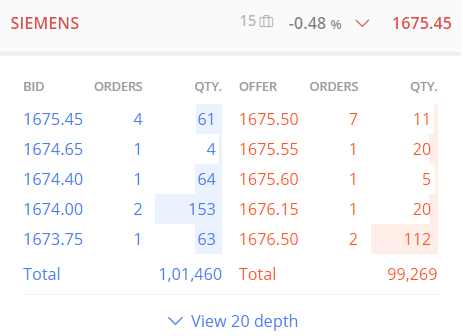
The highest displayed bid is ₹1,675.45, with 61 shares across 4 orders at that level. The lowest displayed offer is ₹1,675.50, with 11 shares across 7 orders. The spread is:
At the instant shown, a buyer seeking 10 shares could look to the 11 shares offered at ₹1,675.50; a seller seeking 10 shares could look to the 61 shares bid at ₹1,675.45. Neither outcome is guaranteed by the screenshot: orders can execute, change, or disappear before a new order reaches the exchange. A larger trade might also need to reach beyond the best price.
The header displays ₹1,675.45, the same number as the best bid. If that header field is labelled LTP in the platform, it means the latest completed trade was at ₹1,675.45. Its equality with the bid in this snapshot does not make LTP another name for the bid.
Volume is not the quantity waiting to trade
Traded volume counts shares that have exchanged hands over a stated period. A quote may show today’s cumulative volume; later, a chart may show volume for a single time interval. Always check the period attached to the number.
The market-depth QTY columns instead show shares waiting at displayed bid and offer prices. The ORDERS columns count orders at those levels, not completed trades. Likewise, the Total figures at the bottom of the pictured bid and offer columns describe order-book quantities; they are not the stock’s traded volume for the day. A large waiting quantity can be cancelled without any share trading.
Read this final comparison of spreads and volume, including its cautions about interpreting a quote.
Stock Quotes Explained: Bid, Ask, Volume, and Change
Questrade’s guide provides a second way to connect spread and traded volume, then identifies common quote-reading errors.
Under “Understanding the Bid-Ask Spread,” begin with the paragraph explaining that the spread indicates liquidity and transaction costs; continue through “Volume Traded and Average Volume,” ending at the sentence about comparing volume with typical activity. Read spread and volume. Then, under “Common Mistakes When Reading Quotes,” read the bullets from “Confusing Last with Bid or Ask” through “Overlooking Delayed Quote Timestamps”: quote-reading cautions.
Volume and spread offer useful context, but neither promises an easy fill. A stock can have substantial volume over the day and still have little quantity available at the best price right now. A spread can widen, and a quote can be delayed. For intraday decisions, check the quote’s timestamp, the best prices, and their displayed quantities rather than treating LTP or daily volume as an execution promise.
The previous lesson’s session distinction still applies: a price shown during pre-open should not automatically be read as a regular-session, continuously tradeable quote.
Key takeaways
LTP records the latest completed trade; volume counts completed trading over a specified period. The bid and ask show currently displayed buying and selling interest, and their difference is the spread. Quantities beside those prices are waiting orders, not traded volume—and a quote is a snapshot, not a guaranteed fill.
Next, you will read open, high, low, close, and volume on a price chart. That will turn individual quote snapshots into a view of how trading developed over time.