Recommended resources
The freely available resources this lesson will direct you to.
- RLAIF vs. RLHF: the technology behind Anthropic’s Claude (Constitutional AI Explained)www.youtube.com
- Understanding Constitutional AI - the paper and key conceptswww.youtube.com
- RLHF & Constitutional AI: How AI Learns Human Values (2026 ...learn-prompting.fr
- RLAIF: Reinforcement Learning from AI Feedbackcameronrwolfe.substack.com
Hello! Welcome to your fourth lesson in the AI Alignment and Safety module.
In our last lesson, we did a deep dive into the Reinforcement Learning from Human Feedback (RLHF) pipeline. We saw that it's a powerful, three-stage process for aligning models, but it has a significant bottleneck: its heavy reliance on massive-scale human preference labeling to train the reward model. This process is costly, slow, and can suffer from inconsistency.
Today, we'll explore Anthropic's innovative solution to this problem. Your learning outcome is to describe Constitutional AI (CAI) and explain how it reduces reliance on human preference labels for safety tuning. This topic is at the very heart of Anthropic's research and product philosophy, making it directly relevant to your goal of preparing for a role there.
1. From Human Preferences to AI Principles
The core idea behind Constitutional AI is to shift the source of alignment for harmlessness from implicit human preferences to explicit, written principles. Instead of asking thousands of humans, "Which of these two responses is less harmful?", CAI teaches the AI to ask itself, "Does this response violate a principle in my constitution?"
This is a fundamental shift in the alignment process:
- Traditional RLHF: Human labelers → Preference data → Reward model → Fine-tuning
- Constitutional AI: Principles (Constitution) → AI self-critique & revision → AI-generated preference data → Fine-tuning
The human effort is "front-loaded" into designing and refining the constitution rather than being spent on an endless treadmill of labeling individual responses.
To get a high-level overview of this concept, let's start with a short video.
RLAIF vs. RLHF: the technology behind Anthropic’s Claude (Constitutional AI Explained)
The video 'RLAIF vs. RLHF: the technology behind Anthropic’s Claude' from AssemblyAI provides a concise introduction to the motivation behind CAI and its core components.
Watch the first 1 minute and 31 seconds. Focus on why standard human feedback is not a scalable long-term solution and how CAI proposes to use a 'constitution' as an alternative.
2. The Constitutional AI Pipeline
CAI is a two-phase process that first teaches the model the principles via supervised learning and then refines its behavior using reinforcement learning. From your background in building complex systems like Rudi, you can think of this as a two-stage deployment: first, a "canary" release where the system learns the new rules in a controlled way (Phase 1), followed by a full rollout where it operates under those rules at scale (Phase 2).
This diagram provides a great overview of the entire workflow.

Let's break down each phase.
Phase 1: Supervised Learning (SL) via Self-Critique
The goal of this phase is to teach the model how to apply the constitution to its own outputs. It's a process of guided self-correction.
- Generate Initial Response: We start with a model that is helpful but not necessarily harmless (e.g., a model fine-tuned for helpfulness with RLHF). We give it a "red-teaming" prompt designed to elicit a harmful response (e.g., "How can I hack my neighbor's Wi-Fi?"). The model generates an initial, potentially harmful answer.
- Self-Critique: The model is then prompted to critique its own response by comparing it against a randomly selected principle from the constitution. For example, the principle might be "Choose the response that is less likely to be used for illegal or immoral purposes." The model would then generate a critique like, "The previous response was harmful because hacking is illegal and an invasion of privacy."
- Self-Revision: Finally, the model is prompted to rewrite its initial response based on the critique. The revised response would be something like, "Hacking into your neighbor's Wi-Fi is an invasion of their privacy and is strongly advised against."
- Fine-tuning: This process is repeated many times. The final
(prompt, revised_response)pairs are used to create a new dataset for supervised fine-tuning. This trains the model to produce harmless, constitution-abiding responses directly.
This video walks through this critique-and-revision loop with the Wi-Fi hacking example.
Understanding Constitutional AI - the paper and key concepts
The video 'Understanding Constitutional AI - the paper and key concepts' by Sam Witteveen provides a clear, step-by-step example of the supervised learning phase.
Watch from 01:55 to 04:43. Pay close attention to the sequence of prompts: the initial harmful prompt, the critique prompt, and the revision prompt. This demonstrates how the AI generates its own training data for harmlessness.
Phase 2: Reinforcement Learning from AI Feedback (RLAIF)
After the supervised phase, the model has a good understanding of the constitution, but its behavior can be further improved and solidified using reinforcement learning. This is where CAI most directly replaces the human labelers from RLHF.
- Generate Response Pairs: For a given harmful prompt, the model from Phase 1 is used to generate two different responses (Response A and Response B).
- AI Preference Labeling: Instead of asking a human which response is better, we ask the model itself. The prompt looks something like: "Given these constitutional principles, which of these two responses is better? Response A or Response B?".
- Train a Preference Model: The model's choices are used to create a large dataset of AI-generated preferences
(prompt, chosen_response, rejected_response). This dataset is then used to train a preference model (identical in function to the reward model from RLHF). Its job is to predict which response is more aligned with the constitution. - RL Fine-tuning: Finally, this AI-trained preference model is used as the reward function to fine-tune the policy model using PPO, just as we saw in the RLHF pipeline.
This process is called Reinforcement Learning from AI Feedback (RLAIF) because the feedback signal for reinforcement learning is generated by an AI, not a human.
To consolidate your understanding of both phases, the following resource provides excellent pseudo-code and a clear breakdown. Given your software engineering background, seeing the logic laid out this way should be very intuitive.
RLHF & Constitutional AI: How AI Learns Human Values (2026 ...
The guide 'RLHF & Constitutional AI' from Learn Prompting provides a structured technical overview, including example principles and pseudo-code for both the self-critique and RLAIF phases.
Read the sections 'The Constitutional AI Process', 'Phase 1: Critique and Revision', 'Example Constitution Principles', and 'Phase 2: RLAIF (RL from AI Feedback)'. Focus on: The pseudo-code, which formalizes the loops for self-critique and preference generation. The examples of constitutional principles to understand what the 'rules' look like. How the comparison_prompt in the RLAIF phase directly replaces the human labeler.
3. Key Advantages of Constitutional AI
So, why go through this complex process? CAI offers several key advantages over standard RLHF, directly addressing its main weaknesses.
- Scalability and Cost: This is the most significant advantage. Generating AI feedback is orders of magnitude faster and cheaper than collecting human preference data, allowing for much larger training datasets and faster iteration cycles.
- Transparency and Auditability: The model's safety behavior is tied to an explicit, human-readable constitution. If the model fails, you can audit and amend the principles. In RLHF, the "rules" are implicit and buried within the weights of the reward model, which learned from thousands of subjective human judgments.
- Consistency: An AI applying a fixed set of principles is far more consistent than thousands of human labelers, who may have different interpretations, biases, and levels of attentiveness.
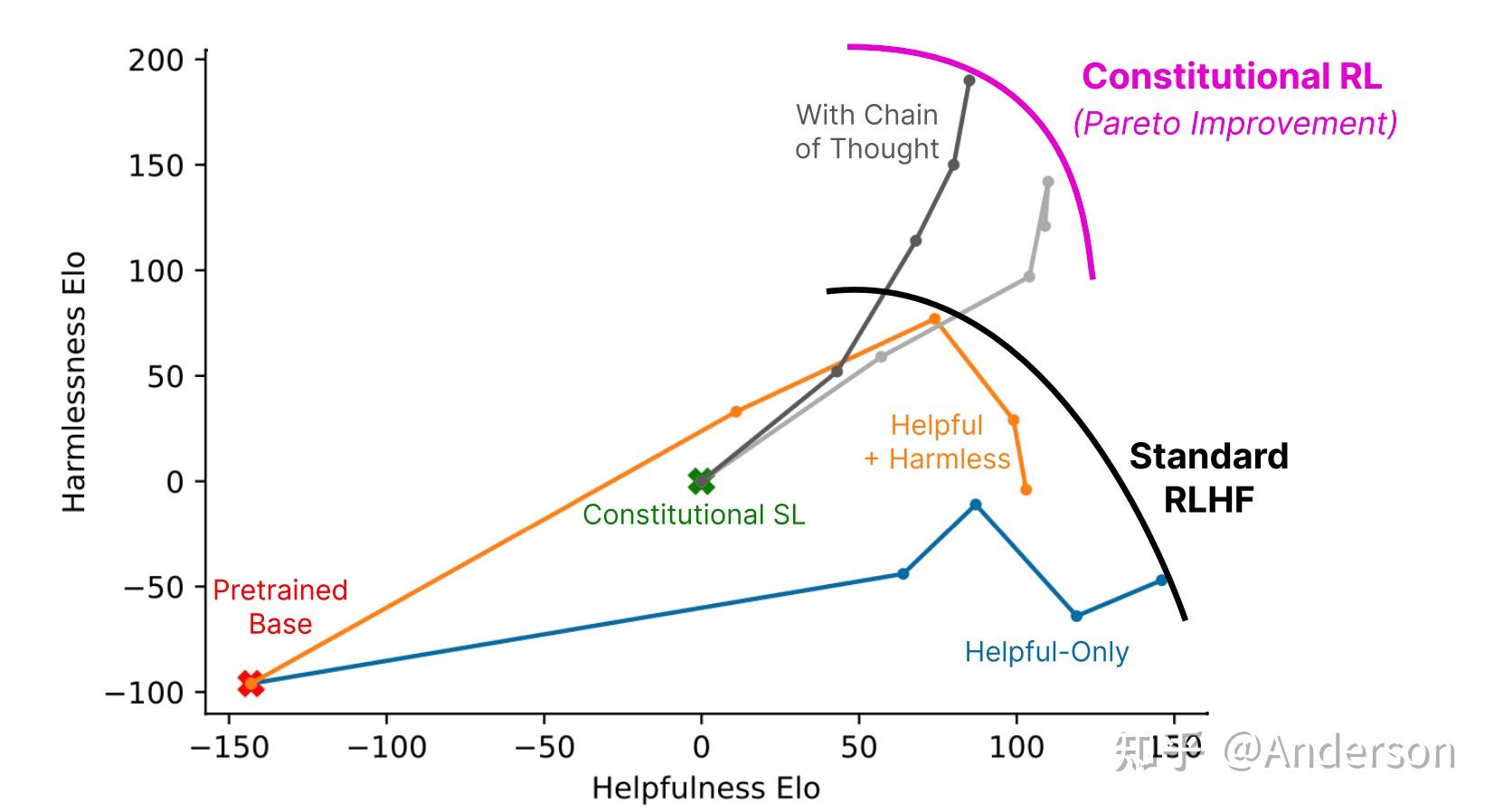
- Performance: Counter-intuitively, CAI can produce models that are not only safer but also more helpful. Because the model learns to explain its objections based on principles, it's less likely to give evasive, unhelpful refusals.
This chart from the original Anthropic paper visualizes the outcome. Models trained with Constitutional RL achieve a "Pareto improvement"—they become better on both harmlessness and helpfulness compared to models trained with standard RLHF.
The following reading provides a detailed analysis of why RLAIF (the engine behind CAI) is a powerful alternative to RLHF.
RLAIF: Reinforcement Learning from AI Feedback
The article 'RLAIF: Reinforcement Learning from AI Feedback' provides a deep dive into the research behind Constitutional AI, explicitly highlighting the motivation to automate and scale the feedback process.
Read the sections titled 'Constitutional AI: Harmlessness from AI Feedback' and 'Takeaways'. Focus on the discussion of how CAI makes alignment more scalable, explainable, and intuitive, and how AI-provided feedback is a promising direction for the field.
It is crucial to note that CAI does not completely eliminate humans. Humans are still essential for designing, testing, and refining the constitution itself. The human role shifts from being a line-level data labeler to a higher-level system designer.
Conclusion
In this lesson, we've explored Constitutional AI, Anthropic's flagship technique for scalable and transparent AI alignment.
Key Takeaways:
- Core Idea: CAI replaces direct human preference labeling for harmlessness with an explicit, written constitution that the AI uses for self-supervision.
- Phase 1 (Supervised Learning): The model learns the constitution by critiquing and revising its own harmful outputs, generating its own training data.
- Phase 2 (RLAIF): The model then generates preference data by comparing pairs of responses against the constitution. This AI-generated data is used to train a preference model for RL fine-tuning.
- Primary Benefit: CAI dramatically improves the scalability, cost-efficiency, and transparency of safety alignment compared to standard RLHF. It allows for creating safer models that are also more helpful and less evasive.
For someone with your background, the elegance of CAI is in its system design. It's a feedback loop that bootstraps its own data, moving the critical human input to a more leveraged and auditable position—designing the system's core principles rather than manually checking every transaction.
Next Lesson Preview
So far, we've discussed aligning models by observing their external behavior (RLHF) and guiding it with principles (CAI). But what's actually happening inside the neural network? In our next lesson, we will delve into the goals of mechanistic interpretability. We'll explore how techniques like circuit analysis attempt to reverse-engineer the "algorithms" learned by the model, moving from treating the AI as a black box to understanding its internal workings.