Recommended resources
The freely available resources this lesson will direct you to.
Hello! Last lesson, you used place value to round numbers and estimate calculations. Now you’ll use that same understanding to calculate exactly with positive and negative decimals. We’ll begin with addition and subtraction, then tackle multiplication and division. Along the way, you’ll use estimates to catch answers whose decimal point is in the wrong place.
Allow about 45 minutes, including the video clips and short check-ins. Work at your own pace: if a check-in reveals a shaky method, revisit it before continuing.
Adding and subtracting: match place values
When adding , the represents tenths and the represents tenths. They belong in the same column. Line up decimal points, not the last digits:
Writing as does not change its value; the extra zero makes the hundredths column visible. Work from right to left, carrying when a column totals or more.
Subtraction uses the same alignment. If there is not enough in a column, regroup from the column to its left. For instance, in , first write as . To subtract the thousandths, you need to exchange across the zero hundredths: one tenth becomes ten hundredths, then one of those hundredths becomes ten thousandths. Continuing column by column gives
Watch the addition example and the first subtraction example in this video. Notice especially why a missing decimal digit must be treated as a zero—not copied straight into the answer.
How to Add, Subtract, Multiply, and Divide Decimals | A Review of Decimals | Math with Mr. J
In “How to Add, Subtract, Multiply, and Divide Decimals,” Math with Mr. J demonstrates the written methods. Watch these two examples to see the place-value alignment and regrouping in action.
Watch decimal addition for aligned points and placeholder zeros. Then watch decimal subtraction, including the warning about incorrectly bringing down a digit when the column above it is empty.
A column method is reliable, but it is not always the quickest. For , adding instead of is easy; you have added too much, so take it back:
Use a mental adjustment when the nearby easy number is obvious. Otherwise, set out the columns.
What changes when a number is negative?
For addition, imagine your starting value as a position on a number line. Adding a positive amount moves towards larger numbers; adding a negative amount moves towards smaller numbers. The decimal calculation itself is unchanged.
For example, starts below zero and recovers . It remains below zero by , so
A useful rule is: when adding numbers with different signs, subtract their positive sizes and use the sign of the number with the larger size. When adding two negatives, add their sizes and keep the negative sign. If the positive and negative sizes match, the result is zero.
For subtraction, keep the first number and add the opposite of the second. This handles both an ordinary subtraction and the easily confused “subtract a negative” case:
Only the second number changes sign when you rewrite a subtraction. The two minus signs in the second example do not mean “ignore both numbers’ signs.”
The following short clips introduce these rules using whole numbers. They apply just as well to decimals because a step of follows the same direction rule as a step of .
Learn Operations with Negative Numbers - Add, Subtract, Multiply, Divide
In “Learn Operations with Negative Numbers,” Mario’s Math Tutoring explains signed addition and subtraction. Use these clips for the sign decisions; the decimal place-value methods come from the examples above.
Watch signed addition for why combining a negative and a positive leaves a difference with a sign. Then watch adding the opposite and subtracting negatives. Focus on which number changes sign when subtraction is rewritten.
Addition and subtraction check-in. Try these without a calculator. For each, decide the sign before finishing the arithmetic.
Answers and fixes: ; (write as ); (the negative size is larger); (subtracting means adding ). If you missed one, correct the setup or sign decision, then try it again before continuing.
Multiplying decimals: calculate first, place the point second
Multiplication does not require the decimal points to line up. Instead:
- Multiply the digits as though the numbers were whole numbers.
- Count the decimal places in both original factors, in total.
- Put that many decimal places in the product, adding leading zeros if necessary.
For example, begins with . The factors have two and one decimal places, giving three altogether. Therefore,
The rule is based on place value, not on a mysterious movement of the decimal point: is eight hundredths and is three tenths. Their product is twenty-four thousandths.
For , calculate . There are two decimal places altogether, so the product is , usually written . An estimate checks its size: should be somewhere around , not or .
Watch one multiplication by a whole number and one by another decimal. Pay attention to the fact that the decimal point is placed after the whole-number multiplication.
How to Add, Subtract, Multiply, and Divide Decimals | A Review of Decimals | Math with Mr. J
Return to the multiplication part of Math with Mr. J’s decimal-operations video. It demonstrates the written method for both kinds of factor.
Watch decimal times integer, then two decimal factors. In the second example, follow the whole-number multiplication separately from the final decimal-place count.
For mental maths, familiar decimal factors can be quicker than the written rule. Multiplying by finds half; multiplying by finds a quarter. Thus .
Dividing decimals: keep the quotient unchanged
Division needs a different approach from multiplication. If you divide both the number being divided and the number you are dividing by by the same scale—or multiply both by the same scale—the answer stays the same. We use this to make the divisor a whole number.
Consider . Multiply both numbers by :
For , the divisor needs multiplying by , so the other number does too:
Dividing by a small decimal can produce a result larger than the number you started with. There are groups of in ; the result should not automatically be made smaller because the operation is division.
If the divisor is already a whole number, leave it alone and use ordinary short or long division. For instance, . If you need another decimal digit to finish the division, you may append a zero: has the same value as . You may never divide by zero.
Watch both division examples below. The second shows why you must scale both numbers, and how a trailing zero lets the division continue.
How to Add, Subtract, Multiply, and Divide Decimals | A Review of Decimals | Math with Mr. J
Finish Math with Mr. J’s video with division. These examples contrast a whole-number divisor with a decimal divisor.
Watch whole divisor for decimal placement during long division. Then watch decimal divisor; focus on the equal change to both numbers before dividing, and on using a trailing zero when needed.
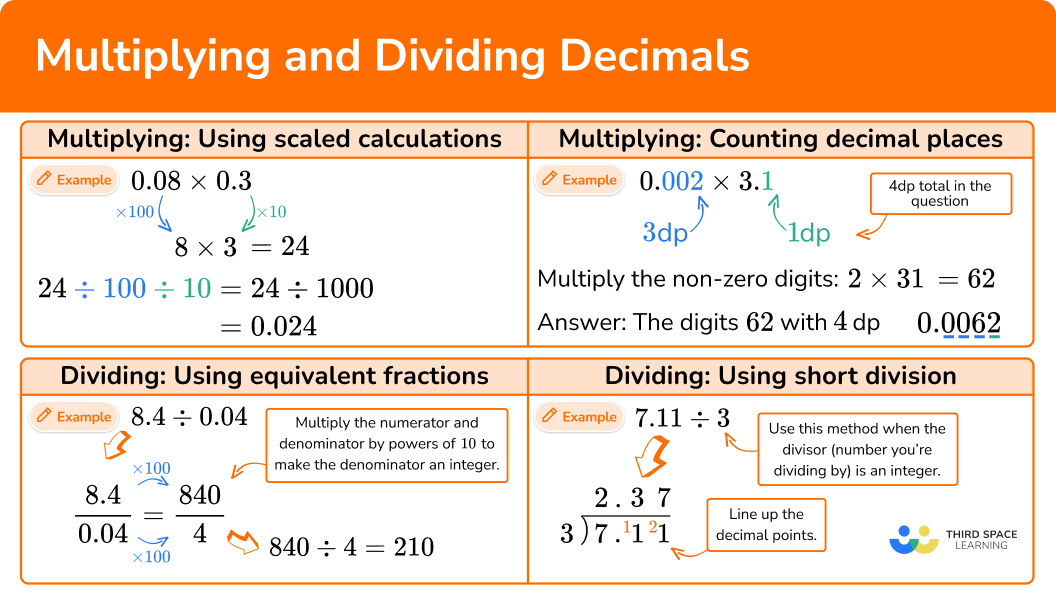
The image below offers a compact comparison of two multiplication methods and two division methods. In particular, its lower-left example shows the equal scaling used above.
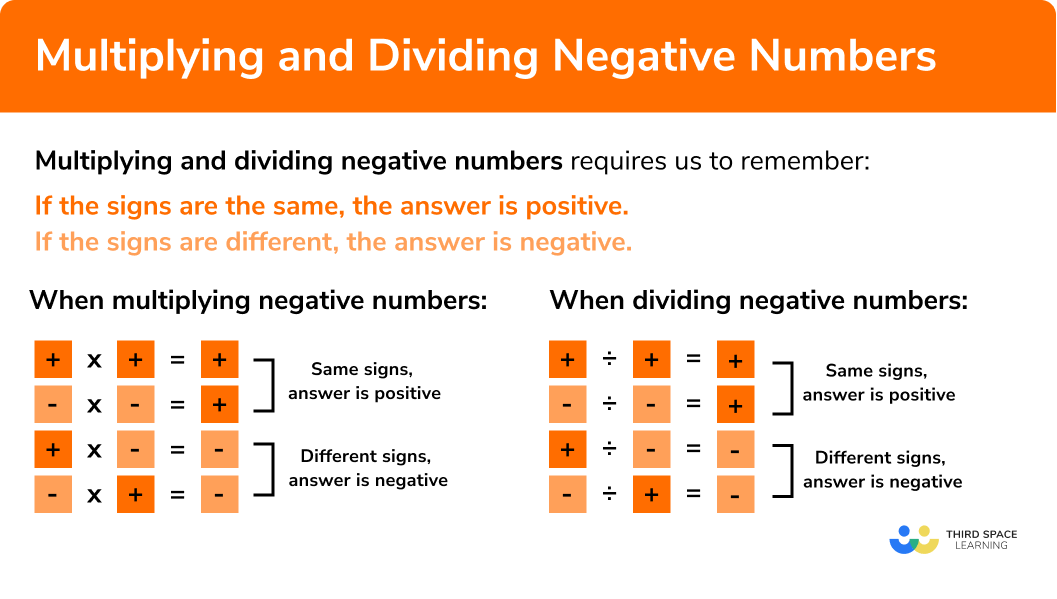
Signs for multiplication and division
Here the sign rule is different from the addition rule. For both multiplication and division:
- Same signs: positive result.
- Different signs: negative result.
Work out the sign and the positive-sized calculation separately. For example,
is positive because the signs match; supplies the digits, and two decimal places give . Similarly,
The signs differ, and multiplying both division numbers by makes the calculation . A zero result is simply zero: .
Learn Operations with Negative Numbers - Add, Subtract, Multiply, Divide
Return to Mario’s Math Tutoring for the multiplication and division sign rules. Compare them with signed addition: the size of a factor does not decide the sign of a product.
Watch product signs for the matching-sign rule. Then watch quotient signs to see that division uses the same rule.
Multiplication and division check-in. Try these in order; the last two combine decimal placement with sign decisions.
Answers and fixes: (three decimal places in total); (divide by ); (same signs); (different signs; ). If a division answer is unexpectedly tiny, check whether you changed both numbers by the same amount.
For one final GCSE-style application, a balance is . You deposit £4.80, then make two payments of £1.35. The final balance is
The payment is subtracted twice, not added twice. Estimating first—roughly —also suggests a small negative balance.
Key takeaways
Addition and subtraction need matching place-value columns; subtraction of a negative becomes addition of its opposite. Multiplication uses whole-number multiplication followed by a count of decimal places. Division becomes easier when you make the divisor a whole number by changing both numbers equally. For multiplication and division with negatives, matching signs give a positive result and different signs give a negative result.
Before moving on, make sure you can explain why you chose each sign and decimal-point position—not just produce an answer. You can share your check-in working for targeted correction. The next module turns to factors, multiples and prime numbers, where these calculation habits will still be useful.