Welcome back. Last lesson, you separated what you have done from what you know, enjoy, or have not yet tested. Today we will look at a different kind of evidence: the circumstances in which learning kept going. Your Japanese study continued through anime, dramas, music, and other exposure, while some large courses and online-income attempts became difficult to sustain. What was different about the learning experience?
The aim is not to prove that you can learn only when something is fun, or that leaving a course was a personal failure. It is to identify conditions you may be able to recreate when learning a future skill. Allow about 40 minutes, including the video and a brief private comparison.
What made returning to Japanese possible?
You have described a starting point that was unusually clear: anime sparked an interest, and Japanese became part of an expanding world of shows, dramas, music, and other material you wanted to explore. The activity offered a reason to return that existed before a course plan or income goal. You could also change the material when your curiosity changed.
Watch Lýdia Machová’s TED talk with that history in mind. Her account is useful for identifying possible conditions, but her personal examples are not a guarantee that the same methods will work for every person or subject.
The secrets of learning a new language | Lýdia Machová | TED
Watch “The secrets of learning a new language” by Lýdia Machová on TED to distinguish an enjoyable way into learning from the methods and time that support progress.
In enjoyable methods, notice how the speaker replaces material she finds dull with material she wants to revisit. In methods and routine, listen for her qualification that enjoyment alone is not enough. In visible progress, focus on small moments of understanding and on why an unsuccessful earlier approach need not settle someone’s ability.
There are at least three distinct possibilities here. Interest gave you a reason to begin. Choice and variety may have helped you return: you were not confined to one instructor’s sequence or one format. Repeated contact gave you opportunities to notice more over time. These are conditions, not claims that watching a show automatically teaches everything needed for language proficiency. Your self-reported intermediate Japanese is a separate claim from the explanation of how you kept learning.
This image groups several ideas often associated with immersive education. It is a map for noticing possibilities, not a checklist you must satisfy.
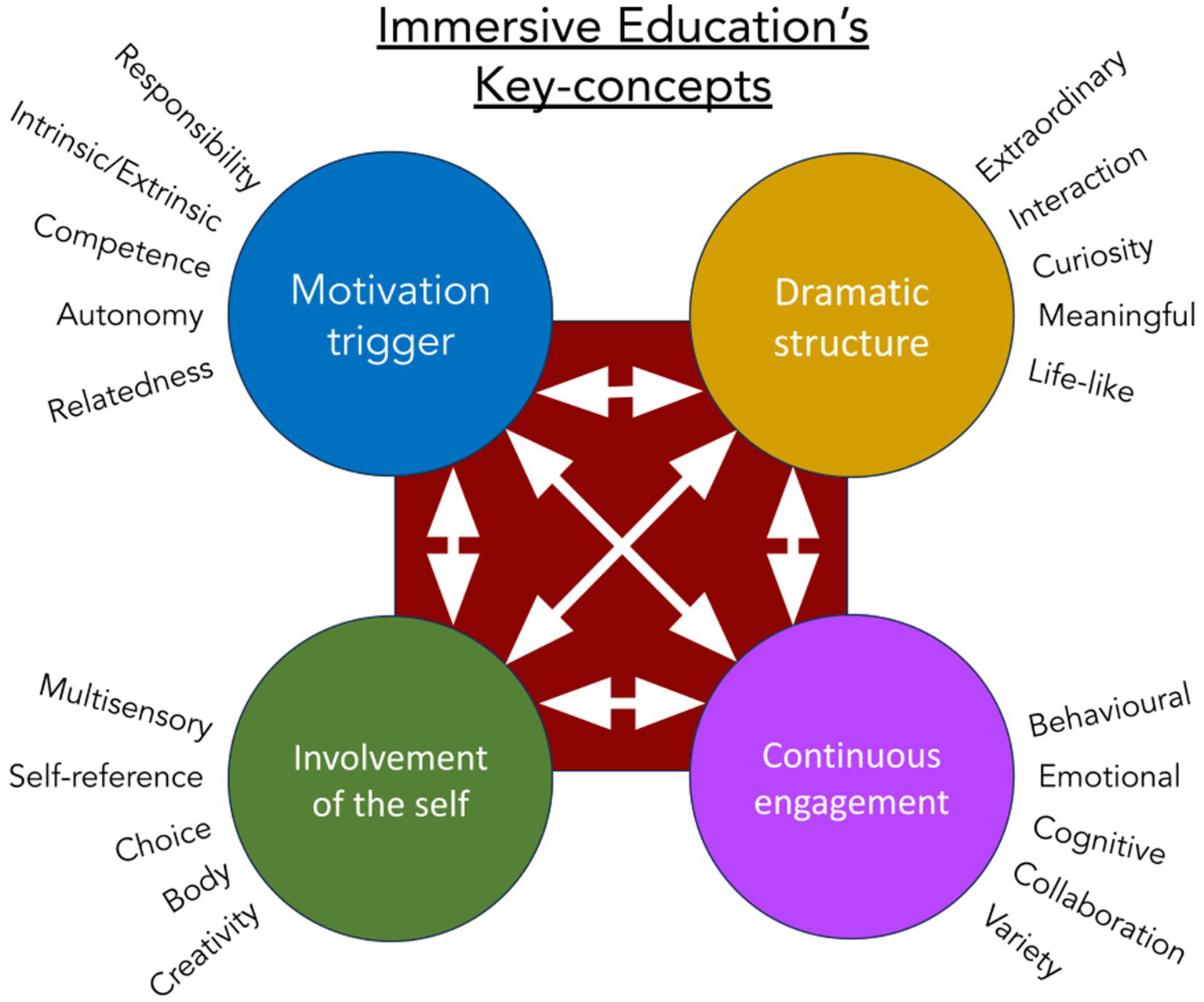
For your Japanese experience, a story you wanted to follow might have supplied the dramatic structure; choosing what to watch or hear might have increased your involvement. “Continuous engagement” need not mean studying every day without illness or interruption. Here it means that returning to the material remained possible over a longer period. Nor does the image’s mention of collaboration mean you need a study group: solitary engagement with meaningful material can be valuable too.
A second lens: choice, effectiveness, connection
Psychologists Richard Ryan and Edward Deci’s self-determination theory gives us three more precise words for examining a learning environment: autonomy, competence, and relatedness. Read the short explanation from the American Psychological Association before applying them.
Self-determination theory: A quarter century of human motivation research
Read the American Psychological Association’s explanation to get clear definitions of three conditions that can support motivation.
Under “Foundations of discovery,” read from the paragraph beginning “SDT describes factors that help or hinder human motivation” through the paragraph ending “feel less fulfilled”; start here and include the discussion of pressure that follows. Then, under “Three steps to motivation,” read the introductory sentence and all three definition bullets, from the three needs. Focus on what each word means rather than on the later university-course example.
Autonomy is not having no structure; it is having meaningful choice within the activity. Choosing a drama because you wanted to understand it offers a different experience from feeling obliged to complete every lecture in a purchased course before doing anything practical.
Competence is the sense that your actions can make a difference. Recognizing a phrase that was previously unfamiliar could provide that feeling—if you recall such moments. We should not insert memories into your inventory just because the theory makes them plausible. In a very large beginner course, by contrast, the distance between the first lesson and a useful result may make progress harder to see. That is a possibility to check against your experience, not a diagnosis of why programming felt difficult.
Relatedness means a sense of connection or belonging. It does not mean you must network, find friends, or talk with strangers to learn. Interest in the people, stories, or cultural world connected with Japanese might have given the subject personal meaning. Whether that describes your experience is for you to decide.
These conditions also explain why “just make learning fun” is incomplete advice. A compelling subject can still become exhausting if the task is too large, progress is invisible, or the schedule ignores your health. Likewise, financial independence is a legitimate reason to learn. The aim is not to remove that goal, but to avoid making every practice session feel like an immediate test of whether you can earn a living.
Compare experiences without rewriting their history
Now bring the lens back to the inventory you already made. Keep reported facts, possible explanations, and unknowns separate. The distinction matters because “this course did not work for me” contains less information than “I could not see how its early lessons connected to a task I wanted to do”—but only if that second statement is true of your experience.
| Condition to inspect | Japanese learning: what you have reported | A large programming course: what is known so far |
|---|---|---|
| Reason to start | Interest sparked by anime | You tried programming courses; your reason for starting a particular one may need checking. |
| Choice of material | Shows, dramas, music, and varied exposure | How much choice you had within the course is not yet established. |
| Size of the next step | You could encounter Japanese through individual pieces of media | You described the large-course format as too difficult; which step first felt too large is unknown. |
| Signs of progress | You report having reached an intermediate level | Whether the course gave you useful early feedback is unknown. |
| Pressure around the activity | Japanese began as a personal interest | An income goal may have added pressure, but its effect on that course is yours to assess. |
This table does not say programming is unsuitable for you. It identifies what we can compare and what we cannot yet conclude. Similarly, your Japanese-learning blog and YouTube attempts involved producing content for an audience and facing commercial difficulty. Those demands differ from learning Japanese for your own interest. Their becoming overwhelming does not erase the learning conditions that previously helped you.
If you have the energy, add a small note beside one abandoned-course entry in your private inventory. Use the headings below; fragments are enough.
Condition present in Japanese: One specific example I remember.
Weaker, absent, or unknown in this course: One specific contrast—or “unknown.”
Possible effect on my ability to continue: My best provisional explanation.
Other possible factors: For example, health, timing, difficulty, cost pressure, or unclear instruction.
A low-energy version is just the first two lines. There is no need to retrieve an old course, buy a replacement, or reconstruct nine years of attempts. If you cannot remember why you stopped, “unknown” is a useful finding. It prevents a guess from becoming a verdict about your abilities.
The most useful result is a design clue, not a universal rule. For example: “I returned more readily when I chose meaningful material and could notice a small gain; for a future skill, I may need a short, relevant task earlier than a large course provides.” That remains a hypothesis. Later lessons will help you test it on actual tasks rather than commit to another entire subject in advance.
You have identified a way to examine learning conditions: look for meaningful choice, material worth returning to, manageable steps, visible progress, and a pace compatible with your life. Use your Japanese experience as evidence about what may support you—not as a demand that career learning feel exactly the same, and not as proof that abandoned courses were failures.
Next, you will turn evidence like this into work constraints: conditions a possible path must respect, including health variability, cost, privacy, contact with others, and payment feasibility.