Recommended resources
The freely available resources this lesson will direct you to.
Hello! Welcome to the third lesson in our journey to build a blockchain application.
In our last session, we dug into the cryptographic foundations that make a blockchain secure: the structure of blocks, the integrity provided by cryptographic hashing, and the ownership proven by public-key cryptography. We established how the ledger is kept secure and unchangeable.
However, a critical question remains: in a decentralized network with thousands of participants, who gets to add the next block to the chain, and how does everyone agree on it? This lesson tackles that question head-on by exploring consensus mechanisms. You will learn to compare the two most important ones: Proof-of-Work (PoW) and Proof-of-Stake (PoS). This is particularly relevant to your goal, as Ethereum, our chosen platform, made a historic transition from PoW to PoS.
The Problem of Agreement in a Decentralized World
Before we compare PoW and PoS, we need to understand the problem they solve. In a system with no central authority, how can we trust the transactions being added? What stops a malicious actor from creating thousands of fake identities (a "Sybil attack") to vote for fraudulent blocks and overwhelm the network?
This challenge is often framed by the "Byzantine Generals Problem," a classic computer science thought experiment. Blockchains solve this by using a consensus mechanism, which forces participants to prove they have "skin in thegame," making it prohibitively expensive to cheat.
PoW and PoS are not, by themselves, full consensus algorithms. They are the Sybil resistance mechanisms at the heart of these algorithms. They provide a way to assign weight to a participant's vote without relying on a central registry of identities.
To get a clear definition of this concept, let's start with a short reading.
Proof of Stake (PoS) Vs Proof of Work (PoW) - The Full Comparison
The following article from Cyfrin clearly distinguishes between a full consensus algorithm and a Sybil resistance mechanism, which is the specific role that Proof-of-Work and Proof-of-Stake play.
Read the introduction and the section 'What is blockchain consensus?'. Focus on understanding what a Sybil attack is and why a 'Sybil resistance mechanism' is necessary for a decentralized network.
With that foundation, let's dive into the first and most famous Sybil resistance mechanism.
Proof-of-Work (PoW): Security Through Computation
Proof-of-Work was the pioneering mechanism introduced by Bitcoin. The core idea is that to earn the right to add the next block, participants, called miners, must perform a significant amount of computational work.
This "work" involves using powerful computers to solve a complex, but arbitrary, mathematical puzzle based on hashing. Essentially, they are racing to be the first to find a specific hash value. The first miner to find the solution gets to broadcast their block of transactions to the network and, in return, receives a reward of newly minted cryptocurrency and transaction fees.
This process ensures security because a bad actor would need to expend an enormous amount of energy and computational power (over 51% of the entire network's power) to attempt to defraud the system.
The following video uses a great analogy to explain how this works.
Proof of Work vs. Proof of Stake: Beginner's Guide!! 👨🏫
This video from Coin Bureau explains the concept of Proof-of-Work using the analogy of a crossword puzzle competition, which makes the idea of computational work very intuitive.
Watch from 5:46 to 10:23. Pay close attention to how 'hashing power' is like intelligence in solving the puzzle and how the difficulty adjusts to keep the competition fair.
Pros and Cons of Proof-of-Work
- Pros:
- Proven Security: PoW has secured the Bitcoin network for over a decade, making it the most battle-tested consensus mechanism.
- High Attack Cost: The massive energy and hardware costs create a very high barrier for attackers.
- Cons:
- High Energy Consumption: The biggest criticism of PoW is the immense amount of electricity required to power the mining hardware.
- Hardware Centralization: The need for specialized hardware (ASICs) has led to a concentration of mining power in the hands of a few large companies and pools.
- Scalability Issues: The computational race makes the process of adding new blocks relatively slow, limiting the number of transactions the network can process per second.
Proof-of-Stake (PoS): Security Through Economic Stake
As an alternative to PoW's high energy consumption, Proof-of-Stake was developed. Instead of expending energy, participants, called validators, lock up or "stake" the blockchain's native currency as collateral.
In a PoS system, the network pseudo-randomly selects a validator to create the next block. The probability of being chosen is typically proportional to the amount of currency the validator has staked. If the validator creates a valid block, they receive a reward (usually from transaction fees).
Crucially, if a validator tries to cheat (e.g., by approving a fraudulent transaction), they can be punished by having a portion of their staked currency destroyed. This is called slashing. The economic incentive is to act honestly to protect your investment.
Let's return to the Coin Bureau video to see how their analogy extends to Proof-of-Stake.
Proof of Work vs. Proof of Stake: Beginner's Guide!! 👨🏫
The video now explains Proof-of-Stake by shifting the analogy from solving a puzzle to putting money in a shared jar, representing the economic stake.
Watch from 10:23 to 13:03. Focus on how staking replaces computational work, the role of randomness, and the concept of 'slashing' as a punishment for bad behavior.
Pros and Cons of Proof-of-Stake
- Pros:
- Energy Efficiency: PoS consumes dramatically less energy than PoW, as it doesn't require intensive computation. Ethereum's move to PoS reduced its energy consumption by ~99.95%.
- Lower Barrier to Entry (Hardware): Validators don't need specialized, expensive hardware; they can run a node on a standard computer.
- Economic Disincentives for Attackers: The slashing mechanism means attackers have a direct financial stake to lose if they are caught.
- Cons:
- Wealth Centralization: The system can favor wealthy participants, as those with more stake are more likely to be chosen and earn rewards, potentially leading to a "rich get richer" dynamic.
- Less Battle-Tested: While gaining widespread adoption, PoS is a newer mechanism and has a shorter history of securing massive-value networks compared to PoW.
Head-to-Head Comparison
The choice between PoW and PoS involves a series of trade-offs between security, decentralization, and scalability.
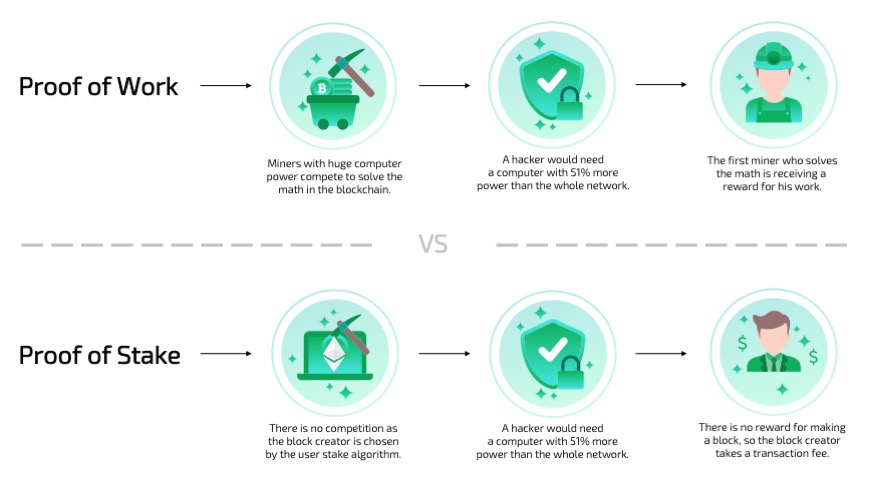
Here's a table summarizing the key differences:
| Feature | Proof-of-Work (PoW) | Proof-of-Stake (PoS) |
|---|---|---|
| Participants | Miners | Validators |
| How Blocks are Won | Solving a computational puzzle (competition) | Being selected based on stake size (lottery) |
| Resource Used | Computational power (electricity, hardware) | Economic capital (staked cryptocurrency) |
| Security Model | Extremely high cost of energy/hardware to attack | Risk of losing staked capital (slashing) if you attack |
| Main Advantage | Proven, robust security | Energy efficiency, scalability |
| Main Disadvantage | High energy consumption, hardware centralization | Potential for wealth centralization ("rich get richer") |
| Example | Bitcoin, Litecoin | Ethereum, Cardano, Solana |
Why Ethereum Chose Proof-of-Stake
For you, as a future Ethereum developer, understanding why the community chose to move to PoS is crucial. The decision was driven by the desire for better energy efficiency and scalability, enabling the network to support a global ecosystem of applications.
There's no better person to hear the rationale from than Ethereum's creator, Vitalik Buterin.
Ethereum 2.0: Proof of Stake vs Proof of Work | Vitalik Buterin and Lex Fridman
In this clip, Vitalik Buterin discusses the primary benefits that motivated Ethereum's transition to Proof-of-Stake with Lex Fridman.
Watch from 4:28 to 12:48. Pay attention to the three main reasons he gives for preferring PoS: reduced resource consumption (environmental and hardware), lower coin issuance needed to secure the network, and the security model where attacks are not only costly but also easier to recover from via slashing.
Test your understanding!
Imagine you are advising the creators of a new blockchain.
- Scenario A: Their top priority is creating a system with the most time-tested, proven security model, and environmental impact is not a primary concern.
- Scenario B: Their top priority is creating a highly scalable, energy-efficient network capable of handling thousands of transactions for applications like social media or gaming.
Which consensus mechanism (PoW or PoS) would you recommend for each scenario, and why?
Show answer
-
Scenario A: Proof-of-Work (PoW) would be the recommended choice. Its security model has been successfully protecting Bitcoin for over a decade, making it the most "battle-hardened" option. The high energy cost is a direct component of its security, making attacks prohibitively expensive.
-
Scenario B: Proof-of-Stake (PoS) is the clear winner here. Its energy efficiency is a massive advantage for a high-throughput network. Furthermore, PoS is generally considered to offer better scalability, as block production isn't tied to a time-consuming computational race, allowing for faster block times and more transactions per second, which is essential for applications like social media and gaming.
Conclusion
You now have a clear understanding of the fundamental differences between Proof-of-Work and Proof-of-Stake. These are not just abstract concepts; they are the engines that determine a blockchain's security, scalability, and environmental footprint.
Key Takeaways:
- Consensus mechanisms are needed to prevent Sybil attacks and allow a decentralized network to agree on the state of the ledger.
- Proof-of-Work secures the network through external, real-world resources: computational power and energy. It's highly secure but energy-intensive.
- Proof-of-Stake secures the network through internal, economic resources: staked cryptocurrency. Validators risk losing their capital if they misbehave, making it very energy-efficient.
- Ethereum's move to PoS ("The Merge") was motivated by a desire for greater sustainability and scalability, which are critical for its long-term vision as a global settlement layer.
Preview of the Next Lesson:
Now that we understand how the Ethereum network reaches consensus, it's time to zoom in on the machine itself. In our next lesson, we will explore the architecture of Ethereum. We'll learn about the Ethereum Virtual Machine (EVM), the global computer that runs smart contracts, and the crucial concept of state, which is how Ethereum tracks every account balance and piece of data across the network.