Recommended resources
The freely available resources this lesson will direct you to.
Hello! Welcome to the first lesson of your journey into building blockchain applications. Your goal is to create a cryptocurrency token on the Ethereum network, and this course is designed to take you from the fundamentals to deploying a complete, feature-rich token project.
This first module, "Blockchain & Ethereum Fundamentals," lays the essential groundwork. Before we can write any code, we need to understand the "why" and "how" behind the technology.
Today, we'll start with the three conceptual pillars of any blockchain:
- Decentralization: What it means to operate without a central authority.
- Immutability: How blockchain records become permanent and unchangeable.
- Consensus: How a global network of computers can agree on a single source of truth.
Understanding these core ideas is the first and most crucial step toward becoming a proficient blockchain developer. Let's begin!
The Shift from Centralized to Decentralized Systems
In your experience as a backend developer, you've likely worked extensively with centralized systems. A typical web application uses a central database managed by a single organization. This server is the authoritative source of truth. If the server goes down, the service is unavailable. If the database is compromised, the data is lost or corrupted. This is a single point of failure and a single point of control.
Blockchain technology offers a fundamentally different architecture: a decentralized one.
Imagine you and your friends want to keep track of money you owe each other. You could use a shared notebook. But who holds the notebook? Whoever holds it has the power to add fake entries or deny others from seeing it. This is a centralized model.
What if, instead, everyone kept their own copy of the notebook? When a transaction happens, it's announced to everyone, and everyone updates their own copy. This is the basic idea of a decentralized, distributed ledger. There's no single person in charge, and no single copy that can be easily controlled or destroyed.
To see this idea built from the ground up, the following video provides an excellent, intuitive explanation.
But how does bitcoin actually work?
Watch the first two main sections of this video from 3Blue1Brown. It introduces the concept of a shared public ledger and the challenges that arise when you try to remove a central authority.
Watch from the beginning until the 11:21 mark. Focus on understanding: The limitations of a simple, publicly accessible ledger. The core problem that arises when everyone maintains their own copy of the ledger: how can everyone agree on what the right ledger is?
As the video explains, moving to a system where everyone has a copy of the ledger solves the problem of a single point of failure but creates a new, massive challenge: How do we ensure all copies are identical and agree on the correct order of transactions?
This brings us to our next key concept.
Achieving Agreement: The Role of Consensus
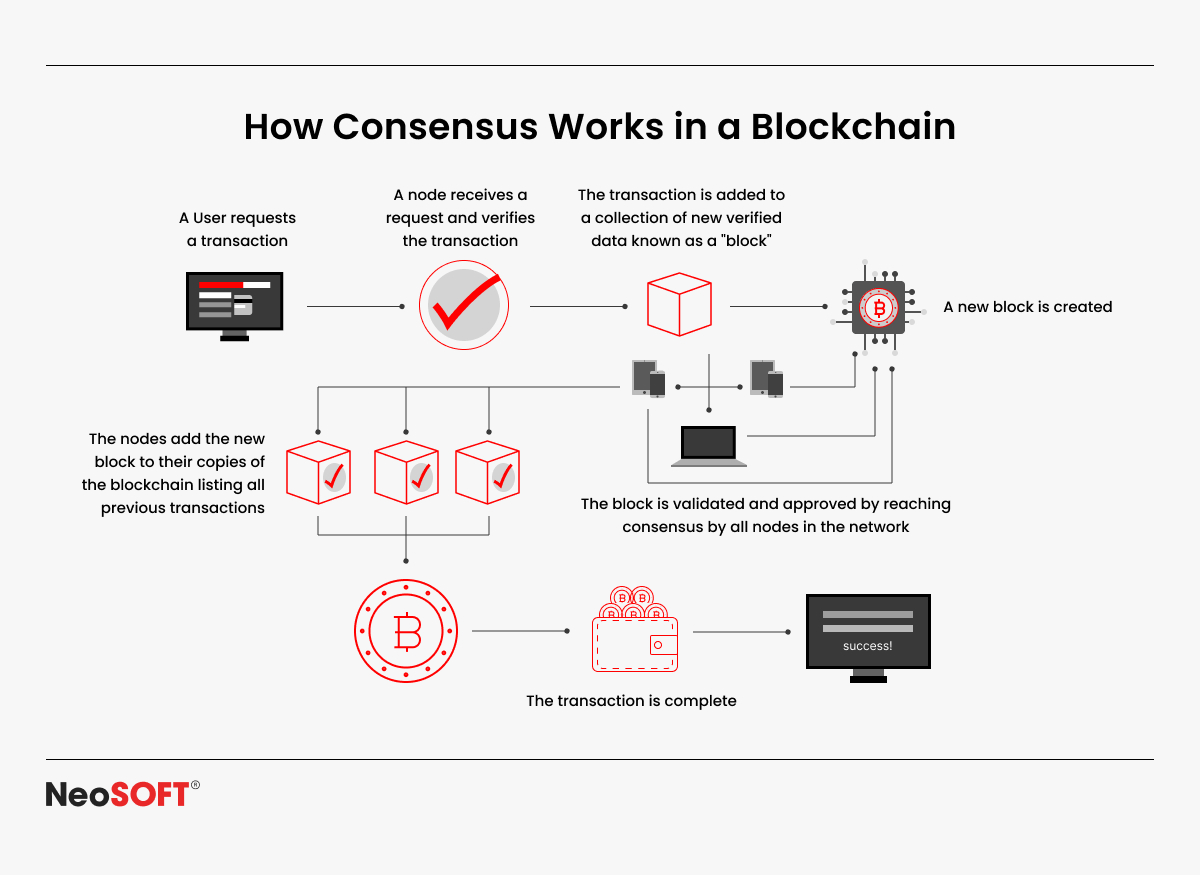
Consensus is the process by which a distributed network of participants (called "nodes") agrees on the current state of the ledger. It's a set of rules that ensures everyone's copy of the blockchain is consistent and that only valid transactions are added. Without a consensus mechanism, a decentralized network would descend into chaos, with conflicting versions of the truth.
The document below provides a concise definition of decentralization and consensus mechanisms.
Blockchain for beginners- basic guiding principles
Read the sections on 'Decentralization' and 'Consensus Mechanisms' from the EU Blockchain Observatory's guide for beginners.
In the PDF, navigate to section '2.1.1. Decentralization' (page 11) and '2.1.3. Consensus Mechanisms' (page 13). These sections will give you formal definitions of the concepts we are discussing.
The reading introduces Proof-of-Work (PoW), the first major blockchain consensus mechanism, used by Bitcoin. In PoW, network participants called "miners" compete to solve a complex computational puzzle. The first one to solve it gets to propose the next "block" of transactions and is rewarded for their effort. This "work" makes it computationally expensive and difficult to add new blocks, which is a key security feature.
The 3Blue1Brown video continues to explain how this process leads to a secure, decentralized agreement.
But how does bitcoin actually work?
Now, let's watch the part of the video that explains how this competition to create blocks results in a unified, trustworthy chain.
Watch the segment from 17:24 to 21:45. Pay close attention to the 'longest chain rule' and why it incentivizes miners to be honest and build on the same chain.
This "longest chain is the truth" rule is the core of PoW consensus. Any malicious actor trying to create a fraudulent version of the blockchain would need to outpace the computational power of the entire rest of the network—an almost impossible feat.
This diagram provides a visual summary of how a transaction gets approved through network consensus.
The Unchangeable Record: Immutability
We now have a decentralized ledger and a way for everyone to agree on what gets added to it. This combination gives rise to blockchain's most powerful feature: immutability.
Immutability means that once data has been recorded on the blockchain, it cannot be altered or deleted. In practice, it's not absolutely impossible, but it is computationally infeasible—meaning it would require an unrealistic amount of resources to pull off.
How is this achieved?
- Cryptographic Hashing: Every block is linked to the previous block by including the previous block's hash—a unique, fixed-length "fingerprint" of its data.
- Chain Reaction: If an attacker tries to alter data in an old block, its hash will change. This breaks the link to the next block, whose hash would now be incorrect. The attacker would have to recalculate the hashes for all subsequent blocks.
- Proof-of-Work & Consensus: While recalculating the hashes, the attacker would also have to re-do the computationally intensive Proof-of-Work for every single one of those blocks, all while trying to outpace the honest network which is continuing to add new blocks to the legitimate chain.
The following short video provides a great visual of this chaining effect.
How does a blockchain work - Simply Explained
This video from Simply Explained offers a clear, concise visualization of how blocks are chained together and what happens when one is tampered with.
Watch the segment from 0:58 to 2:59. Notice how a change in one block creates a domino effect, invalidating the rest of the chain.
For a more detailed breakdown, this article clearly explains the mechanisms that work together to ensure immutability.
How Does Blockchain Ensure Immutability?
To solidify your understanding, read this article's definition of immutability and its explanation of how different components contribute to it.
Read the sections 'What is Immutability?' and 'How Does Blockchain Ensure Immutability?'. Focus on how cryptographic hashing, decentralization, and consensus mechanisms all play a role.
From your backend perspective, you can think of a blockchain as a globally replicated, append-only log file. Once a line is written and validated by the network, it’s there for good, creating a verifiable and trustworthy audit trail.
Test your understanding!
An attacker wants to reverse a transaction they made a week ago on a major blockchain like Ethereum. Based on what you've learned, explain why this would be practically impossible. Mention at least two of the three core concepts we discussed today.
Show answer
This would be practically impossible due to several factors rooted in the core concepts:
-
Immutability and Hashing: The transaction is in a block that is cryptographically linked to thousands of subsequent blocks. To change the old transaction, the attacker would have to alter that block, which would change its hash. This would invalidate the entire chain of blocks that came after it. The attacker would need to recalculate the correct hash and proof-of-work for every single block from that point to the present.
-
Decentralization and Consensus: While the attacker is trying to rebuild a fraudulent chain, the rest of the decentralized network is honestly adding new blocks to the legitimate chain, making it longer. According to the "longest chain rule" of the consensus mechanism, the network will always ignore the attacker's shorter, fraudulent chain. To succeed, the attacker would need to control more than 50% of the entire network's computing power (a "51% attack"), which is prohibitively expensive and difficult on a large, established network.
Conclusion
In this lesson, we've unpacked the three foundational concepts that make blockchain technology revolutionary.
Key Takeaways:
- Decentralization: Blockchains operate as distributed systems without a central authority, removing single points of failure and control. The ledger is maintained by a peer-to-peer network of nodes.
- Consensus: This is the mechanism, like Proof-of-Work, that allows the decentralized network to agree on the validity of transactions and maintain a single, shared version of the ledger.
- Immutability: A result of cryptographic hashing and network consensus, this property ensures that once data is recorded on the blockchain, it is permanent and tamper-proof.
These three pillars work in concert to create a system for recording and verifying transactions that is secure, transparent, and trustless—meaning you don't have to trust an intermediary, only the protocol itself.
Preview of the Next Lesson:
We've mentioned "cryptographic hashing" and "digital signatures" several times today. In our next lesson, we will dive deeper into these fundamental cryptographic tools. You'll learn exactly what a hash function is, how public-key cryptography works to prove ownership, and how these two technologies secure the entire network.