Recommended resources
The freely available resources this lesson will direct you to.
Bonjour! Let's begin our journey into the French past tense.
Introduction
In our recent lessons, we've focused on asking questions about the world around you. Now, we're going to shift our focus to telling stories and describing events that have already happened. This is a crucial step for understanding novels and films.
We'll start with the most common French past tense, the passé composé, which is used to talk about completed actions in the past. To master it, we must first understand the two most important verbs in French, être (to be) and avoir (to have), in a new light.
Today's learning outcome is to distinguish the roles of 'être' and 'avoir' as main verbs versus auxiliary verbs in the passé composé. You'll learn to recognize when j'ai means "I have" and when it's just a "helping" word to talk about something you did.
Part 1: The Main Role of Être and Avoir
From your experience with comprehensible input, you're already familiar with être and avoir in their primary roles: "to be" and "to have". Let's quickly formalize this knowledge by seeing some clear examples.
When/How to Use the French Verbs Être and Avoir
The video 'When/How to Use the French Verbs Être and Avoir' from the Rachel Cartwright channel provides excellent examples of these verbs used as main verbs. We'll watch a few segments to see the patterns.
Please watch the following sections. Focus on what the verbs are used to express: Uses of être: Watch from 01:44 to 02:45. Notice its use with adjectives for descriptions (il est timide) and for professions (elle est professeur). Uses of avoir: Watch from 03:28 to 04:40. Observe its use for possession (j'ai un frère), age (j'ai dix-sept ans), and physical features (j'ai les cheveux noirs). Special Expressions with avoir: Watch from 05:11 to 06:05. Pay attention to common phrases like avoir faim (to be hungry) and avoir froid (to be cold), which use avoir in French where English uses 'to be'.
In all these examples, être and avoir are main verbs. They carry the primary meaning of the sentence: someone is something, or someone has something.
Je **suis** grand.(I am tall.) -êtreas a main verb.J'**ai** un livre.(I have a book.) -avoiras a main verb.
Part 2: The "Helping" Role of Être and Avoir
Now for the new concept. In the passé composé, être and avoir take on a second job as auxiliary verbs (or "helping verbs"). Their job is not to mean "to be" or "to have," but to help another verb express a past action.
This is similar to English. In the sentence "I have eaten," the word "have" doesn't mean you possess something; it helps "eaten" form a past tense.
Let's see how this is introduced in French.
Être or Avoir in the Passé Composé in French... French PAST TENSE explained!
The video 'Être or Avoir in the Passé Composé' from Learn French With Alexa clearly explains this concept of an auxiliary verb.
Watch from the beginning at 00:25 until 01:14. Focus on understanding that the passé composé is formed with two parts: an auxiliary verb (être or avoir) and a past participle.
As the video explains, the structure of the passé composé is:
Subject + [Auxiliary Verb avoir or être] + [Past Participle]
When used this way, the meaning changes entirely:
J'**ai** mangé.(I ate / I have eaten.) - Here,aiis an auxiliary helping the verbmanger.Je **suis** tombé.(I fell / I have fallen.) - Here,suisis an auxiliary helping the verbtomber.
The key is to see that avoir or être is followed by another verb (the past participle).
Part 3: Seeing Both Roles Together
Let's use a text resource to see clear, side-by-side examples of these two different roles. This will help solidify the pattern.
The article 'Avoir vs. être' from Lingolia is a well-structured guide that directly compares the two functions of these verbs.
Please read the following two sections in the article. For each example, ask yourself: is the verb followed by a noun/adjective (main verb), or by another verb (auxiliary verb)? Start at the heading 'When to use avoir and être as main verbs'. Read through the examples for both avoir and être. Continue to the next heading, 'When to use avoir and être as auxiliary verbs'. Read this section carefully to see how they combine with other verbs to form past tenses.
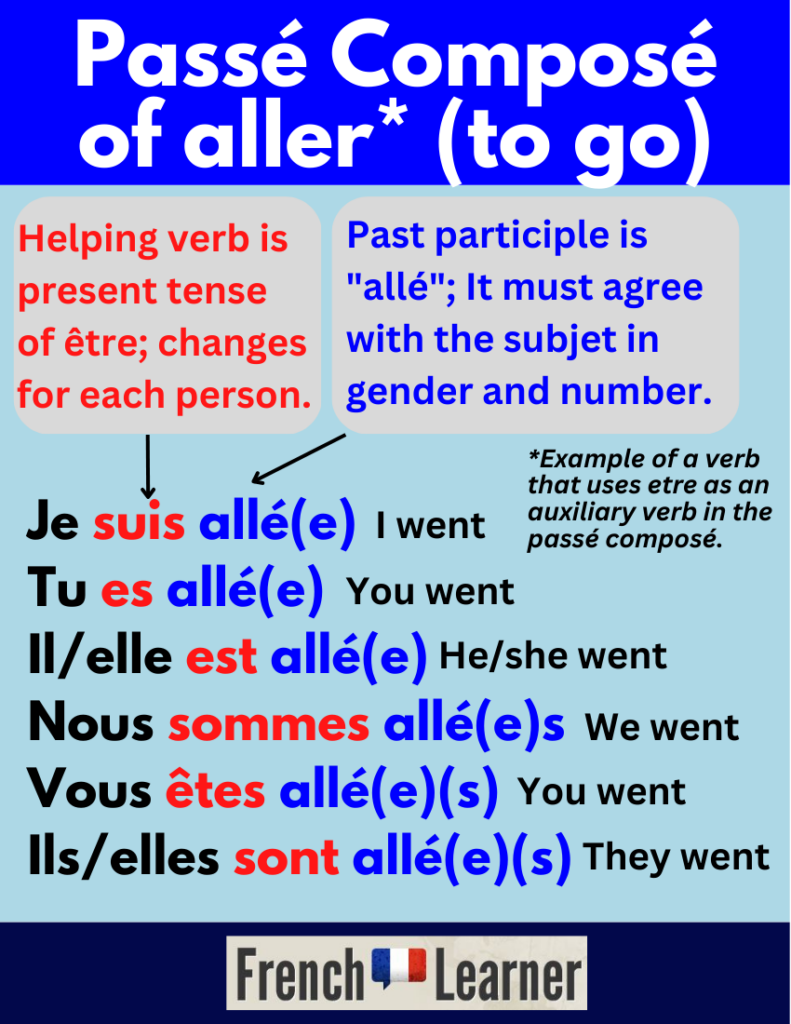
To give you a visual pattern, here are two classic examples of the passé composé in action.
Here is a verb that uses avoir as its auxiliary:

And here is a verb that uses être:
Quick Practice: Main Verb or Auxiliary?
Let's test your ability to distinguish the two roles. For each sentence below, decide if the bolded verb is a main verb or an auxiliary verb.
- Elle a une belle voiture. (She has a beautiful car.)
- Elle a voyagé en Italie. (She traveled to Italy.)
- Nous sommes fatigués. (We are tired.)
- Nous sommes arrivés hier. (We arrived yesterday.)
- Tu as quel âge ? (How old are you?)
- Tu as fini tes devoirs ? (Did you finish your homework?)
.
.
.
Answers:
- Main verb. It expresses possession ("has").
- Auxiliary verb. It helps the verb
voyagerform thepassé composé. - Main verb. It expresses a state of being ("are").
- Auxiliary verb. It helps the verb
arriverform thepassé composé. - Main verb. It's the fixed expression for age ("have years").
- Auxiliary verb. It helps the verb
finirform thepassé composé.
Conclusion
Excellent work today! You've grasped a fundamental concept for narrating the past in French.
Key Takeaways:
Êtreandavoircan function as main verbs, meaning "to be" and "to have," respectively. They are typically followed by adjectives, nouns, or used in fixed expressions.Êtreandavoircan also function as auxiliary (helping) verbs to form thepassé composé. In this role, they have no meaning on their own and are always followed by a past participle (e.g.,mangé,allé).- Recognizing whether
êtreoravoiris followed by another verb is the key to distinguishing its role.
Now that you can distinguish the roles of these verbs, our next lesson will focus on the practical application: how to form the passé composé with avoir for regular verbs. We will start with avoir because it is used for the vast majority of French verbs.