Recommended resources
The freely available resources this lesson will direct you to.
- Practise your French Passé Composé Irregular Verbswww.youtube.com
- 15 Most Used French Irregular Verbs in Passé Composé : Quick Conjugation & Pronunciationwww.youtube.com
- Beginner French Bilingual Story-Lesson Part 1learn-french-free-with-stories.weebly.com
- Intermediate French: 14 July: 1.1.1 Perfect tense | OpenLearnwww.open.edu
Bonjour! Welcome back.
Introduction
In our previous lesson, you learned to form the passé composé for regular verbs using avoir. You saw how the past participles for -er, -ir, and -re verbs follow a very predictable pattern (-é, -i, -u). This is a powerful tool, but it doesn't cover some of the most frequently used verbs in French.
Today, we will address those exceptions. The goal of this lesson is to identify common irregular past participles in context. You'll encounter verbs like avoir (to have), être (to be), faire (to do/make), prendre (to take), and voir (to see). These verbs are so common that their past forms don't follow the simple rules, but you will see them so often that they will quickly become familiar. We'll focus on recognizing them through examples, which suits your preferred learning style.
Why Irregulars Exist
Before we dive in, a quick thought on why these exist. In many languages, the most common verbs are often irregular. Because they are used so frequently, they tend to preserve older, historical forms or evolve in unique ways over centuries. The key is not to get bogged down by the lack of a simple rule, but to build familiarity through exposure.
Encountering the Most Common Irregular Participles
Let's start by seeing and hearing some of the most essential irregular verbs in the passé composé. The following video presents them one by one, showing the full conjugation. This is a great way to see the pattern of avoir + past participle that you already know, but with these new, irregular forms.
15 Most Used French Irregular Verbs in Passé Composé : Quick Conjugation & Pronunciation
The video '15 Most Used French Irregular Verbs in Passé Composé' from the channel 'Learn French with Lexie' clearly demonstrates the formation and pronunciation of these key verbs. We'll focus on the most essential ones first.
Please watch the following segments. For each verb, pay attention to the past participle that is introduced and how it's used in the example sentences. être (to be) → été: Watch from 00:49 to 01:53. avoir (to have) → eu: Watch from 01:53 to 02:42. faire (to do/make) → fait: Watch from 03:57 to 04:58. dire (to say/tell) → dit: Watch from 06:50 to 07:40. voir (to see) → vu: Watch from 07:40 to 08:41. prendre (to take) → pris: Watch from 00:12:33 to 00:13:24.
As you saw, the structure remains the same (J'ai..., Tu as..., etc.), but the participle is unique:
J'ai **été** malade.(I was sick.)Elle a **eu** une idée.(She had an idea.)Nous avons **fait** un gâteau.(We made a cake.)Tu as **dit** la vérité.(You told the truth.)Ils ont **vu** le film.(They saw the film.)J'ai **pris** le train.(I took the train.)
A Visual Summary
Here is a helpful image that summarizes the verbs you just saw and adds a few more common ones. It provides a simple example for each, reinforcing the pattern.
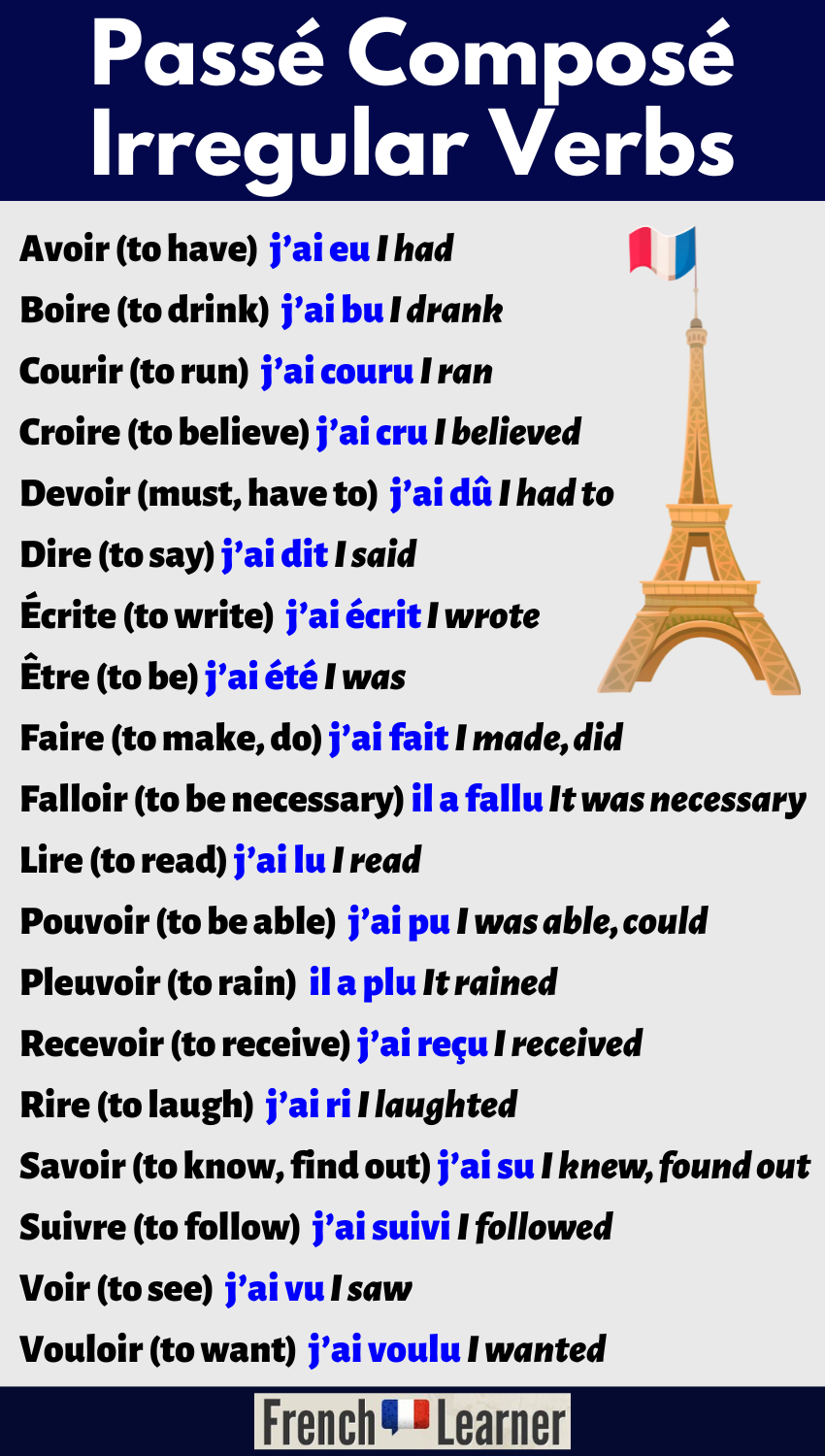
Grouping Irregulars: Finding New Patterns
While these participles are "irregular," we can still find patterns to help us learn them. Some of them share similar endings. The following text introduces a useful way to group them.
Intermediate French: 14 July: 1.1.1 Perfect tense
The article 'Perfect tense' from OpenLearn offers a simple way to categorize past participles by their ending.
Read the section titled 'Past participle endings'. You don't need to memorize the list, but notice how irregulars can be grouped into endings like -i/-is/-it (like pris, dit) and -u (like vu, eu). This can be a helpful mental model.
This approach shows that even within irregularity, there are clusters of similarity. Recognizing that pris, mis (put), compris (understood), and appris (learned) all end in -is can make them easier to recall as a group.
Identifying Participles in Context
Now, let's practice identifying these forms in a real conversation. The following activity uses several irregular participles that end in -u. Read the dialogue and see if you can spot them and understand the meaning.
Intermediate French: 14 July: 1.1.1 Perfect tense
This activity, also from the OpenLearn article, presents a short dialogue packed with irregular participles.
Find and read 'Activité 3'. First, read the French dialogue and try to identify the bolded verbs. The infinitives are listed below it. Then, try to translate the dialogue into English. Finally, compare your translation with the answer provided in the resource.
In that short exchange, you saw:
avez **vu**(fromvoir- to see)ai **dû**(fromdevoir- to have to)ai **lu**(fromlire- to read)a **plu**(fromplaire- to please)ai **pu**(frompouvoir- to be able to)ai **bu**(fromboire- to drink)a **plu**(frompleuvoir- to rain)
This exercise demonstrates how naturally these forms appear in everyday conversation.
Quick Check
Let's do a quick recall. Based on what you've seen, what is the past participle for each of these verbs?
faireavoirvoirprendreêtre
.
.
.
Answers:
faiteuvuprisété
Excellent. Getting these core participles down is a huge step forward.
Conclusion
In this lesson, you've moved beyond regular verbs and started to build a catalogue of the most common irregular past participles.
Key Takeaways:
- Many of the most frequent French verbs have irregular past participles that don't follow the standard
-é,-i,-urules. - The best way to learn them is through repeated exposure in context, not rote memorization.
- Some key irregular participles are
été(to be),eu(to have),fait(to do),dit(to say),vu(to see), andpris(to take).
So far in this module, we have focused exclusively on verbs that form the passé composé with avoir. However, a small but important group of verbs uses être as the auxiliary. In our next lesson, we will explore these verbs and learn how to form the passé composé with être.