Recommended resources
The freely available resources this lesson will direct you to.
- CAT Arithmetic | Session 02: Successive percentage change | CAT 2026 | Amit Panchmatiawww.youtube.com
- Percentages 3: Percentage Increase Decrease | Arithmetic for CAT 2027 | Ravi Prakash Rodhawww.youtube.com
- Successive Percentage Change — Percentages | CAT Quant | Vidaaravidaara.org
- Percentages Formulas for CAT 2026: 18 Shortcuts + 20 PYQs | Optima Learnwww.optimalearn.com
Hello! Last lesson, you translated verbal comparisons into equations and checked which quantity each expression represented. That same habit is essential with percentages: “20% of what?” matters more than the arithmetic that follows.
In this lesson, you will calculate a single percentage change, combine successive changes, and work backward from a changed value. These are core CAT Quantitative Aptitude methods, and the final section brings them together into a quick way to choose a method under time pressure.
1. A percentage change has a base
A percentage change compares a difference with the original quantity. If a value changes from to , then
For instance, a rise from to is a rise of on a base of , so it is a increase. A fall from to is a fall of on a base of , so it is a decrease. The absolute difference is identical; the percentage is not, because the base has changed.
For calculations involving a known starting value, use a multiplier. An increase of multiplies the value by ; a decrease of multiplies it by . Thus, increasing by gives , while decreasing it by gives . The multiplier packages the original together with the change.
2. Successive changes use successive bases
Suppose a value of rises by , then falls by . After the rise it is . The fall is of , or , leaving . Relative to the original , that is a decrease—not no change.
Multipliers make the shifting base visible without requiring you to choose every time. If the original value is , the same calculation is
The result is of the original. More generally, translate each change into its own multiplier and multiply them. Compare the product with to find the net change.
Watch the opening methods in CAT Arithmetic | Session 02: Successive percentage change from CAT Preparation - iQuanta. The assumed-value method is useful for seeing where the new base comes from; the fraction and formula methods offer faster alternatives once that idea is secure.
CAT Arithmetic | Session 02: Successive percentage change | CAT 2026 | Amit Panchmatia
Watch how three methods describe the same pair of changes, rather than memorizing them as separate rules.
Watch three methods for assumed values, fractional multipliers, and the direct formula, including how the formula handles increases and decreases. Then watch equal changes to check why an equal-percentage rise and fall do not cancel.
For two changes, you may also use a compact formula. Treat increases as positive and decreases as negative. If the signed percentage changes are and , their net percentage change is
This is just the multiplier product expanded: . For a increase followed by a decrease, take and . The net change is , an increase. Equivalently, .
For three or more changes, multiplier chains usually keep the work clearer. A rise, then a rise, then a fall has multiplier
so the final value is below the original. As a useful check, successive percentage changes to the same quantity can be rearranged without changing their final multiplier. Do not, however, chain percentages that describe unrelated quantities as though they share a base.
Read the introduction and first three worked examples in Vidaara’s Successive Percentage Change. Focus on how the signs in its formula agree with the multipliers, particularly for two discounts and for an increase followed by a decrease.
Successive Percentage Change — Percentages | CAT Quant | Vidaara
Read Vidaara’s explanation to consolidate the assumed-value, multiplier, and formula approaches.
Under “Successive Percentage Change,” read the opening explanation. Then, under “Solved examples,” read examples 1–3. In each, identify the multiplier you could use instead of the displayed formula.
3. Reverse percentages: work back from the result
A reverse problem tells you the changed value and asks for the original. If the final value is obtained by multiplying the original by , then
For example, a value is after a decrease. Because of the original remains, , so . Dividing by would answer a different question: it would treat as the amount of the decrease.
There is a closely related wording: “ of a number is .” Here is itself of the original, not the value after a decrease. The image shows one way to work back through .
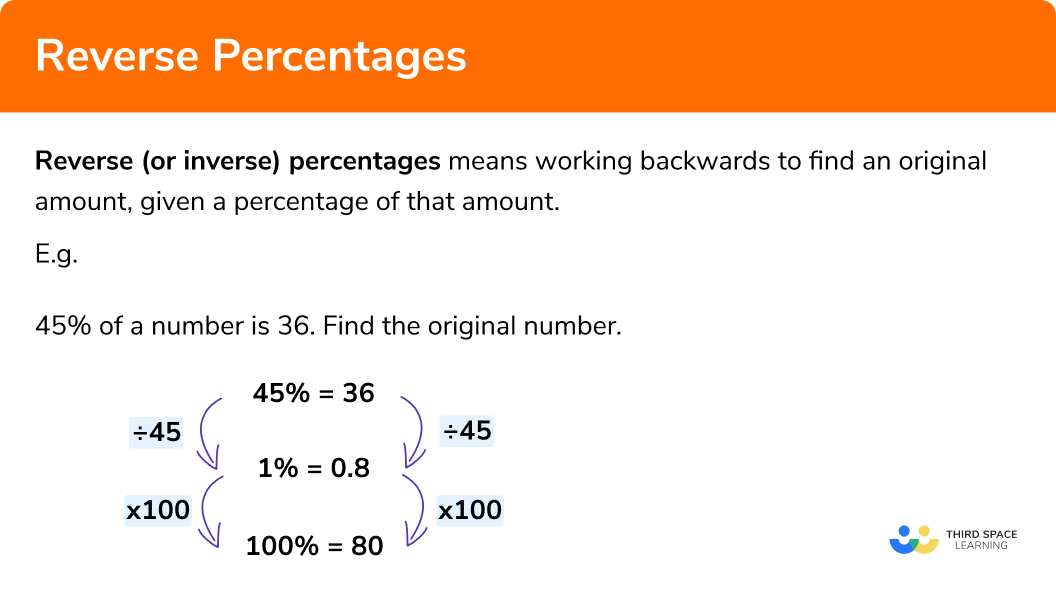
In multiplier form, the image’s calculation is , giving . Both methods express the same division; the wording determines whether the known amount is , , or some other percentage of the original.
Reverse thinking also answers “What change restores the original?” If rises , it becomes . Returning to requires a fall of , measured against the new base :
A increase is therefore undone by a decrease. Conversely, a decrease takes to ; restoring it requires an increase of . There is no need to memorize two unrelated exceptions. The percentage changes because the base changes.
Watch the selected part of Percentages 3: Percentage Increase Decrease by Ravi Prakash Rodha. It develops this base shift through comparisons in both directions.
Percentages 3: Percentage Increase Decrease | Arithmetic for CAT 2027 | Ravi Prakash Rodha
Use the video to connect reverse changes with statements such as “A is 40% more than B.”
Watch the changing base first. Continue through reverse comparisons, paying attention to which value is used as the denominator when the comparison is reversed.
The same reasoning applies when no change occurs over time. If is more than , choose temporarily; then . From ’s perspective, is less. “ compared with ” and “ compared with ” use different bases.
4. Choose a method quickly, then check the base
In a CAT question, classify the structure before calculating:
- One change, original known: apply one multiplier, or use if both values are given.
- Changes happen in sequence: multiply their factors. Use the two-change formula only if it saves work.
- Final value known, original sought: divide by the factor that produced the final value.
- Change needed to restore a value: measure the required difference against the current value, not the earlier one.
A final plausibility check can catch a base error. After a decrease, the original must exceed the final value. After an increase, it must be smaller. Two equal-percentage changes in opposite directions, applied successively to the same positive value, leave it below where it started.
Key takeaways
Every percentage refers to a base. A single change has a multiplier; successive changes multiply those factors; a reverse problem divides by the factor that produced the known result. When a comparison is reversed, reassess the denominator rather than reusing the original percentage.
Next, you will use these methods in a timed set of CAT previous-year questions on numerical operations and percentages, where identifying the base quickly is as important as computing accurately.