Recommended resources
The freely available resources this lesson will direct you to.
Hello! Last time, you identified chloroplasts as the parts of plant cells that absorb light for photosynthesis, and the vacuole as a structure that helps keep a cell firm. A leaf brings many specialised cells together so that light, water, and carbon dioxide can reach the places where they are needed.
In this lesson, you’ll use a labelled leaf cross-section to explain three connected processes: photosynthesis, gas exchange, and transpiration (water loss from a leaf). Allow about 35–40 minutes, including time to study the diagram and trace each process through it.
Look inside a leaf
Imagine cutting across a leaf from its upper surface to its lower surface. The diagram shows the layers you would pass through. It is a simplified model: its colours help distinguish structures, rather than showing exactly how a leaf would appear under a microscope.
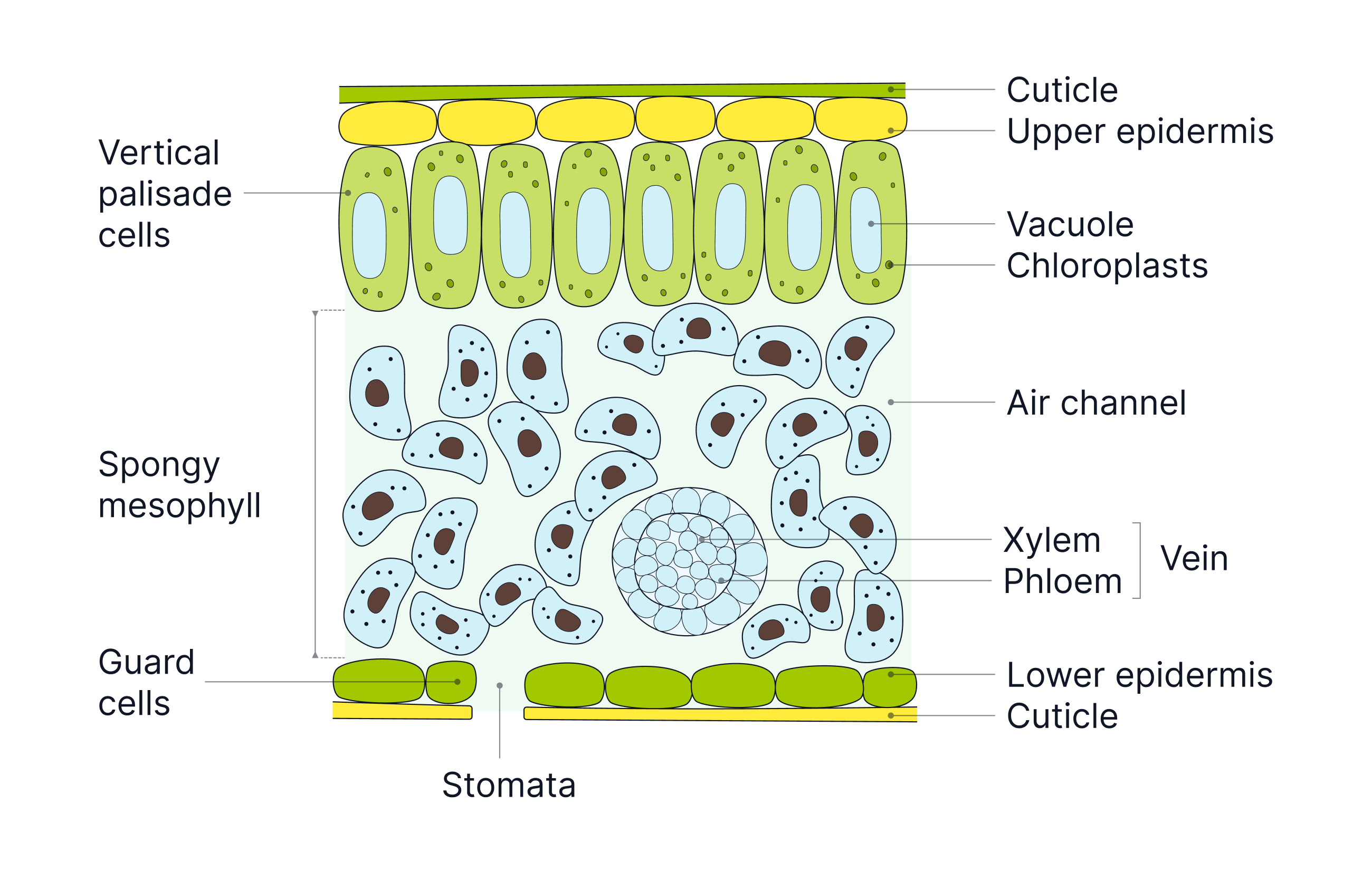
Read the diagram from top to bottom. The waxy cuticle coats the outer surface, while the upper epidermis is a thin protective layer beneath it. Below that, the closely packed palisade mesophyll cells contain many chloroplasts. The more loosely arranged spongy mesophyll cells leave spaces through which gases can move. At the bottom is the lower epidermis, with pores bordered by guard cells.
A pore is one stoma; stomata is plural. The diagram’s “Stomata” label points to one example. Notice also that the vein is not a single tube: it contains xylem and phloem, which transport different materials.
Watch the following short video with the cross-section beside you. Focus less on memorising the order of labels and more on what each layer makes possible.
GCSE Biology Revision "Plant Tissues"
Watch “GCSE Biology Revision ‘Plant Tissues’” by Freesciencelessons for a guided tour of the leaf’s layers and transport tissues.
Watch outer layers for the epidermis, cuticle, stomata, and guard cells. Continue with mesophyll layers, noting the contrast between packed palisade cells and the air spaces below them. Finish with leaf veins to distinguish what xylem brings into the leaf from what phloem carries away.
How the leaf supports photosynthesis
Photosynthesis uses light energy to make glucose from carbon dioxide and water. Oxygen is also produced:
Each input has a route through the leaf. Its broad surface exposes many cells to light. Light passes through the relatively transparent upper epidermis to the palisade layer, where numerous chloroplasts contain light-absorbing chlorophyll. Being near the upper surface helps these cells receive light. Some photosynthesis also occurs in the spongy mesophyll, but the palisade layer is the main site shown in this diagram.
Carbon dioxide enters through stomata and moves through the spongy layer’s air spaces toward photosynthesising cells. A leaf is thin, so the distance gases travel to reach those cells is short. Water arrives from the roots through the xylem in the vein. The vein’s phloem transports dissolved sugars made from the products of photosynthesis to other parts of the plant. Xylem supplies a raw material; phloem carries away products.
Read the BBC Bitesize explanation to connect these routes with the leaf’s external features and internal tissues.
Plant organisation - Edexcel Adaptations of the leaf for photosynthesis
Read BBC Bitesize’s guide to see why a leaf’s shape, layers, and veins are adaptations rather than just labels on a diagram.
On the “Adaptations of the leaf for photosynthesis” page, begin at “Functions of leaves.” Read the adaptations, including the “Features of leaves” table and the first “Functions of tissues of the leaf” table under “Structure of a leaf.” Then, under “Gas exchange,” read gas movement. Focus on how each feature helps light, water, or carbon dioxide reach photosynthesising cells.
Gas exchange through the same openings
A stoma connects the outside air to the spaces inside the leaf. During photosynthesis, carbon dioxide is used in the cells, so it can diffuse inward from the air. Oxygen produced by photosynthesis can diffuse in the opposite direction and leave through the stomata. Diffusion means particles spread from where they are more concentrated toward where they are less concentrated.
The spongy mesophyll’s air spaces matter here: gases can move through those gaps to and from cells across the leaf. A pore by itself would be much less useful if the tissues behind it were packed without spaces.
The two guard cells around a stoma help control its opening. When they are firm with water, the pore can open wider; when they lose water and become less firm, it can narrow or close. Opening helps carbon dioxide enter, but it also allows water vapour to escape. This creates a trade-off for the leaf rather than a perfect setting that maximises everything at once.
Transpiration: the cost of an open stoma
Water supplied by the xylem moistens cells inside the leaf. Some water evaporates from those moist internal surfaces into the air spaces. The resulting water vapour can then diffuse out through an open stoma. This loss of water vapour from the leaf is transpiration. Water drawn up from the roots through the xylem replaces water lost from the leaf.
Why not let water escape everywhere across the surface? The waxy cuticle helps limit water loss through the outer epidermis. In many leaves, most stomata are on the lower surface, which helps reduce exposure while still permitting gas exchange. The cuticle cannot simply seal the whole leaf: carbon dioxide still needs a route in. Guard cells allow the openings to change size as conditions change.
Read the opening of the same BBC Bitesize guide for its account of evaporation, transpiration, and the cuticle.
Plant organisation - Edexcel Adaptations of the leaf for photosynthesis
Return to BBC Bitesize to follow what happens to water once it reaches a leaf.
In the opening paragraphs of “Adaptations of the leaf for photosynthesis,” just before “Functions of leaves,” read water loss. Start at the paragraph about large surface area and stomata; stop after the explanation of why leaves usually have fewer stomata on their top surface. Pay particular attention to the difference between water evaporating inside the leaf and water vapour escaping through the stomata.
Make the labels do explanatory work
Return to the cross-section. A labelled diagram is most useful when you can explain a route across it, not merely name its parts. For photosynthesis, locate the transparent upper epidermis and palisade chloroplasts, then identify the two supply routes: carbon dioxide through the stomata and air spaces, and water through the xylem. Locate the phloem to account for sugar transport away from the leaf.
For gas exchange, look at the same stoma and spongy air spaces, but distinguish carbon dioxide entering from oxygen leaving. For transpiration, begin at the water supplied by xylem, locate the moist cells and air spaces, and finish at the stoma where water vapour exits. The cuticle and guard cells explain why water loss is limited and regulated, not eliminated.
If you sketch the cross-section for your notes, a simple stack of layers with one vein and one pair of guard cells is enough. Label the structures first, then add short process notes beside them, such as “absorbs light,” “supplies water,” and “allows gases through.” That turns a drawing into an explanation.
Key takeaways
A leaf’s broad, thin shape and chloroplast-rich palisade cells help it capture light and carry out photosynthesis. Stomata and spongy-mesophyll air spaces allow carbon dioxide in and oxygen out, while xylem supplies water and phloem transports sugars. Those same open stomata also let water vapour escape: transpiration is linked to the gas exchange photosynthesis needs.
Next, you’ll move from leaves to flowers and trace how a flowering plant progresses from pollination to seeds and fruit.