Recommended resources
The freely available resources this lesson will direct you to.
Hello! In the previous lesson, you saw that TOGAF provides a framework for developing an enterprise architecture, not a ready-made design or a rigid set of documents. That raises a practical question: when someone says “the TOGAF Standard,” what material are they referring to?
The TOGAF Standard, 10th Edition is organized into two parts: TOGAF Fundamental Content and TOGAF Series Guides. Today you will learn what each part is for, recognize examples of each, and avoid a tempting but misleading shortcut: assuming that everything called “how-to guidance” must be a Series Guide.
One standard, two complementary parts
The distinction begins with a difference between a common foundation and guidance for using it in particular circumstances. The Fundamental Content sets out core TOGAF concepts and practices. The Series Guides offer more focused advice on configuring and applying that foundation. Both belong to the 10th Edition; the guides are not an unrelated collection of optional third-party commentary.
The Open Group’s video The TOGAF Standard, 10th Edition and the TOGAF Certification Portfolio introduces this modular structure. Watch the two short passages below for the broad distinction, rather than trying to memorize guide titles.
The TOGAF® Standard, 10th Edition and the TOGAF Certification Portfolio
The Open Group explains why the 10th Edition separates enduring core material from more flexible, topic-focused guides.
Watch the two parts for the speaker’s initial distinction. Then watch guide examples for the kinds of practical and subject-specific advice the Series Guides offer. Treat the speaker’s “what” and “how” description as a useful orientation, not an absolute classification rule.
Here is the structure in one picture:
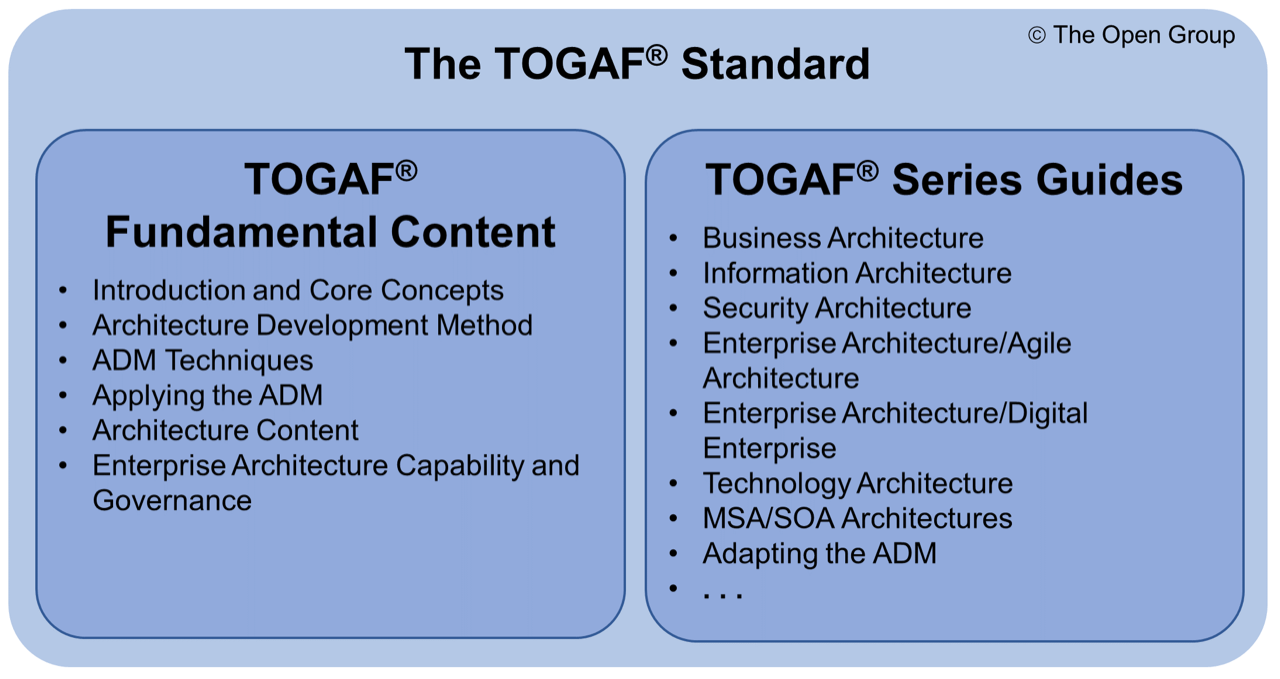
The image is a map of the distinction, not a checklist of documents you must read in full. Its left side names the stable areas of the framework; its right side illustrates the range of topics on which additional guidance can be useful. Series Guides can be added or updated, so a picture of example topics should not be treated as a permanent, exhaustive catalog.
What belongs to the Fundamental Content?
The Open Group’s public overview of The TOGAF Standard, 10th Edition states the distinction and lists the six Fundamental Content components. Read its short introduction and list, then scan some guide titles to see how their focus differs. You do not need access to the full standard documents for this reading.
The TOGAF® Standard, 10th Edition
This overview from The Open Group gives the authoritative division between Fundamental Content and Series Guides, followed by their document names.
On the page titled “The TOGAF Standard, 10th Edition,” find the paragraph immediately before “The TOGAF Fundamental Content is structured as follows.” Read the distinction. Under that lead-in, read the six components, stopping at “The following TOGAF Series Guides are available.” In the guide list below, scan the topic examples. Notice the difference between a component that establishes the common framework and a guide that develops advice for a particular topic or setting; do not memorize the entire guide list.
The six Fundamental Content components have different jobs within the shared framework:
- Introduction and Core Concepts establishes foundational ideas and terminology.
- Architecture Development Method (ADM) describes the method used to develop and manage architecture.
- ADM Techniques covers techniques that support that method.
- Applying the ADM addresses using the method in practice.
- Architecture Content describes how architecture work can be represented and organized.
- Enterprise Architecture Capability and Governance addresses the organizational ability and oversight needed to sustain architecture work.
For now, recognize these as components of the Fundamental Content, not six steps to perform in order. You have already encountered the ADM at a high level. Later modules will examine its phases, techniques, content, and governance more closely.
There is an important nuance in this list. ADM Techniques and Applying the ADM clearly provide guidance about doing architecture work, yet they are Fundamental Content. The convenient description “Fundamental Content is the what; Series Guides are the how” captures a difference in emphasis, but it cannot replace the actual document classification. The fundamental material includes a method and advice for applying it.
What do the Series Guides add?
A Series Guide takes a topic that architects may need to address and develops more specific advice. The overview you just read includes guides concerning digital enterprises, risk and security, business capabilities, information mapping, and applying the ADM using agile sprints. These titles illustrate the guides’ range: some deepen a particular architecture subject, while others help adapt TOGAF to a way of working or an organizational context.
Return to the cross-branch borrowing service from earlier lessons. A team needs the common concepts and ADM structure to frame the architecture work. Suppose, however, that its organization delivers changes in short agile cycles. Guidance on applying the ADM using agile sprints could help the team consider how to organize its architecture activities in that setting. It does not replace the ADM with a different universal framework, nor does it decide the library’s borrowing rules.
Likewise, a guide about business capabilities can provide greater depth on that topic. It does not mean that business concerns exist only in the Series Guides: Business Architecture is already part of the core architecture work. The guides extend or contextualize the foundation; they do not partition enterprise architecture into subjects that the foundation ignores.
This relationship also explains why the 10th Edition is modular. An architect can turn to guidance relevant to the work at hand rather than treating every specialized guide as a chapter that must be applied on every engagement. Selecting relevant guidance is not permission to discard core concepts whenever they are inconvenient. It is a way to configure a shared framework for a real situation—the same disciplined flexibility you considered in the previous lesson.
How to recognize the distinction in study and practice
When you encounter an unfamiliar TOGAF title, ask what role that publication plays, not merely whether it contains instructions.
The TOGAF Standard – Applying the ADM is named among the Fundamental Content components. TOGAF Series Guide: Applying the TOGAF ADM using Agile Sprints is a Series Guide. Both concern application of the ADM, but the second develops advice for a more particular way of working. Similarly, a Series Guide on business capabilities adds focused treatment of a subject that can also appear in core architecture work.
For Foundation preparation, keep three points separate:
- Structure: The 10th Edition comprises Fundamental Content and Series Guides.
- Purpose: Fundamental Content supplies core concepts and practices; Series Guides advise on configuring and applying them, often for particular topics or contexts.
- Classification: Some practical guidance—including ADM Techniques and Applying the ADM—is Fundamental Content. Do not classify a document solely because it sounds like a “how-to.”
This document structure is also not, by itself, an exam blueprint. Do not infer that every guide must be memorized, or that something cannot matter to an exam simply because it appears in a guide. At this stage, the goal is to understand the relationship well enough to navigate TOGAF’s ideas accurately. Later, when you work through Practitioner scenarios, that understanding will help you decide which guidance is relevant to a particular situation.
Key takeaways
The TOGAF Standard, 10th Edition has a common foundation and more focused guides. Fundamental Content contains the core concepts, ADM, techniques, architecture content, and capability and governance material. Series Guides provide additional advice for configuring and applying that foundation to topics and contexts. The guides complement the core; “what versus how” is a helpful shorthand, not an infallible test.
Next, we will move from the structure of the standard to a distinction used within architecture work: the difference between an architecture viewpoint and an architecture view.