Recommended resources
The freely available resources this lesson will direct you to.
Hello! This first lesson begins the priority part of your test preparation: algebra language and notation. You already know some basic equation-solving, so the immediate goal is to make the English wording and symbols feel familiar rather than confusing.
By the end, you should be able to look at a question and identify what it is asking you to do, read its symbols aloud, and translate the most common algebra phrases into mathematical notation. We will use English terms with Hebrew translations throughout.
The essential idea: read the mathematics before doing it
A math question has two “languages” at once:
- Words tell you what action to take: solve, simplify, calculate, explain.
- Notation shows the mathematical objects and relationships: , , , , and so on.
Do not rush to calculate. First ask:
- What is the command word?
- Is this an expression, an equation, or an inequality?
- What does each symbol mean?
For example:
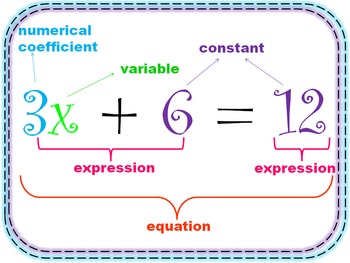
This is read: “three plus six equals twelve.”
It is an equation — משוואה — because it has an equals sign. If the question says solve the equation — פתור את המשוואה — you must find the value of that makes the two sides equal.
Notice an important point: the equals sign does not simply mean “the answer comes next.” It means:
The value on the left side is the same as the value on the right side.
So if , then the left side of becomes , which is true.
Core algebra vocabulary: English and Hebrew
Keep this table nearby during the course. You do not need to memorize every term today; focus first on recognizing them.
| English | Hebrew | Meaning |
|---|---|---|
| number | מספר | A value such as , , or |
| variable | משתנה | A letter standing for an unknown or changeable value, such as |
| constant | קבוע | A fixed number, such as in |
| coefficient | מקדם | The number multiplying a variable, such as in |
| term | איבר | A part separated by addition or subtraction, such as and |
| expression | ביטוי אלגברי | A mathematical phrase with no equality statement, such as |
| equation | משוואה | A statement that two expressions are equal, such as |
| solution | פתרון | A value that makes an equation true |
| formula | נוסחה | A rule written with symbols, such as a formula for area |
| function | פונקציה | A rule connecting an input to an output |
| fraction | שבר | A number or algebraic expression written as a numerator over a denominator |
| numerator | מונה | The top of a fraction |
| denominator | מכנה | The bottom of a fraction |
| inequality | אי־שוויון | A comparison such as “greater than” or “less than” |
| domain | תחום ההגדרה | The permitted input values of a function or expression |
A close look at one expression
Consider:
- is the variable — משתנה.
- is the coefficient — מקדם.
- is one term — איבר.
- is another term and a constant — קבוע.
- The complete is an expression — ביטוי אלגברי.
There is no equals sign, so it is not an equation yet.
Compare it with:
Now it is an equation — משוואה — because it says that the expression has the same value as .
Must-Know Math Words and Phrases in Hebrew
Read the HebrewPod101 vocabulary list to connect the English operation and algebra words to Hebrew words you may see or use in class.
In the first part of the list, find the entries for number, plus, minus, times, divide, and equal. Read the whole cluster of operation words, including the short examples. Then continue to the later entries beginning with formula and read the algebra vocabulary for formula, equation, variable, solution, function, and calculate. Focus on matching each English word to its Hebrew script, not on memorizing the pronunciations.
Reading the most common symbols
Symbols save space, but they only help once you can read them confidently.
| Symbol | Read in English | Hebrew | What it says |
|---|---|---|---|
| plus / added to | ועוד / פלוס | Add | |
| minus / less | פחות | Subtract | |
| equals / is equal to | שווה | The two sides have the same value | |
| does not equal | לא שווה | The values are different | |
| is greater than | גדול מ־ | The left side is larger | |
| is less than | קטן מ־ | The left side is smaller | |
| is greater than or equal to | גדול או שווה ל־ | Greater, or exactly equal | |
| is less than or equal to | קטן או שווה ל־ | Smaller, or exactly equal | |
| parentheses / brackets | סוגריים | Group what must be handled together | |
| divided by | חלקי | A fraction; is numerator, denominator | |
| squared | בריבוע | multiplied by itself | |
| cubed | בחזקה שלוש | ||
| square root of | שורש ריבועי של | A number whose square is |
Two notation habits will help throughout the course:
Multiplication is often invisible
In algebra, multiplication is usually written without a multiplication sign:
So read as “three ,” “three times ,” or “three multiplied by .” Never read it as the number thirty-.
Parentheses tell you what belongs together
Compare:
with
The first means: double , then subtract .
The second means: first calculate , then double the entire result. The parentheses are meaningful; do not ignore them.
Maths Symbols & Equations - English Vocabulary | Maths Vocabulary | Math or Maths | Basic Math
Watch “Maths Symbols & Equations - English Vocabulary” from Learn English with Tonguemation to hear the symbols spoken aloud in clear English.
Watch basic operations for plus, minus, multiplication, division, and the names sum, difference, product, and quotient. Then watch comparison symbols for equality and inequalities, followed by fractions and powers for numerator, denominator, decimals, roots, and exponents. Pause briefly after each example and say the notation aloud yourself.
Command words: what the question expects from you
Test questions often begin with one word. That word is not decoration; it tells you what kind of answer earns credit.
| Command in English | Hebrew | What you should do |
|---|---|---|
| Find | מצא | Give the requested value, point, length, angle, or expression. |
| Calculate | חשב | Perform calculations and state the numerical result. |
| Solve | פתור | Find the value or values of the variable that make an equation true. |
| Simplify | פשט | Rewrite an expression in an equivalent, cleaner form. |
| Factor | פרק לגורמים | Rewrite an expression as multiplication. |
| Determine | קבע / מצא | Work out which value, type, condition, or set of values is correct. |
| Write | כתוב | Give the requested expression, equation, coordinates, or statement. |
| Explain | הסבר | Show reasoning, not only the final answer. |
| Show your steps | הראה / רשום את שלבי הפתרון | Write the important calculations in order. |
| Verify / Check | בדוק / וודא | Test whether an answer is correct, often by substitution. |
| Given | נתון | Information supplied in the question; use it. |
Do not confuse these commands
Suppose you see:
- Simplify means combine or rewrite it more simply. You are not yet being asked for a value of .
- Solve would require an equation, for example:
Now you must find the value of that makes the statement true.
Later lessons will teach the exact techniques for simplifying and solving. For now, the key is to recognize what each command demands.
“Explain” means show enough work to follow your thinking
For a written test, a final answer alone may not receive full credit. A clear answer usually has:
- The equation or expression you used.
- The important algebra steps.
- The final answer, clearly marked.
- A brief check when the question asks for one.
The exact rules for your placement test may be different, especially because you do not yet know whether it is written or multiple-choice. Still, showing organized steps is a safe habit whenever you have space.
This older bilingual Ministry of Education sample is not a prediction of your own test. Use it as practice reading formal English test instructions alongside Hebrew.
On page 1, go to Instructions for examinees, especially Special instructions item (2). Read the answer writing instruction and compare it with the Hebrew beside it. Then go to page 2 under Questions and scan Questions 1–2, beginning at the first question. Do not try to solve them yet; circle command words such as find, calculate, and explain, and identify familiar terms such as width, coordinates, and equation.
Translating English into algebra
When a question is written in words, build the mathematics in a controlled order.
-
Name the unknown.
“A number” often becomes . -
Mark operation words.
Words such as sum, difference, product, and quotient tell you which operation is happening. -
Find the relationship word.
Words such as is, equals, and gives often mean .
But be careful: in “is less than,” the relationship is , not . -
Use parentheses when a whole group is being multiplied or divided.
Common operation language
| English phrase | Mathematical meaning |
|---|---|
| a number increased by | |
| a number decreased by | |
| twice a number | |
| the product of and a number | |
| the sum of a number and | |
| the difference of a number and | |
| divided by a number | |
| the quotient of a number and | |
| twice the difference of a number and |
The final row is why parentheses matter. “Twice the difference” means multiply the entire difference by .
The subtraction-order warning
Addition can be reversed without changing the result:
Subtraction cannot:
Watch carefully for phrases that reverse the order.
| English phrase | Correct translation | Reason |
|---|---|---|
| five less than a number | Begin with the number; remove . | |
| five subtracted from a number | is being removed from the number. | |
| a number less | Begin with the number, then subtract . | |
| a number is less than | This compares two values; it is an inequality. |
The words less than can therefore mean two different things depending on grammar:
- “Five less than a number” describes subtraction: .
- “A number is less than five” describes a comparison: .
When uncertain, say the sentence in a complete form: “What is being taken away from what?” That usually reveals the correct order.
Language of Algebra: Translating English to Math
Watch “Language of Algebra: Translating English to Math” by DeeMathify for a guided explanation of operation keywords and the special danger of subtraction wording.
Watch keyword families to connect sum, difference, product, and quotient to their operations. Then watch subtraction order carefully. Focus on why phrases containing less than, subtracted from, or taken from may require reversing the order of the quantities.
A short translation model
Read this statement:
“Five less than twice a number is .”
Start with “a number,” so use .
“Twice a number” is:
“Five less than twice a number” means subtract from :
“Is ” gives the equals sign:
You do not need to solve it yet to understand the language. You have successfully translated English into an equation.
A useful habit for the next few days is to make a small two-column glossary in your notebook:
| English | Hebrew / meaning |
|---|---|
| solve | פתור — find the value that makes an equation true |
| simplify | פשט — rewrite more simply but equivalently |
| coefficient | מקדם — number multiplying a variable |
| denominator | מכנה — bottom of a fraction |
| greater than | גדול מ־ — |
Add new words whenever you meet them. This turns unfamiliar English into a list you can steadily control.
Key takeaways
- An expression — ביטוי אלגברי — has no equality claim; an equation — משוואה — uses to state that two values are equal.
- In , the is a coefficient — מקדם — and is a variable — משתנה.
- Read symbols precisely, especially , , , fractions, parentheses, and exponents.
- Command words tell you what kind of answer is needed: solve, simplify, factor, calculate, determine, and explain are different tasks.
- Be especially careful with subtraction language: “five less than a number” is , while “a number is less than five” is .
Next, you will use this vocabulary to simplify algebraic expressions by combining like terms and applying the distributive property.